

Pakistan inaugurates modern bazaar, border terminal in ‘gateway to Central Asia’

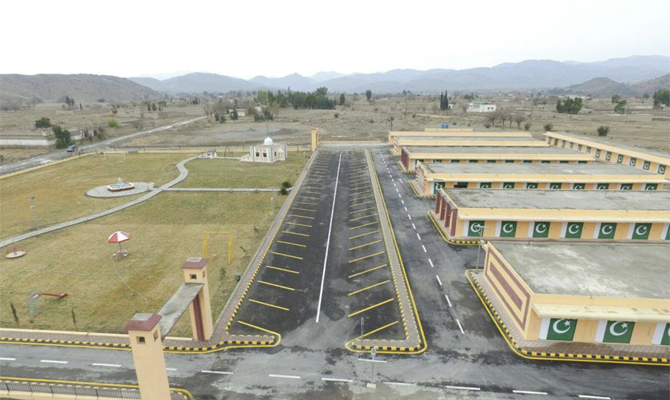
The Miranshah Bazaar sports a new look after construction work by the Pakistani Army in 2016. (Twitter photo)
Updated 30 April 2018
Follow

Pakistan inaugurates modern bazaar, border terminal in ‘gateway to Central Asia’

  • ‘The people of the tribal territories have the same rights enjoyed by people in other parts of the country,’ says Abbasi
  • The Miranshah Bazaar is a modern bazaar with different facilities and 1,344 shops

PESHAWAR:  Pakistan’s Prime Minister Shahid Khaqan Abbasi and Army Chief Gen. Qamar Javed Bajwa on Monday inaugurated Miranshah Bazaar and a National Logistics Cell (NLC) terminal in the Ghulam Khan area of the North Waziristan tribal region.

Khyber Pakhtunkhwa Gov. Iqbal Zafar Jhagra and Corps Commander Peshawar Lt. Gen. Nazir Butt were also present, as were parliamentarians from the Federally Administered Tribal Areas (FATA) and other officials.

“It’s a modern bazaar with different facilities and 1,344 shops,” Taimur Afridi, assistant political officer of Miranshah, told Arab News.

The visiting dignitaries later went to the Pakistani-Afghan border in Ghulam Khan and inaugurated an NLC terminal there, he added. 

The NLC is Pakistan’s premier logistics company. “The organization’s terminal at the border has space for parking 150 trucks,” Afridi said.

Addressing a jirga (tribal elder’s council), Abbasi said Miranshah “is a gateway to Central Asia and has much significance for regional trade.” 

He added: “The government and all political parties are now trying to mainstream FATA. The people of the tribal territories have the same rights enjoyed by people in other parts of the country.”

Malik Habib, a North Waziristan tribesman whose family has been in the business of transporting goods to Afghanistan, said the reopening of the border route was a longstanding demand of the locals.

“Traders here mostly export pulses, flour, sugar and cement, while Afghans mostly supply vegetables, fruit and dried fruit,” he added.

Dr. Sarfaraz Khan, former director of the Area Study Center at the University of Peshawar, said FATA was deeply neglected by successive governments. “It’s good that they’re building markets and shops there,” he told Arab News.

Most of Iranian women’s soccer team leave Australia

Updated 11 March 2026
Follow

Most of Iranian women’s soccer team leave Australia

GOLD COAST: The Iranian women’s soccer team left Australia without seven squad members after tearful protests of their departure outside Sydney Airport and frantic final efforts inside the terminal by Australian officials, who sought to ensure the women understood they were being offered asylum.

As the team’s flight time drew nearer and they passed through security late on Tuesday, each woman was taken aside to meet alone with officials who explained through interpreters that they could choose not to return to Iran.

Before the team traveled to the airport, seven women had accepted humanitarian visas allowing them to remain permanently in Australia and were ushered to a safe location by Australian police officers. 

One has since changed her mind, underscoring the tense and precarious nature of their decisions.

“In Australia, people are able to change their mind,” said Australian Home Affairs Minister Tony Burke, who had hours earlier posted photos of the seven women granted humanitarian visas to his social media accounts, their identities clearly visible.

After what Burke described as “emotional” meetings between the remaining women who reached the airport and Australian officials, the rest of the team declined offers of asylum and boarded their flight.

It was a dramatic conclusion to an episode that had gripped Australia since the Iranian team’s first game at the Asian Cup soccer tournament, when they remained silent during their national anthem.