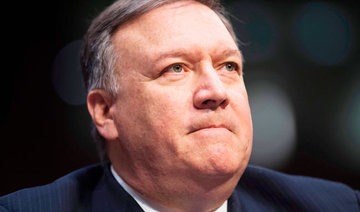
RIYADH: Washington’s newly appointed secretary of state landed in Riyadh Saturday on a tour of America’s key Middle East allies, after vowing to bring some “swagger” back to US diplomacy.
After attending NATO talks in Brussels, Mike Pompeo embarked on a three-day trip to Saudi Arabia, Israel and Jordan to update friends on President Donald Trump’s plans for the Iran nuclear deal.
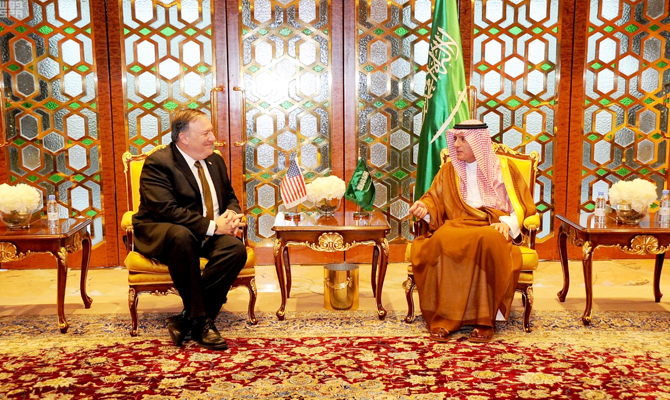
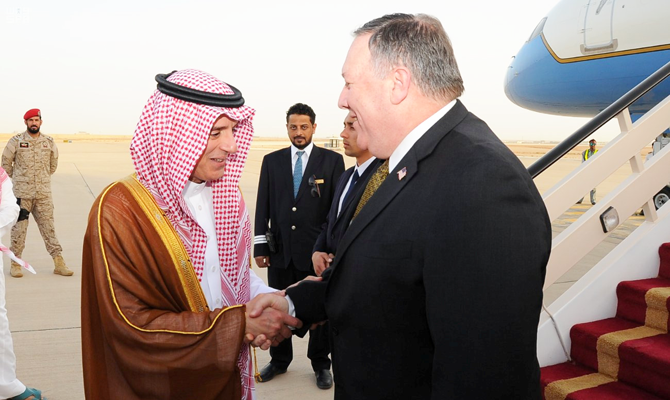
Pompeo was met on the tarmac in Riyadh by a sizeable Saudi Arabian delegation, including the kingdom’s foreign minister, Adel Al-Jubeir, and US ambassador Khalid bin Salman — brother of the powerful Crown Prince Mohammed bin Salman.
Trump is widely expected to pull the United States out of the Iran accord next month, re-imposing sanctions against Tehran’s nuclear program. Pompeo insists the president has not yet made the decision.
The former CIA chief, who was sworn in as Trump’s top diplomat on Thursday and set off within two hours for Brussels, will consult with leaders of Iran’s main regional opponents ahead of the announcement.
But he also has a second more personal mission, to show foreign capitals and his own colleagues that US diplomacy is back on track after the troubled reign of his sacked predecessor Rex Tillerson.
Trump’s first secretary of state, a former oil executive, failed to fill senior positions, embarked on unpopular bureaucratic reforms and had conspicuously little chemistry with the president.
Pompeo — a former army officer, businessman and conservative congressman — wanted to set off on the road immediately on being sworn in, in order to reach out to NATO and Middle East allies.
But he has promised to address State Department staff in Washington on his return on Tuesday, and was full of praise for the staff who scrambled to put together his first foreign itinerary.
“I just met with a great group of State Department officers who work here at the mission. They may have been demoralized, but they seemed in good spirits,” he said Friday, at NATO headquarters.
“They are hopeful that the State Department will get its swagger back, that we will be out doing the things that they came onboard at the State Department to do,” he promised.
“To be professional, to deliver diplomacy — American diplomacy — around the world, that’s my mission set, to build that esprit and get the team on the field so that we can effectuate American diplomacy.”
The former Kansas politician is seen as an anti-Iran hawk with hard-line views about projecting US military might, and his socially conservative opinions might be out of place at the State Department.
In Saudi Arabia on Saturday, Pompeo is due to hold talks with Jubeir in Riyadh, before having dinner with Prince Mohammed, who has strengthened his ties to Washington since being appointed in June.
Trump also wants Riyadh to do more and spend more to support the US-led operation in Syria to defeat the Daesh group and allow American forces to come home more quickly.
After Saudi Arabia, Pompeo is due to fly on to Israel for talks with staunch US ally Prime Minister Benjamin Netanyahu and then to Jordan, a friend with a long border with war-torn Syria.

Confident Pompeo makes Middle East diplomatic debut from Saudi Arabia
Gaza health officials say strikes kill 21 after Israel says shots wounded officer
GAZA CITY: Gazan health officials said Israeli air strikes on Wednesday killed 21 people in the Palestinian territory, with Israel’s military saying it struck after gunfire targeting its troops wounded an officer.
Despite a US-brokered truce entering its second phase last month, violence has continued in the Gaza Strip, with Israel and Hamas accusing each other of breaching the agreement.
The latest bloodshed came days after Israel partly reopened the Rafah crossing between Gaza and Egypt, the only exit for Gazans that does not pass through Israel.
The health ministry, which operates under Hamas authority, said that 21 people were killed in a series of strikes, with at least 38 others wounded, updating an earlier figure given by the territory’s civil defense agency.
Among the dead were three children, said the agency, which operates as a rescue force under the Hamas authority.
“We were sleeping when suddenly shells and gunfire rained down on us,” said Abu Mohammed Haboush, whose son was killed.
“Young children were martyred, my son and my nephew were among the dead. We lost many young men,” he said, adding that he and his family were living far away from the so-called “Yellow Line,” where Israeli forces are stationed.
AFP images showed mourners offering prayers in the compound of Al-Shifa hospital in Gaza City, where several bodies wrapped in white shrouds were laid out.
An AFP photograph showed a relative holding a body of a child wrapped in a shroud at the hospital as relatives gathered around him.
Shortage of medical aid
Three bodies were brought to Nasser Hospital after Israeli strikes hit homes and tents housing displaced Palestinians in the southern Khan Yunis area, the civil defense agency said.
Fourteen more bodies were taken to Al-Shifa Hospital, its director Mohamed Abu Salmiya said in a statement.
“We also received dozens of wounded. The situation is extremely difficult in the hospitals of the Gaza Strip due to the severe shortage of medicines and medical supplies,” Abu Salmiya said.
Israel scrutinizes all aid into besieged Gaza, a tiny coastal territory surrounded by fences, walls and the Mediterranean Sea.
The Israeli military said it had launched strikes after “terrorists opened fire on troops” Wednesday, seriously wounding an officer, adding that it considers the incident a violation of the ceasefire.
It said the troops came under attack near the “Yellow Line,” without specifying which side of the line the troops were on.
The ceasefire took effect after two years of war in Gaza, sparked by Hamas’s October 2023 attack on Israel.
Following what was reportedly US pressure, Israel allowed the opening of the Rafah crossing, but limited passage to patients and their travel companions.
Sick and wounded Gazans have begun crossing into Egypt to seek medical treatment since Monday.
On Tuesday, 45 people crossed into Egypt and 42 entered the territory, a source at the Palestinian Red Crescent Society told AFP.
Shortly after midnight Wednesday, those meant to enter during the day on Tuesday arrived in Gaza through Rafah in a large bus, an AFP journalist reported.
‘My homeland’
Relatives of those returning from Egypt screamed in joy, hugging and crying.
“I am so happy to be back with my husband, my children, my family, my loved ones, and of course, my homeland,” Fariza Barabakh, who returned that day, told AFP.
“It’s an indescribable feeling, thank God. What can I say? My two young children didn’t recognize me, but thank God. I hope it will be alright,” Yusef Abu Fahma, another returnee, told AFP.
Gaza’s health ministry says at least 556 people have been killed in Israeli strikes since the ceasefire took effect on October 10, while the Israeli military says four of its soldiers have been killed over the same period.
Saturday was among the deadliest days, with the civil defense agency reporting at least 32 people killed in Israeli attacks, which the military said were in response to a Hamas ceasefire violation.
Media restrictions and limited access in Gaza have prevented AFP from independently verifying casualty figures or freely covering the fighting.
Despite a US-brokered truce entering its second phase last month, violence has continued in the Gaza Strip, with Israel and Hamas accusing each other of breaching the agreement.
The latest bloodshed came days after Israel partly reopened the Rafah crossing between Gaza and Egypt, the only exit for Gazans that does not pass through Israel.
The health ministry, which operates under Hamas authority, said that 21 people were killed in a series of strikes, with at least 38 others wounded, updating an earlier figure given by the territory’s civil defense agency.
Among the dead were three children, said the agency, which operates as a rescue force under the Hamas authority.
“We were sleeping when suddenly shells and gunfire rained down on us,” said Abu Mohammed Haboush, whose son was killed.
“Young children were martyred, my son and my nephew were among the dead. We lost many young men,” he said, adding that he and his family were living far away from the so-called “Yellow Line,” where Israeli forces are stationed.
AFP images showed mourners offering prayers in the compound of Al-Shifa hospital in Gaza City, where several bodies wrapped in white shrouds were laid out.
An AFP photograph showed a relative holding a body of a child wrapped in a shroud at the hospital as relatives gathered around him.
Shortage of medical aid
Three bodies were brought to Nasser Hospital after Israeli strikes hit homes and tents housing displaced Palestinians in the southern Khan Yunis area, the civil defense agency said.
Fourteen more bodies were taken to Al-Shifa Hospital, its director Mohamed Abu Salmiya said in a statement.
“We also received dozens of wounded. The situation is extremely difficult in the hospitals of the Gaza Strip due to the severe shortage of medicines and medical supplies,” Abu Salmiya said.
Israel scrutinizes all aid into besieged Gaza, a tiny coastal territory surrounded by fences, walls and the Mediterranean Sea.
The Israeli military said it had launched strikes after “terrorists opened fire on troops” Wednesday, seriously wounding an officer, adding that it considers the incident a violation of the ceasefire.
It said the troops came under attack near the “Yellow Line,” without specifying which side of the line the troops were on.
The ceasefire took effect after two years of war in Gaza, sparked by Hamas’s October 2023 attack on Israel.
Following what was reportedly US pressure, Israel allowed the opening of the Rafah crossing, but limited passage to patients and their travel companions.
Sick and wounded Gazans have begun crossing into Egypt to seek medical treatment since Monday.
On Tuesday, 45 people crossed into Egypt and 42 entered the territory, a source at the Palestinian Red Crescent Society told AFP.
Shortly after midnight Wednesday, those meant to enter during the day on Tuesday arrived in Gaza through Rafah in a large bus, an AFP journalist reported.
‘My homeland’
Relatives of those returning from Egypt screamed in joy, hugging and crying.
“I am so happy to be back with my husband, my children, my family, my loved ones, and of course, my homeland,” Fariza Barabakh, who returned that day, told AFP.
“It’s an indescribable feeling, thank God. What can I say? My two young children didn’t recognize me, but thank God. I hope it will be alright,” Yusef Abu Fahma, another returnee, told AFP.
Gaza’s health ministry says at least 556 people have been killed in Israeli strikes since the ceasefire took effect on October 10, while the Israeli military says four of its soldiers have been killed over the same period.
Saturday was among the deadliest days, with the civil defense agency reporting at least 32 people killed in Israeli attacks, which the military said were in response to a Hamas ceasefire violation.
Media restrictions and limited access in Gaza have prevented AFP from independently verifying casualty figures or freely covering the fighting.
© 2026 SAUDI RESEARCH & PUBLISHING COMPANY, All Rights Reserved And subject to Terms of Use Agreement.