WASHINGTON: CIA Director Mike Pompeo, if confirmed as the next secretary of state, would bring a number of assets to his new role as the top US diplomat: The confidence of President Donald Trump, government experience and an insider’s knowledge of Congress and the federal bureaucracy.
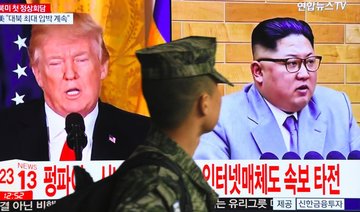
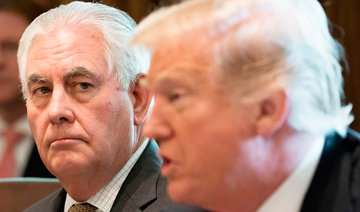
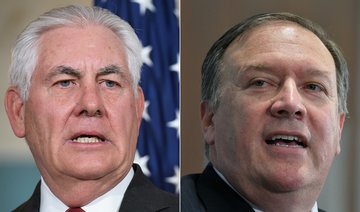
Trump on Tuesday said he had selected Pompeo, a 54-year-old conservative Republican who has served since last year as CIA director, to replace fired Secretary of State Rex Tillerson in the biggest Cabinet shakeup of his presidency.
Pompeo, a former US Army officer and Harvard Law School graduate who represented a Kansas district in the US. House of Representatives before being tapped to lead the CIA, is seen as a Trump loyalist who has enjoyed a less hostile relationship with career spies than Tillerson had with career diplomats.
While some intelligence officers have said that Pompeo tends to tell Trump what he wants to hear rather than giving him their assessments, others say they have been impressed by his intellect, willingness to listen and advocacy of more robust covert operations.
Unlike Tillerson, a former businessman who lacked government experience when Trump picked him last year as secretary of state, Pompeo is well aware of the ways of Washington.
Current and former officials said Pompeo was likely to get along better with Congress and with the White House, not least because of his conservative bent.
Pompeo, however, will need to find a way to grapple with a boss who has shown little regard for diplomacy and no qualms about undermining Tillerson with Twitter posts, current and former US officials said.
If confirmed by the US Senate, Pompeo also would take over a State Department shaken by the departures of many senior diplomats and embittered by proposed budget cuts.
“Pompeo was the most political CIA director in memory,” said an administration official, who spoke on the condition of anonymity.
“He dived into policy matters in a way that unnerved many professionals at the agency,” the official added, “and morale was taking a blow that was spreading from the analytical side, where some people feared he was tailoring some PDBs (President’s Daily Briefs intelligence assessments presented to the president) to tell Trump what he wanted to hear rather than what the intelligence assessments were.”
Trump also announced that he picked the CIA’s deputy director, Gina Haspel, to replace Pompeo as head of the agency. If confirmed by the Senate, she would become the first woman to hold the post.
Haspel, while a career CIA officer from the operational side of the organization, will be a controversial choice on Capitol Hill. Sen. Ron Wyden and other Democrats opposed her nomination as deputy director last year.
She oversaw a “black site” detention facility in Thailand where a Senate Intelligence Committee report found that Abu Zubaydah and other suspected Al-Qaeda extremists were subjected to waterboarding, a form of simulated drowning, and other “special interrogation methods” widely considered torture.
Haspel also became embroiled in another controversy later, as deputy to Jose Rodriguez, the controversial head of the CIA’s Counterterrorism Center. He wrote in his memoir that in 2005 she ordered the destruction of dozens of videotapes of interrogations at the camp. For that reason, she was denied the job of deputy director of the National Clandestine Service.

Pompeo brings insider’s touch to his new role
Pakistan rules out talks with Afghanistan, says more than 330 Afghan fighters killed in operations
- More than 330 Afghan fighters killed in operations
ISLAMABAD: Pakistan has ruled out talks with Afghanistan until there is an end to “terrorism” emanating from Afghan soil, officials said on Friday. The statement follows the killing of more than 330 Afghan fighters in cross-border skirmishes this week.
The latest clashes between the neighbors erupted after Pakistani airstrikes on Afghan territory last weekend triggered retaliatory attacks along the border on Thursday, escalating long‑simmering tensions over Pakistan’s claim that Afghanistan shelters Pakistani Taliban militants. Afghanistan denies this, saying Pakistan is deflecting blame for its own security failures.
Pakistani Information Minister Attaullah Tarar said his country had killed 331 Afghan fighters, destroyed over 100 posts and targeted 37 military locations across Afghanistan. Afghan officials have said more than 50 Pakistani soldiers have been killed and several Pakistan posts captured. Neither casualty figures nor battlefield claims by either side could be independently verified.
Meanwhile, Mosharraf Zaidi, Prime Minister Shehbaz Sharif’s spokesperson for foreign media, ruled out any talks with Afghanistan until Kabul addresses the issue, while the US expressed support for what it called Pakistan’s “right to defend itself” against attacks from Afghanistan’s Taliban rulers.
“There won’t be any talks, there is nothing to talk about ... Terrorism from Afghanistan has to end,” Zaidi told state-run Pakistan TV Digital, saying Islamabad would continue to target militant havens inside Afghanistan.
“Pakistan’s responsibility is to protect its citizens. If we know that there is a terrorist in point A and we know that there is a terrorist enabler at point A, we will find a weapon to land at point A and eliminate the threat.”
Zaidi said he did not expect Pakistan to deviate from this position: “We have clearly articulated what we are doing and what we plan on continuing to do and what it will take for us to stop doing what we are doing.”
He added: “And we will expect that both the international community and the regime in question, the Afghan Taliban, will come to their senses and will help reduce instability and disorder in this region.”
Pakistan is a major non-NATO ally of Washington, while the US considers the Afghan Taliban a “terrorist” group.
“The United States supports Pakistan’s right to defend itself against attacks from the Taliban, a Specially Designated Global Terrorist group,” Reuters quoted a State Department spokesperson as saying.
US diplomat Allison Hooker said on X she had spoken with Pakistan Foreign Secretary Amna Baloch on Friday.
The State Department spokesperson said Washington was aware of the escalation in tensions and “outbreak of fighting between Pakistan and the Afghan Taliban,” adding the US was “saddened by the loss of life.”
“The Taliban have consistently failed to uphold their counterterrorism commitments,” it said. “Terrorist groups use Afghanistan as a launching pad for their heinous attacks.”
Meanwhile, Afghan Taliban spokesperson Zabihullah Mujahid called for talks to resolve the crisis.
“We have always emphasized peaceful resolution, and now too we want the issue to be resolved through dialogue,” he said on Friday afternoon.
Asked what Pakistan desired, Tarar said: “Neutralizing the threat and ensuring that Pakistan is safe. Because for us, we’ve been good neighbors, we’ve been very friendly neighbors, we’ve been very, very generous neighbors. Our generosity, unfortunately, has often been seen as our weakness. So the objective, aim is to neutralize the threat and make Pakistan safe.”
He added it was too early to comment on a ceasefire as it was an evolving situation.