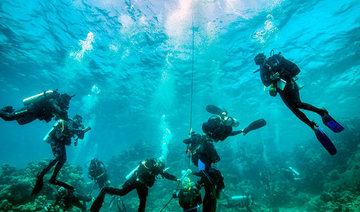
JEDDAH: The Red Sea offers much for divers to discover — corals, marine life, pearls and more — but they also see the plastic bottles, old furniture and fishing tools that impact marine life and kill coral reefs.
Three Saudi youth initiatives have raised awareness of the problem by marking Earth Day, celebrated on April 22, and highlighting crucial environmental issues such as the effect of plastic particles on marine life, especially in the Red Sea around Jeddah.
 The three initiatives are Global Shapers-Jeddah Hub, Naqaa Sustainability Solutions and Greenzie.
Global Shapers, in cooperation with Greenzie, have organized a workshop to present the efforts of Saudi youths to keep the Red Sea coral reefs safe and to protect marine life.
The theme of the workshop, “The Land Beneath Our Red Sea,” — held on Wednesday at The Spot in Jeddah — a workspace that allows freelancers and entrepreneurs to evolve their business ideas by providing them with an environment which is motivating and creative.
The workshop included four speakers: Muna Othman, social entrepreneur, Nouf Alosaim, first Saudi female Scuba diver instructor, Captin Rebhi Skaik, who has a Guinness record for holding the largest flag unfurled underwater, and Abdulrahman Saati, master scuba diver.
Nouf Alosaim told Arab News: “During one of my scuba diving trips to clean the polluted Red Sea I was shocked at what I saw as it was a totally different world where the reef was full of wires and ropes.”
She added: “One human touch for coral reefs and it will turn to a dead white rock, we need to intensify teamwork in this regard to have healthier marine life.”
Coral reefs are nursery areas for small fish and other organisms and it is dangerous to remove or destroy them, affecting fish stocks in the future. Reefs also protect coasts from storms and waves, lessening the power of large waves to reach the shore and reducing their destructive power.
Abdulrahman Saati said: “Our vision is to build community seekers and to sustain the community by enjoying our healthy earth and nature. We need to have a sustainable ecosystem, and social awareness is always part of our message.”
He added: “Ten percent of the great creatures are only found in our Red Sea, the rest is still hidden, and 2,000km of the Red Sea reefs are coral so we need to keep them safe, not only because they look so beautiful but because they contribute to producing oxygen.” 
Skaik said: “In March 2018, I was the leader of an initiative that was launched to clean the depths of the Jeddah sea with the participation of more than 100 Saudi divers. The aim was to clean the coral basin below the surface and remove all remains of fishing and remnants from previous beach visitors that have accumulated over more than 10 years.”
“Since the beginning of 2018, my team of divers and I have collected 2.5 tons of objects from the Jeddah Red Sea from only six dives,” he said.
Muna Othman, co-founder and head of Naqaa Sustainability Solutions social enterprise, established in 2012, said: “Our main vision is to help companies and organizations to adopt eco-friendly practices, go green and manage recyclable waste.”
She added: “We want to raise environmental awareness in society. We also try to collaborate with people who have a similar interest and passion, as we have with Global Shapers to commemorate Earth Day, by spreading awareness about cleaning our shores to end plastic pollution in the sea in Jeddah.”
Jeddah municipality has detected several violations committed by visitors at the new Jeddah waterfront through surveillance cameras, and Makkah Gov. Prince Khalid Al-Faisal advised people to keep their waterfront clean.
Greenzie is another local initiative that aims to bring together scientific and human understanding of the environment in a way that can be widely communicated and lead to effective actions.
Mohammed Tomalieh, head of Global Shapers Community, Jeddah Hub, told Arab News: “Global Shapers is all about volunteer work. In Jeddah, we have 19 global shapers from different backgrounds with 70 percent women and 30 percent men including musicians, doctors, accountants, consultants and psychologists. They all work with their own passion to create change.”