

Pakistan announces 5.7 trillion rupee budget

1 / 2
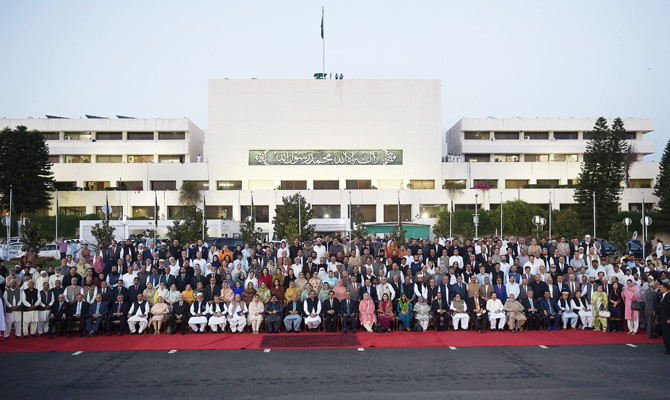
Outgoing parliamentarians pose for a group photo after the National assembly session to present 2018/19 budget in Islamabad, Pakistan on Friday, April 27, 2018.(AFP / AAMIR QURESHI)
2 / 2
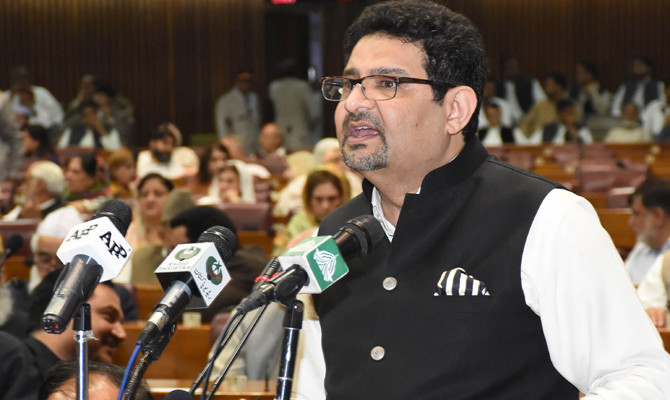
Pakistan's Finance Minister Miftah Ismail presenting the annual fiscal budget for 2018-19 at the Parliament House building in Islamabad. Pakistan's economy is set to record its fastest growth since 2005 during the current fiscal year, authorities said on Friday. (Pakistan Press Information Department via AFP)
Updated 28 April 2018
Follow

Pakistan announces 5.7 trillion rupee budget

  • Ruling Pakistan Muslim League-Nawaz presents sixth fiscal announcement as country gears up for polls in August
  • Opposition members had been demanding that the government announce the budget only for one quarter

KARACHI: Pakistan on Friday announced the federal budget for 2018-19 with a total outlay of 5.7 trillion Pakistan rupees and with a 6.2 percent growth target.

The government increased allocations for defense and cut development expenditures. Economists called it an “election budget.”

Dr. Miftah Ismail, who was sworn in as finance minister hours before his budget speech, presented the budget for the fiscal year amid uproar in the National Assembly of Pakistan.
The 2018-19 budget is the sixth presented by the outgoing Pakistan Muslim League-Nawaz (PML-N) government.
“The country has achieved 5.8 percent growth, the highest in the past 13 years, and the paces of growth cannot be compromised,” the finance minister announced.
Opposition members had been demanding that the government announce the budget only for one quarter. However, Prime Minister Shahid Khaqan Abbasi assured the parliament that the budget was being presented for continuity.
“Whoever makes the next government will have the right to make changes,” he said.
Ismail announced that with a backdrop of high growth, the size of the economy had increased from 22.385 trillion Pakistan rupees in 2013 to 34.396 trillion Pakistan rupees in 2018.
“The FBR tax collection target is 4.435 trillion Pakistan rupees for the next fiscal year,” Ismail said, adding that the increase in the tax base is expected to contribute to a tax rate cut.
“The target tax to GDP is 13.8 percent, the target budget deficit is 1.9 trillion Pakistan rupees or 4.9 percent of GDP, and the target net public debt to GDP is 63.2 percent,” Ismail said.
The current expenditure of the federal government was estimated at 4.78 trillion Pakistan rupees, and development expenditure set at 1.152 trillion Pakistan rupees.
“The share of current and development expenditure in the total budgetary outlay is 80.6 percent and 19.4 percent respectively,” Ismail said.
The defense budget has been set at 1.1 trillion Pakistan rupees from 999 billion Pakistan rupees, which is 18.5 percent of the total outlay.

“Another 100 billion Pakistan rupees has been allocated to the Armed Forces Development Program,” Ismail said.
The Public Sector Development Programme (PSDP) has been slashed to 800 billion Pakistan rupees next year. Under the PSDP, 47 billion Pakistan rupees is allocated for the Higher Education Commission, 37 billion Pakistan rupees for basic health and 10 billion Pakistan rupees for the prime minister’s youth programs.
Ismail said the aim was to keep the inflation rate in check, to below 6 percent during the fiscal year 2018-19.
Agricultural production was bound to increase with the government intending to continue implementing an agricultural policy in FY18-19, Ismail said. “Loans to the agriculture sector will increase to 100 billion Pakistan rupees,” he said.
Remittances are expected to be more than $20 billion by the end of the year, “which would be are record,” Ismail said, adding: “Forex reserves are expected to be $15 billion in FY18-19”.
The government allocated 342 billion Pakistan rupees and 174 billion Pakistan rupees for pension payments and subsidies. “The minimum pension has been increased to 10,000 Pakistan rupees from 6,000 Pakistan rupees and those above 75 years will get 15,000 Pakistan rupees,” Ismail said.
He announced a 10 percent ad-hoc relief allowance to civil and armed forces employees with effect from July 1.
Ismail announced the reduction of the super tax rate by 1 percent for both banking and non-banking companies.
The government announced a 25 billion Pakistan rupee special package for development in Karachi. “A large-scale desalination plant will be set up in Karachi to end the city’s water woes. The plant would clean 50 million gallons per day,” said.
He announced a reduction in the duty on the import of electric cars to 25 percent from 50 percent and the removal of regulatory duty.
As part of poverty alleviation efforts, the Benazir Income Support Program will get 125 billion Pakistan rupees from 121 billion Pakistan rupees, Ismail said.
“Under the CPEC government had made significant investments in the energy sector by adding 12,330MW to the national grid, initiating the Neelum-Jhelum hydro project in 2004, and setting up the 680MW Chashma Power Plant, which is now operational,” Ismail said.
The Federation of Pakistan Chambers of Commerce and Industry (FPCCI), the apex body of industrialists and traders, called the budget positive. “The measures taken for agriculture sector are encouraging,” said Waheed Ahmed, vice president of FPCCI.


US immigration officials grilled by Congress over Trump crackdown

Updated 2 sec ago
Follow

US immigration officials grilled by Congress over Trump crackdown

  • Trump administration officials faced a barrage of criticism and tough questions from Democratic lawmakers over the major crackdown on migrants in multiple US cities
  • Rodney Scott hailed efforts on the southern US frontier, saying CBP ‘spent the last year rebuilding what was an intentionally broken border’
WASHINGTON: The heads of US immigration agencies faced heavy criticism in Congress Tuesday as they defended President Donald Trump’s mass deportation drive and fielded questions about the fatal shootings of two protesters in Minneapolis.
Trump acknowledged in the wake of the Minneapolis killings that a “softer touch” may be needed on immigration, and his administration announced concessions including the withdrawal of hundreds of officers from the Midwestern city.
But the issue remains far from resolved, with Democrats demanding changes to the way the Department of Homeland Security (DHS) conducts its immigration sweeps and threatening to block its funding, while Trump’s administration vows to maintain its deportation efforts, with backing from Republican lawmakers.
“The president tasked us with mass deportation, and we are fulfilling that mandate,” Todd Lyons, the acting head of Immigration and Customs Enforcement (ICE), said in his opening remarks during the Tuesday hearing on DHS oversight.
He testified alongside Rodney Scott, the head of US Customs and Border Protection (CBP), and Citizenship and Immigration Services director Joseph Edlow.
Scott hailed efforts on the southern US frontier, saying CBP “spent the last year rebuilding what was an intentionally broken border” and that “the United States... enjoys the most secure border in our nation’s history.”
The Trump administration officials faced a barrage of criticism and tough questions from Democratic lawmakers over the major crackdown on migrants in multiple US cities, which Republican representatives largely defended.
“This administration and the agencies represented before us have shown a complete and utter disregard for the law and the Constitution,” Democratic Representative Tim Kennedy said.
Representative Eli Crane, a Republican, pushed back on criticism of immigration enforcement, accusing Democrats of seeking to “demonize ICE and Homeland Security.”

‘Days, not weeks’

In Minneapolis, thousands of federal agents have in recent weeks conducted raids in what the administration claims are targeted operations against criminals.
Minnesota Governor Tim Walz said Tuesday that he expects the crackdown — which has seen detentions of broad categories of immigrants and sometimes citizens — to end soon.
“We’re very much in a ‘trust but verify’ mode. But it’s my expectation... that we are talking days, not weeks and months, of this occupation,” Walz said.
The operations have sparked mass protests in Minneapolis, and the fatal shootings of US citizens Renee Good and Alex Pretti less than three weeks apart last month led to a wave of outrage.
When Democratic Representative Eric Swalwell asked Tuesday if Lyons would apologize to Good and Pretti’s families over the Trump administration’s initial description of them as “domestic terrorists,” he declined, saying he would not comment on active investigations.
Opposition Democrats have been calling for sweeping reforms to ICE operations, including ending mobile patrols, prohibiting agents from concealing their faces, and requiring warrants.
Democratic leaders in Congress are also threatening to block the 2026 funding bill for DHS. The White House has indicated it is willing to negotiate, but its response has failed to satisfy opposition lawmakers so far.
“Republicans shared an outline of a counterproposal, which included neither details nor legislative text,” House Minority Leader Hakeem Jeffries and Senate Minority Leader Chuck Schumer said in a statement.
They denounced the White House response as “incomplete and insufficient in terms of addressing the concerns Americans have about ICE’s lawless conduct,” and said they were awaiting further details.
If negotiations fail, DHS could face a funding shortfall starting Saturday. CBP and ICE operations could continue using funds approved by Congress last year, but other sub-agencies such as federal disaster organization FEMA could be affected.