

Taliban launches spring offensive; dashes Afghan peace hopes

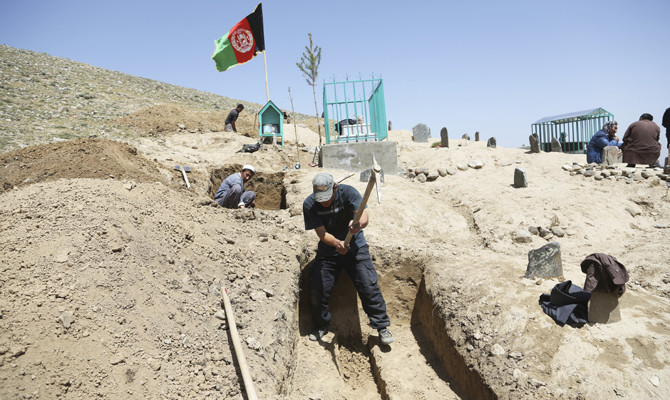
Afghan men prepare the graves for the victims of Sunday's suicide attack at a voter registration center in Kabul, Afghanistan,on April 23, 2018. (AP Photo/Rahmat Gul)
Updated 27 April 2018
Follow

Taliban launches spring offensive; dashes Afghan peace hopes

  • Group vows to employ ‘new and intricate tactics’ in response to ‘new war strategy of the enemy’
  • The Taliban says it will focus on “crushing, killing and capturing American invaders and their supporters.”

KABUL: The Taliban’s announcement on Tuesday of the launch of its annual spring offensive has dashed the chances of peace talks with the Afghan government

The announcement follows last week’s deadly attack by Daesh on a voter registration center in Kabul. 

“When the Taliban declares its spring offensive, it’s not only rejecting President Ashraf Ghani’s peace overture, but also launching a war against it,” Mohammed Daud Kalakani, a lawmaker from Kabul, told Arab News.

Since the announcement, the Taliban has unleashed a series of attacks, killing dozens of Afghan security personnel and the deputy governor of Logar province, Foreign Ministry officials told Arab News on Friday.

The offensive spells “disaster for the people,” Defense Ministry spokesman Mohammed Radmanesh told Arab News.

“We have our own preparations, and have launched 11 offensives in different parts of the country.”

There have been at least six attacks on voter registration offices, including one in Kabul. The government has acknowledged that many of them are in areas beyond its control, but has vowed to beef up security for parliamentary elections scheduled for October. 

There are fears that the Taliban offensive could escalate violence and reduce the chances of a transparent and secure election.

“So far, only 200,000 people have registered,” Ahmad Saeedi, an analyst and former Afghan diplomat, told Arab News.

“We have 13 million people qualified to vote, so even if we step up security and prolong the period of voter registration, possibly 1 or 2 million will register,” he said.

“Will this be enough of a turnout? Will the election be free, fair and transparent? No. The election will add to the crisis,” he added. 

“Elections are held to bring political stability, but this one will increase the challenges for the government and the people.” Government officials insist the election will be held on time.


Air Canada suspends Cuba flights citing airport fuel shortage

Updated 4 sec ago
Follow

Air Canada suspends Cuba flights citing airport fuel shortage

  • Jet fuel shortage linked to US blocking Venezuelan oil exports
  • Cuba ​historically relies on Venezuela for jet fuel supply

MONTREAL: Air Canada said it was suspending service to Cuba from Monday due to a lack of guaranteed fuel supply at airports in the country, where US pressure has created an oil crisis.
“It is projected that as of February 10 aviation fuel will not be commercially available at the island’s airports,” Air Canada said in a statement, announcing it would be sending empty flights to Cuba over the coming days to repatriate people already there.
Cuba warned international airlines that jet fuel will no longer be available on the island beginning on Tuesday in the latest sign of fast-worsening conditions as the United States moves to cut off ‌the communist-run nation’s oil ‌supply. The shortfall is set to ‌last ⁠from ​February ‌10 through March 11, according to a Notice to Aviation (NOTAM) published late on Sunday, and comes just two days after top officials said air travel would not be impacted by a fuel rationing plan announced on Friday.
Cuba has historically relied on Venezuela to provide much of its jet fuel, ⁠but the Caribbean island nation has not received any crude or ‌refined products from its top ally ‍since mid-December, when the US ‍moved to block the South American nation’s exports.
US president ‍Donald Trump has since vowed Cuba would receive no more oil from Venezuela and has threatened to slap tariffs on any nation sending fuel to Cuba, effectively cutting off the ​island’s supply of aviation gas.
Such shortfalls are not new to Cuba and many airlines already have ⁠plans in place to deal with them.
A similar crisis last year, as well as others recently, have prompted many carriers to refuel in nearby third countries, including Panama, the Bahamas, the Dominican Republic and the United States.
Most airline flights into Havana appeared on time and on schedule on Monday morning.
An early morning COPA airlines flight to Panama departed on time Monday, and several American Airlines flights were slated to arrive later in the day, ‌airport officials confirmed to Reuters.
None of the major carriers servicing Cuba have yet commented on the situation.