Israeli army kills 3 Palestinians, injures 300 in Gaza border protests

1 / 6
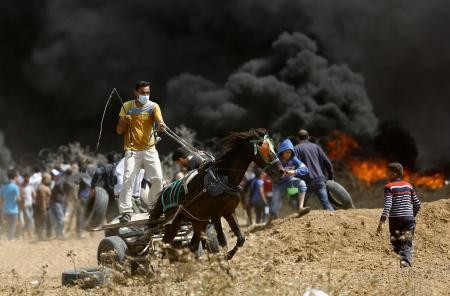
A Palestinian drives a horse-drawn cart during clashes with Israeli security forces near the eastern border of the Gaza Strip, on April 27, 2018. (AFP)
2 / 6
Palestinian demonstrators remove Israeli barbed wire during clashes with Israeli troops at a protest demanding the right to return to their homeland, at the Israel-Gaza border, east of Gaza City, April 27, 2018. (Reuters)
3 / 6
Palestinians carry an injured man during clashes with Israeli security forces near the eastern border of the Gaza Strip, east of the northern town of Jabalia, on April 27, 2018, on the fifth straight Friday of mass demonstrations and clashes along the Gaza-Israel border. (AFP)
4 / 6
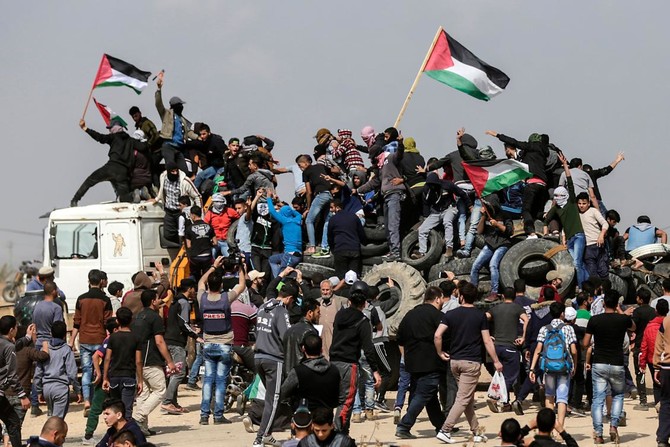
Palestinian demonstrators hold their national flag on a truck on the Israel-Gaza border, east of Gaza City in the central Gaza Strip, during the fifth straight Friday of mass demonstrations and clashes along the border with Israel on April 27, 2018. (AFP)
5 / 6
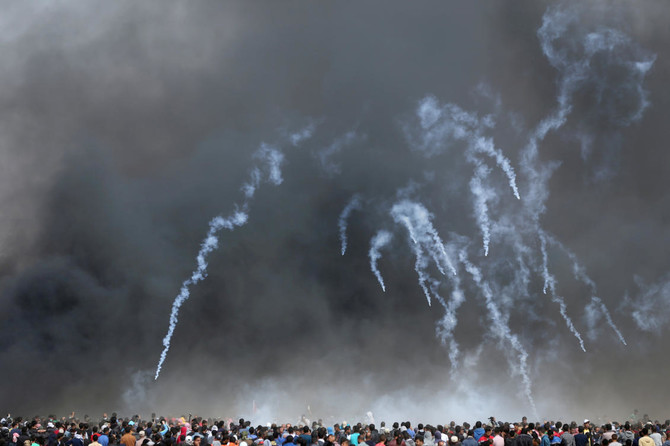
Tear gas canisters are fired by Israeli troops at Palestinian demonstrators during clashes at a protest demanding the right to return to their homeland, at the Israel-Gaza border in the southern Gaza Strip, April 27, 2018. (Reuters)
6 / 6
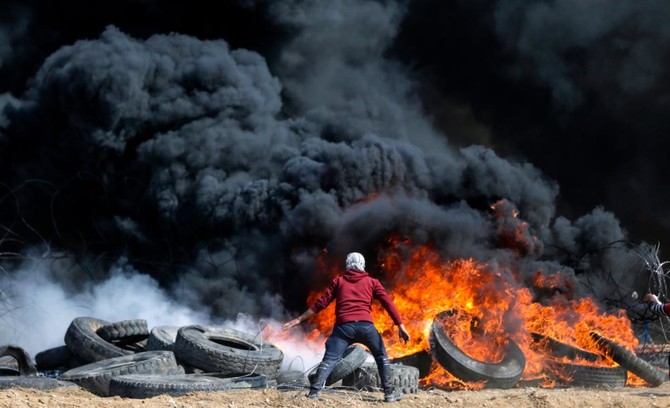
A Palestinian demonstrator burns tires near the fence on the Israel-Gaza border, east of Gaza City in the central Gaza Strip, during the fifth straight Friday of mass demonstrations and clashes along the border with Israel on April 27, 2018. (AFP)
Updated 27 April 2018
Follow

Israeli army kills 3 Palestinians, injures 300 in Gaza border protests

  • Fifty people were injured by gunfire or teargas inhalation, Gaza’s health ministry said.
  • Marchers are demanding the right to return to their homes seized by Israel in 1948.

GAZA CITY: Three Palestinians were shot dead Friday as thousands demonstrated along the border between Gaza and Israel for a fifth consecutive week of rallies dubbed the 'Great March of Return'.
More than 300 other people were hospitalised for gunshot wounds and tear gas inhalation, Gaza's health authority said.
Forty-four Palestinians have now been killed by Israeli fire since major protests began on March 30, with hundreds more wounded.
No Israelis have been hurt. 
Palestinians again gathered at five sites near the border fence, though numbers were down on previous weeks.
Dozens of young men burned tires and threw stones a few hundreds meters from the border, with Israeli soldiers occasionally firing at them.
More than 300 Palestinians were injured by gunfire or teargas inhalation, Gaza’s health ministry said.
A 22-year-old freelance photographer was among those shot, the ministry said.
Forty-one Palestinians have been killed since the demonstrations began on March 30, with hundreds more injured.
Marchers are demanding the right to return to their homes seized by Israel in 1948.
Israel says that allowing the refugees in would mean the end of the Jewish state, and accuses Gaza’s rulers Hamas of using the protests as a pretext for violence.
Demonstrations are expected to spike again in the lead up to May 14, when the United States is expected to move its embassy from Tel Aviv to Jerusalem.
The decision has infuriated Palestinians, who see the annexed eastern half of the holy city as the capital of their future state.
Israel has rejected calls for an independent inquiry into the deaths along Gaza’s border, with the army saying its troops only use live ammunition as a last resort.


Israel’s hostage forum releases AI-generated video of last Gaza captive

Updated 23 December 2025
Follow

Israel’s hostage forum releases AI-generated video of last Gaza captive

  • The Gaza ceasefire, which came into effect in October, remains fragile with both sides alleging violations, and mediators fearing that Israel and Hamas alike are stalling

JERUSALEM: An Israeli group representing the families of Gaza hostages released on Tuesday an AI-generated video of Ran Gvili, the last captive whose body is still being held in the Palestinian territory.
The one-minute clip, created whole cloth using artificial intelligence, purports to depict Gvili as he sits in a Gaza tunnel and appeals to US President Donald Trump to help bring his body back to Israel.
“Mr President, I’m asking you to see this through: Please bring me home. My family deserves this. I deserve the right to be buried with honor in the land I fought for,” says the AI-generated image of Gvili.
Gvili was 24 at the time of Hamas’s October 7, 2023 attack on Israel.
He was an officer in Israel’s Yasam elite police unit and was on medical leave when he learnt of the attack.
He decided to leave his home and brought his gun to counter the Hamas militants.
He was shot in the fighting at the Alumim kibbutz before he was taken to Gaza.
Israeli authorities told Gvili’s parents in January 2024 that he had not survived his injuries.
The AI clip was released by the Hostages and Missing Families Forum, the main group representing those taken captive to Gaza.
The Forum said it was published with the approval of Gvili’s family.
“Seeing and hearing Rani speak in his own voice is both moving and heartbreaking. I would give anything to hear, see and hold him again,” Gvili’s mother Talik said, quoted by the Forum.
“But all I can do now is plead that they don’t move to the next phase of the agreement before bringing Rani home — because we don’t leave heroes behind.”
The Gaza ceasefire, which came into effect in October, remains fragile with both sides alleging violations, and mediators fearing that Israel and Hamas alike are stalling.
In the first stage, Palestinian militants were expected to return all of the remaining 48 living and dead hostages held in Gaza.
Since the ceasefire came into effect on October 10, militants have released 47 hostages.
In the next stages of the truce, Israel is supposed to withdraw from its positions in Gaza, an interim authority is to govern the Palestinian territory instead of Hamas, and an international stabilization force is to be deployed.
Israeli Prime Minister Benjamin Netanyahu is expected to meet Trump in Florida later this month to discuss the second phase of the deal.