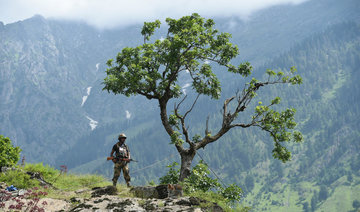
ISLAMABAD: Pakistan’s Foreign Ministry says Indian troops have fired across the frontier between the two countries in the disputed Kashmir region, killing two civilians and wounding two others.
Ministry spokesman Mohammad Faisal says Indian troops Thursday targeted the villages of Thub and Banchiran on the Pakistani side of the Line of Control with mortars and other weapons. Army officials said Pakistani forces returned fire and it was unclear if there were any casualties on the Indian side.
There was no immediate comment from India.
The nuclear-armed rivals routinely blame each other for starting any skirmishes and insist they are only retaliating.
Pakistan and India have fought two of their three wars since 1947 over their competing claims to Kashmir, which is split between them, and both claim the region in its entirety.

Pakistan says Indian fire kills 2 villagers in Kashmir
- Indian troops targeted the villages of Thub and Banchiran on the Pakistani side of the Line of Control with mortars and other weapons, says Foreign Ministry spokesman
- Army officials say Pakistani forces retaliated and it was unclear if there were any casualties on Indian side

Bangladesh’s religio-political party open to unity govt
- Opinion polls suggest that Jamaat-e-Islami will finish a close second to the Bangladesh Nationalist Party in the first election it has contested in nearly 17 years
DHAKA: A once-banned Bangladeshi religio-political party, poised for its strongest electoral showing in February’s parliamentary vote, is open to joining a unity government and has held talks with several parties, its chief said.
Opinion polls suggest that Jamaat-e-Islami will finish a close second to the Bangladesh Nationalist Party in the first election it has contested in nearly 17 years as it marks a return to mainstream politics in the predominantly Muslim nation of 175 million.
Jamaat last held power between 2001 and 2006 as a junior coalition partner with the BNP and is open to working with it again.
“We want to see a stable nation for at least five years. If the parties come together, we’ll run the government together,” Jamaat chief Shafiqur Rahman said in an interview at his office in a residential area in Dhaka, days after the party created a buzz by securing a tie-up with a Gen-Z party.
Rahman said anti-corruption must be a shared agenda for any unity government.
The prime minister will come from the party winning the most seats in the Feb. 12 election, he added. If Jamaat wins the most seats, the party will decide whether he himself would be a candidate, Rahman said.
The party’s resurgence follows the ousting of long-time Prime Minister Sheikh Hasina in a youth-led uprising in August 2024.
Rahman said Hasina’s continued stay in India after fleeing Dhaka was a concern, as ties between the two countries have hit their lowest point in decades since her downfall.
Asked about Jamaat’s historical closeness to Pakistan, Rahman said: “We maintain relations in a balanced way with all.”
He said any government that includes Jamaat would “not feel comfortable” with President Mohammed Shahabuddin, who was elected unopposed with the Awami League’s backing in 2023.