

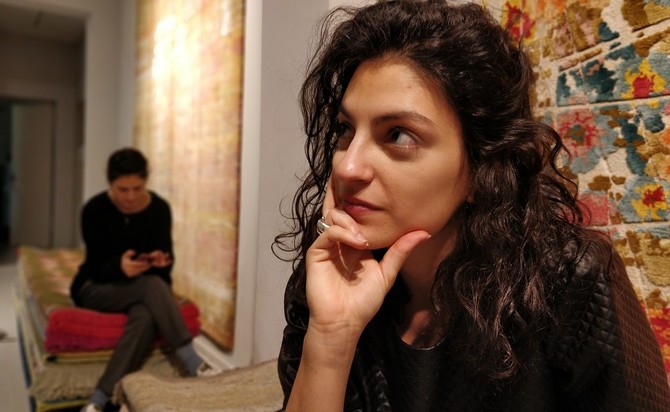
Muse: Nour Hage talks self-expression and serial killers

1 / 2
2 / 2
Updated 26 April 2018
Follow

Muse: Nour Hage talks self-expression and serial killers

  • The UK-based Lebanese fashion designer talks boredom, self-expression and serial killers


My parents are definitely the biggest influence on my personality and philosophy. We were always careful with waste, for environmental and financial reasons. One of the things that I’m thankful for is that they never let us spend money on meaningless things. From very young, I was aware of the value of money and the value of everything I use. That’s why my brand always has a sustainable side to it. I always try to inflict less harm on the environment.

I always admire people that go against the stream and stand for what they are doing, whether that is professionally or personally.

I think the most fundamental difference between men and women (I’m generalizing here) is that women tend to be very careful with their decision making and think things through, while men tend to go with their first instincts; much more daring but also much more risky. I think the perfect balance is to have those two facets in a relationship and in a professional situation.

There’s this perception that some people are so fundamentally different that it’s impossible to solve our differences. I think that’s lazy. Everything is solvable.

Some people think this is a bit worrying, but I love reading about serial killers. I have this big obsession. It’s curiosity; I want to know the why, the how, and the why of the how.

What people wear is how they want others to perceive them; they’re trying to put a message out there. Even if it’s just a t-shirt and jeans, you’re still saying you’re someone who likes to keep things simple. So for me the ultimate form of expression is designing clothes. It just feels very rewarding. There’s this indescribable feeling when I look at my completed collection for the first time.

The school I went to was one of the most boring and strict schools in Lebanon. Everybody dressed the same. I wanted to stand out, wanted to look different. I started to wear these strange DIY outfits I’d cobble together. I was so bored on a daily basis, both visually and mentally, that I felt the need to start experimenting. So I guess you could say that boredom was my major inspiration to start designing. More people should allow themselves to get bored these days.


Review: ‘Relay’

Updated 21 December 2025
Follow

Review: ‘Relay’

RIYADH: “Relay” is a thriller that knows what its role is in an era of overly explained plots and predictable pacing, making it feel at once refreshing and strangely nostalgic. 

I went into the 2025 film with genuine curiosity after listening to Academy Award-winning British actor Riz Ahmed talk about it on Podcrushed, a podcast by “You” star Penn Badgley. Within the first half hour I was already texting my friends to add it to their watchlists.

There is something confident and restrained about “Relay” that pulls you in, and much of that assurance comes from the film’s lead actors. Ahmed gives a measured, deeply controlled performance as Ash, a man who operates in the shadows with precision and discipline. He excels at disappearing, slipping between identities, and staying one step ahead, yet the story is careful not to mythologize him as untouchable. 

Every pause, glance, and decision carries weight, making Ash feel intelligent and capable. It is one of those roles where presence does most of the work.

Lily James brings a vital counterbalance as Sarah, a woman caught at a moral and emotional crossroads, who is both vulnerable and resilient. The slow-burn connection between her and Ash is shaped by shared isolation and his growing desire to protect her.

The premise is deceptively simple. Ash acts as a middleman for people entangled in corporate crimes, using a relay system to communicate and extract them safely. 

The film’s most inventive choice is its use of the Telecommunications Relay Service — used by people who are deaf and hard of hearing to communicate over the phone — as a central plot device, thoughtfully integrating a vital accessibility tool into the heart of the story. 

As conversations between Ash and Sarah unfold through the relay system, the film builds a unique sense of intimacy and suspense, using its structure to shape tension in a way that feels cleverly crafted.

“Relay” plays like a retro crime thriller, echoing classic spy films in its mood and pacing while grounding itself in contemporary anxieties. 

Beneath the mechanics and thrills of the plot, it is about loneliness, the longing to be seen, and the murky ethics of survival in systems designed to crush individuals. 

If you are a life-long fan of thrillers, “Relay” might still manage to surprise you.