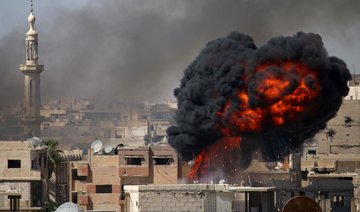
DARAA: On a tense urban frontline in Syria’s Daraa, rebel Atallah Qutayfan has been steadily reinforcing his defensive post for weeks in anticipation of a looming assault by government troops.
The 25-year-old spends his days stacking sandbags to shore up his post overlooking a market in the southern city, and monitoring the amassing regime forces nearby.
“Their reconnaissance planes are constantly above the city. There are daily clashes and they try to infiltrate our positions, but we’ve stopped them,” says Qutayfan.
“Our commanders told us to be ready for an attack by regime forces — and we’re on high alert.”
As loyalist forces mop up the last pockets of resistance around the capital, President Bashar Assad appears to already have set his sights on his next target: Daraa.
The city is split between rebels, who hold the southern Old City, and regime forces who control the modern districts and government posts to the north.
Opposition forces still hold more than two-thirds of the surrounding 3,730-square-kilometer province which borders Jordan.
Seizing the border area could bring the regime both military and economic security, analysts have said.
And a victory in Daraa city would carry symbolic weight — it was the cradle of Syria’s seven-year uprising against Assad’s rule.
The resurgent regime just this month dealt rebels their biggest blow yet by recapturing Eastern Ghouta, the former opposition stronghold outside Damascus.
That freed up troops who had spent years bombing the Ghouta front.
“After Ghouta, the regime escalated its bombing against us with surface-to-surface missiles, machine-gun fire, mortars, tanks, and heavy artillery,” says rebel fighter Fahed Abu Hatem.
In response, Abu Hatem says, his forces reinforced their positions, dug trenches and erected fresh barricades.
Gritting his teeth, rebel field commander Ibrahim Musalima, 27, insists the extra measures are necessary.
“It’s not fear, it’s readiness,” says Musalima.
“We’re setting up lines of defense and attack, and upping our coordination with the Quneitra rebels to the west, all the way to the border with Suweida to the east.”
Quneitra is the province directly to Daraa’s west, and Suweida neighbors it to the east.
Sections of the three provinces make up a “de-escalation zone” agreed in May 2017 by rebel backer Turkey and regime allies Russia and Iran.
The US and Jordan have also backed the zone, announcing alongside Russia in July that a cessation of hostilities would begin in the southern sliver.
Despite the steadily increasing violence, Musalima says the south’s rebel factions had been “advised” by their foreign backers not to provoke the regime or its loyalist militias, and to preserve the de-escalation zone.
The subtle warning belies the region’s importance to rival actors in Syria’s complex war.
Assad is keen to recapture the strategic Nasib crossing with Jordan, which the regime lost to rebels in 2015 but whose recapture could generate desperately needed income from cross-border trade.
Meanwhile, the presence of Iran-backed militias in southern Syria, including Lebanon’s Hezbollah, has irked neighboring Israel.
Far away from these geopolitical interests, civilians are worried about what the escalation could bring.
Umm Mohammad Al-Baghdadi, a 45-year-old nurse in a field clinic in Daraa, describes a constant stream of wounded from shelling and bombing.
“We can’t say we’re not scared of more escalation. After the end of Ghouta, of course the regime is going to go for any area that opposes it,” she says.
“It wants to snuff out the uprising generally, and in Daraa especially.”
Around 30,000 people live in rebel-held parts of Daraa city, according to the local opposition-run council.
Its head Mohammad Abdulmajid Al-Musalima, 38, says residents struggle to cope with severe shortages of water and electricity, and widespread destruction.
“Women and children will bear the brunt of any military escalation, because they’re the main pressure point used by the regime against opposition groups,” says Musalima.
Rebels and local opposition officials alike insist Daraa’s fate will not resemble Ghouta’s, where a five-year siege had worn down rival rebel groups.
“We’re saying to the regime: Daraa is not Ghouta. The armed opposition here is holding it together,” says Mohammad Al-Masri, 60, a member of the local council.
“Here, the front lines are holding on. Our popular base and the rebels are in agreement: Daraa is our city, and we will stand firm in it,” says Masri.


![]()

Syria rebels dig in for Daraa fight
Syria rebels dig in for Daraa fight
- The city is split between rebels, who hold the southern Old City, and regime forces who control the modern districts and government posts to the north
- Far away from geopolitical interests, civilians are worried about what the escalation could bring

Latest updates


© 2026 SAUDI RESEARCH & PUBLISHING COMPANY, All Rights Reserved And subject to Terms of Use Agreement.