

Saudi Cabinet approves MoUs with Ukraine and Sudan

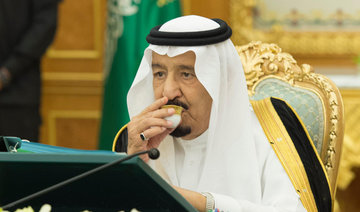
King Salman chaired the Cabinet at Al-Yamamah Palace in Riyadh. (SPA)
Updated 25 April 2018
Follow

Saudi Cabinet approves MoUs with Ukraine and Sudan

  • Cabinet reiterated the Kingdom’s strong condemnation of the suicide attack west of the Afghan capital Kabul
  • Cabinet confirmed that the king would inaugurate Al-Qiddiya Project on Saturday

RIYADH: The Cabinet on Tuesday approved memorandums of understanding (MoUs) with Ukraine, for investment cooperation in agriculture, and with Sudan, for cooperation in communications and information technology.

King Salman chaired the Cabinet at Al-Yamamah Palace in Riyadh.

Royal decrees have been prepared for both MoUs.

The king briefed the Cabinet on his telephone calls with President Michel Temer of Brazil, President Mauricio Macri of Argentina, Prime Minister of Canada Justin Trudeau, and Prime Minister of Norway Erna Solberg, and on his meetings with the chairman of NATO Partnerships Sub-committee, Mateen Lutfi, and the president of the Pontifical Council for Interfaith Dialogue in the Vatican State, Cardinal Jean-Louis Tauran.

The Cabinet reiterated the Kingdom’s strong condemnation of the suicide attack west of the Afghan capital Kabul, offering its condolences to the families of the victims and the government and people of Afghanistan. It wished a speedy recovery to the wounded, renewing the Kingdom’s stand with Afghanistan against terrorism and extremism.

On local affairs, the Cabinet confirmed that the king would inaugurate Al-Qiddiya Project on Saturday. It is the new entertainment, sports and cultural destination to be built west of Riyadh. Al-Qiddiya embodies the Kingdom’s aspirations and ongoing efforts to develop gigantic projects in line with Vision 2030.

The Cabinet also extended its thanks and appreciation to the king for honoring the winners of the Custodian of the Two Holy Mosques Award for Inventors and the Talented at its fourth session. This, said Minister of Culture and Information Awwad bin Saleh Al-Awwad, reflects the Kingdom’s interest in giftedness and innovation as well as the importance of honoring talents and abilities in recognition of their achievements and the development of the spirit of creativity and innovation.

The Cabinet also commended the positive results in the performance indicators of the security agencies of the Ministry of Interior over the past year, which showed outstanding achievements and a significant decrease in crime rates and rise in the level of safety.

Separation of Somali conjoined twins Rahma and Ramla begins in Riyadh

Rahma and Ramla will be the 68th pair of conjoined twins to be separated under the Saudi Conjoined Twins Program. (Supplied)
Updated 58 min 41 sec ago
Follow

Separation of Somali conjoined twins Rahma and Ramla begins in Riyadh

  • Surgery to take 14 hours in 8 stages with 37-member team
  • Initiative is led by leading surgeon Dr. Abdullah Al-Rabeeah

RIYADH: Surgery to separate Somali conjoined twins Rahma and Ramla is underway at the King Abdullah Specialized Children’s Hospital of the Ministry of the National Guard in Riyadh.

The children came with their parents to Saudi Arabia upon King Salman’s directives in May last year and were transferred to the hospital for tests to determine whether the operation would be safe.

An official of the Saudi Conjoined Twins Program told Arab News that in addition to the complexity of the intervention, there was also a waiting list of other children.

Dr. Abdullah Al-Rabeeah, who heads the SCTP’s teams and is also supervisor-general of the Saudi aid agency KSrelief, said the 13-month-old girls who arrived on May 6 were joined at the lower abdomen and pelvis. 

“Each twin has two complete lower limbs, and they share a pelvic bone, colon and rectum, with overlaps in the urinary and reproductive systems,” said Al-Rabeeah.

He explained that Ramla suffers from complete atrophy of both kidneys and would need immediate dialysis after separation.

Rahma suffers from complete atrophy of her left kidney, and there are cysts in her right kidney, which is currently functioning adequately but would require close monitoring following surgery to ensure its continued function, he added. 

Al-Rabeeah said the risk was 40 percent due to the case’s medical challenges. The situation was explained in detail to the twins’ parents, who accepted the plan to separate the girls, he added.

He said the procedure is expected to take about 14 hours in eight stages, and would involve 37 consultants, specialists, nurses and staff in the fields of anesthesia, pediatrics, orthopedics and plastic surgery.

He said Rahma and Ramla will be the 68th pair of conjoined twins to be separated under the program, which began 35 years ago. 

Al-Rabeeah thanked the Saudi leadership for supporting the initiative over the years. He prayed for the success of the separation, which he said would give the girls the best chance to live happy and healthy lives.