Yemen army removes 300,000 Houthi landmines in liberated areas

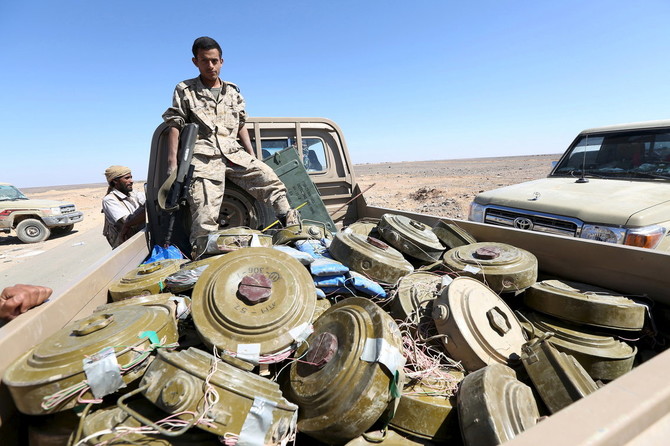
A Yemeni government soldier stands on a truck transporting land mines left by the Houthi rebels in al-Jadaan area, in the country's central province of Marib, December 21, 2015.(Reuters)
Updated 24 April 2018
Follow

Yemen army removes 300,000 Houthi landmines in liberated areas

  • According to army officials in Yemen, the country has been subjected to the “largest mine-laying operation since the end of the Second World War”
  • International human rights groups have previously condemned Iran-backed Houthi militias for their use of the banned antipersonnel landmines in Yemen that have caused numerous civilian casualties

Yemen’s national army has seized 300,000 mines planted by Houthi militia in liberated areas, it was announced on Monday.

“In the past two years, the National Army has managed to extract 300,000 mines planted by the Houthi militia in liberated areas, including 40,000 mines on the outskirts of Marib province,” a statement on the army’s website read.

According to army officials in Yemen, the country has been subjected to the “largest mine-laying operation since the end of the Second World War.”

That statement added that the total number of mines laid by the militia exceeds half a million mines, and that this “huge amount continues to pose a sustainable threat to the lives of civilians.”

International human rights groups have previously condemned Iran-backed Houthi militias for their use of the banned antipersonnel landmines in Yemen that have caused numerous civilian casualties and hindered the safe return of people to displaced by fighting.

Human Rights Watch (HRW) called on Houthis last year to “immediately cease using these weapons and observe the 1997 Mine Ban Treaty, which Yemen ratified in 1998.”

According to the group, landmines have been used in at least six governorates since the Saudi-led Arab coalition began military operations in support of President Abdu Rabbu Mansour Hadi in March 2015.

HRW said Mines have killed and maimed hundreds of civilians and disrupted civilian life in affected areas.


Algeria inaugurates strategic railway to giant Sahara mine

President Tebboune attended an inauguration ceremony in Bechar. (AFP file photo)
Updated 02 February 2026
Follow

Algeria inaugurates strategic railway to giant Sahara mine

  • The mine is expected to produce 4 million tons per year during the initial phase, with production projected to triple to 12 million tons per year by 2030
  • The project is financed by the Algerian state and partly built by a Chinese consortium

ALGEIRS: Algerian President Abdelmadjid Tebboune on Sunday inaugurated a nearly 1,000-kilometer (621-mile) desert railway to transport iron ore from a giant mine, a project he called one of the biggest in the country’s history.
The line will bring iron ore from the Gara Djebilet deposit in the south to the city of Bechar located 950 kilometers north, to be taken to a steel production plant near Oran further north.
The project is financed by the Algerian state and partly built by a Chinese consortium.
During the inauguration, Tebboune described it as “one of the largest strategic projects in the history of independent Algeria.”
This project aims to increase Algeria’s iron ore extraction capacity, as the country aspires to become one of Africa’s leading steel producers.
The iron ore deposit is also seen as a key driver of Algeria’s economic diversification as it seeks to reduce its reliance on hydrocarbons, according to experts.
President Tebboune attended an inauguration ceremony in Bechar, welcoming the first passenger train from Tindouf in southern Algeria and sending toward the north a first charge of iron ore, according to footage broadcast on national television.
The mine is expected to produce 4 million tons per year during the initial phase, with production projected to triple to 12 million tons per year by 2030, according to estimates by the state-owned Feraal Group, which manages the site.
It is then expected to reach 50 million tons per year in the long term, it said.
The start of operations at the mine will allow Algeria to drastically reduce its iron ore imports and save $1.2 billion per year, according to Algerian media.