

Jordan ‘discriminatory’ stance on women criticized by rights group

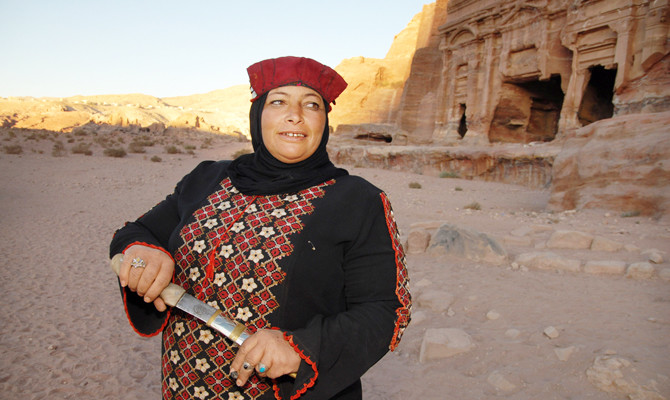
A Jordanian Bedouin woman shows of her knife in front of an ancient sandstone tomb in Petra, Jordan in this file photo. Human Rights Watch says Jordan should discard its discriminatory policy toward women over the issue of nationality, as other Arab countries have done. (Shutterstock photo)
Updated 24 April 2018
Follow

Jordan ‘discriminatory’ stance on women criticized by rights group

  • Jordan violated both international law and its own constitution, which guarantees all Jordanians equality before the law — HRW
  • Algeria, Egypt, Morocco, Tunisia, and Yemen provide equal rights to women and men to confer citizenship to their children

AMMAN: The global advocacy group Human Rights Watch has criticized Jordan for what it claims is a discriminatory policy toward women over the issue of nationality.

In a report released on Tuesday, the organization said Jordan violated both international law and its own constitution, which guarantees all Jordanians equality before the law.

In spite of progress made by other countries across the Middle East and North Africa to allow women to pass their nationality on to their children, Jordan has no plans to amend its nationality law. 

Algeria, Egypt, Morocco, Tunisia, and Yemen provide equal rights to women and men to confer citizenship to their children. Iraq and Mauritania allow women with foreign husbands to confer nationality to children born in the country.

Jordanian authorities restrict the rights of non-citizen children of Jordanian women to work, own property, travel, enrol in higher education, and access government health care and other services. 

“This is the first comprehensive report that deals with the half measures adopted in 2014 and shows that the government didn’t make any serious change of laws and regulations,” Adam Coogle, Middle East researcher for HRW, told Arab News.

In 2014, following domestic pressure, Jordanian authorities appeared ready to recognize non-citizen children of Jordanian women. The Cabinet issued a decision purporting to ease restrictions on their access to employment opportunities, public education, government health care, property ownership, investment and acquiring a driver’s license.

Almost half the Jordanian population are citizens of Palestinian origin, with 2 million registered refugees who are also citizens of Jordan. The report explained the argument used to deny Jordanian women equal rights with men. 

“Given that Jordan is home to one of the largest populations of Palestinian refugees and that the majority of Jordanian women married to foreign nationals are married to non-citizen Palestinian men who hold various legal statuses in Jordan, local politicians and officials’ chief argument against repealing this discriminatory policy is the claim that it would both undermine the effort to secure Palestinian statehood and alter Jordan’s demographic balance,” it said.

Human Rights Watch rejected this justification as discriminatory, saying it was not applied to Jordanian men who chose to marry foreign nationals, most of whom are also married to Palestinians.

“While I am totally for ending the discriminatory policy against Jordanian women, the government should immediately remove all barrier to their children,” Salma Nims, secretary-general of the Jordanian National Commission for Women, whose organization was set to host the unveiling of the report, told Arab News.


Algeria inaugurates strategic railway to giant Sahara mine

President Tebboune attended an inauguration ceremony in Bechar. (AFP file photo)
Updated 02 February 2026
Follow

Algeria inaugurates strategic railway to giant Sahara mine

  • The mine is expected to produce 4 million tons per year during the initial phase, with production projected to triple to 12 million tons per year by 2030
  • The project is financed by the Algerian state and partly built by a Chinese consortium

ALGEIRS: Algerian President Abdelmadjid Tebboune on Sunday inaugurated a nearly 1,000-kilometer (621-mile) desert railway to transport iron ore from a giant mine, a project he called one of the biggest in the country’s history.
The line will bring iron ore from the Gara Djebilet deposit in the south to the city of Bechar located 950 kilometers north, to be taken to a steel production plant near Oran further north.
The project is financed by the Algerian state and partly built by a Chinese consortium.
During the inauguration, Tebboune described it as “one of the largest strategic projects in the history of independent Algeria.”
This project aims to increase Algeria’s iron ore extraction capacity, as the country aspires to become one of Africa’s leading steel producers.
The iron ore deposit is also seen as a key driver of Algeria’s economic diversification as it seeks to reduce its reliance on hydrocarbons, according to experts.
President Tebboune attended an inauguration ceremony in Bechar, welcoming the first passenger train from Tindouf in southern Algeria and sending toward the north a first charge of iron ore, according to footage broadcast on national television.
The mine is expected to produce 4 million tons per year during the initial phase, with production projected to triple to 12 million tons per year by 2030, according to estimates by the state-owned Feraal Group, which manages the site.
It is then expected to reach 50 million tons per year in the long term, it said.
The start of operations at the mine will allow Algeria to drastically reduce its iron ore imports and save $1.2 billion per year, according to Algerian media.