Pakistan Pashtun activists vow to hold banned Lahore rally

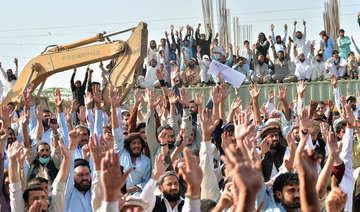
Pakistani members of the Pashtun Protection Movement (PTM) and student activists gather before the start of a demonstration in Lahore on April 22, 2018. (AFP)
Updated 22 April 2018
Follow

Pakistan Pashtun activists vow to hold banned Lahore rally

  • The PTM came to prominence in February after the killing of a young social media star in Karachi unleashed festering anger at authorities over the alleged targeting of Pashtuns
  • The military has accused the PTM of colluding with arch-rival India and overseeing a campaign to destabilize the country

LAHORE: Leaders of Pakistan’s Pashtun Tahafuz Movement (PTM) vowed to defy a ban and go ahead with a mass protest in the eastern city of Lahore Sunday, just hours after officials cracked down on the group.
Since launching three months ago, the PTM has rattled the powerful military with a nationwide campaign calling for an end to extrajudicial killings, “disappearances” and other abuses by police and troops.
Despite a far-reaching media blackout the movement has drawn tens of thousands of supporters to their protests in one of the strongest challenges to Pakistan’s security establishment for years.
Late Saturday officials in Lahore detained PTM leaders along with representatives of the Awami Workers Party and student activists following raids on Punjab University and a hotel.
A local police official confirmed the incident but said the activists have since been released.
The crackdown sparked anger on social media with the hashtags #ReleasePTMWorkers and #ShameOnPunjabPolice gaining traction.
PTM supporters from across the country have flocked to Lahore in recent days before the anticipated rally.
The movement’s leader Manzoor Pastheen vowed to continue with the demonstration even after authorities refused to provide the necessary documentation, citing “security circumstances.”
“We won’t stay silent. We will hold the rally at any cost,” said Pastheen in a message posted early Sunday.
The PTM came to prominence in February after the killing of a young social media star in Karachi unleashed festering anger at authorities over the alleged targeting of Pashtuns in the country’s long war on militancy.
The military has accused the PTM of colluding with arch-rival India and overseeing a campaign to destabilize the country.
Criticism of Pakistan’s powerful armed forces, especially their counter-insurgency operations, is largely seen as a step too far.
However, the PTM argues that Pashtuns have bore the brunt of the long fight against terrorism.
The “Pashtun belt” in the northwest bordering Afghanistan has suffered severely from militant violence for over a decade as the Afghan war split over the border, leading to repeated military operations in the region.
Pashtuns account for roughly 15 percent of the population, with a majority of the 30 million-strong group living in the northwest.


Iran war unsettles India’s packaged water makers as bottles, caps get pricey

Updated 4 sec ago
Follow

Iran war unsettles India’s packaged water makers as bottles, caps get pricey

  • Higher polymer ‌prices hurt bottled water industry
  • Industry worth $5 billion has big multinational players like Pepsi, Coca-Cola
NEW ​DELHI: The Iran war is rattling India’s $5 billion packaged water market just ahead of the sweltering summer season.
One of the world’s fastest growing bottled water markets is seeing some manufacturers hike prices for distributors, as supply disruptions linked to the war fuel higher costs in everything from plastic bottles to caps, labels and cardboard boxes.
Though retail prices are yet to feel the heat and bigger companies are absorbing the pain, about 2,000 smaller bottled water makers have increased rates for their resellers by around 1 rupee per ‌bottle, a ‌5 percent hike, which will rise by a further 10 percent in ​coming ‌days, ⁠according ​to the ⁠Federation of All India Packaged Drinking Water Manufacturers’ Association.
Consumers usually pay less than 20 rupees, or around 20 US cents, for a one-liter bottle.
“There is chaos and within the next 4-5 days, this will start impacting customer prices,” said Apurva Doshi, the federation’s secretary general.
Rising oil prices have increased the cost of polymer, which is made from crude oil and is a key material for the industry’s plastic bottles. The cost of material used in making ⁠plastic bottles has risen by 50 percent to 170 rupees per kilogram, ‌while the price of the caps has more than ‌doubled to 0.45 rupees apiece. Even corrugated boxes, labels and ​adhesive tape are costing much more, ‌industry letters showed.
Clean water is a privilege in the country of 1.4 billion people where ‌researchers say 70 percent of the groundwater is contaminated, leaving people reliant on bottled water. Companies including Bisleri, Coca-Cola’s Kinley, Pepsi’s Aquafina, billionaire Mukesh Ambani’s Reliance and Tata all compete for a share of the $5 billion market. The companies did not respond to Reuters request for comment.
PREMIUM WATER FACES HEAT ‌TOO
Within the broad bottled water market, natural mineral water is a $400 million business in India and a new, fast-growing wellness product for ⁠India’s wealthy.
The premium ⁠water segment accounted for 8 percent of the bottled water market last year in India, compared to just 1 percent in 2021, Euromonitor says.
Aava, which sells mineral water sourced from the foothills of the Aravalli mountains, has increased prices of its water bottles by 18 percent for resellers, Shiroy Mehta, CEO of the company, told Reuters.
“Most manufacturers are absorbing 40-50 percent of the cost to ensure that they don’t lose clients. It’s a poor situation for the beverage industry ahead of the summer season,” he said.
The mass market, however, is dominated by companies that produce “drinking water” to be sold in 1-liter bottles to customers. Clear Premium Water, a brand of India’s Energy Beverages, said in a notice to its distributors there ​had been an “unprecedented and continuous surge” in ​prices of key raw materials used in packaging and production.
“It is no longer possible for us to absorb the escalating costs while maintaining existing product prices,” the notice said.