
ISTANBUL: They say that a woman’s hair is her crowning glory, but what about men? Men are just as attached emotionally to the hair on their head, perhaps even more so since they are far more likely to lose it.
For Arab men, the risk of losing a much-prized good head of hair is even greater. As well as genetic factors, the hot, dry climate of the Middle East, and the local habit of covering the head make hair preservation more difficult.
Hair transplants are one answer, but the costs are high: Around $25,000 in European clinics. However, in recent years, cheaper alternatives have emerged in Turkey, offering the same surgical techniques and medical care as Europe, but at a fraction of the price — as much as 90 percent cheaper.
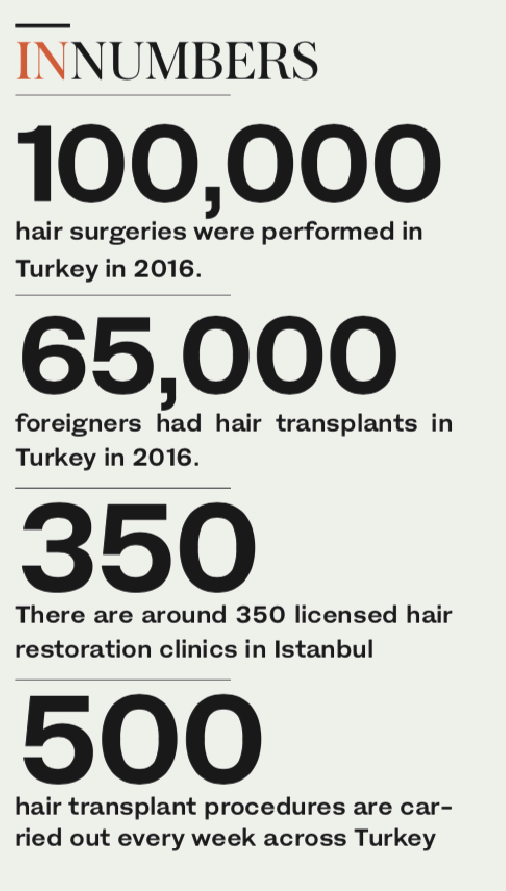
Depending on the type of operation, hair transplants cost between $1,500 and $3,000. Combined with its proximity to the Middle East, all this adds up to making Turkey the destination of choice for balding men from Saudi Arabia, Iraq and Somalia. And men from Europe and the US have also been traveling to have the procedure.
Up to 500 hair transplants are carried out every week across the country. Of the 100,000 or so procedures carried out in Turkey in 2016, 65,000 were on foreign patients.
One of them was Dr. Suheyl Jubara, 42, a Kuwaiti-born dentist of Jordanian origin who has worked in a Turkish state hospital for 21 years. He was intrigued by the Arab men he often saw at the airports with black bandages wrapped around their heads, waiting for their flight home.
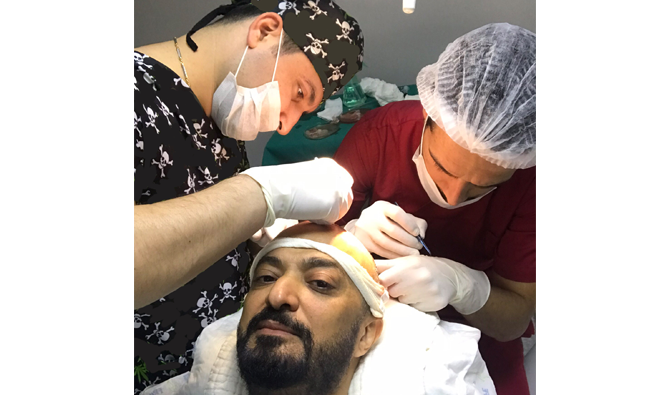
 He began studying hair transplant techniques. “Finally on a cold Ankara morning a few weeks ago, I found myself here at this clinic where the whole staff guided me very well throughout the process,” he said.
Istanbul alone has around 350 licensed hair restoration clinics. Some have branches in other major cities such as Ankara, Izmir and Bursa, the cities most visited by Arab tourists.
One of the biggest, Estetik International, where Dr. Jubara was treated, opened its first overseas branch in Dubai last year.
Follicular transfer
Founded in 1999 by Dr. Bulent Cihantimur, Estetik International uses cutting-edge technology. The most common procedure, known as organic hair transplantation, involves injecting the patient with a chemical mixture that also contains his own fatty tissue and stem cells. This mixture nourishes the scalp, creating prime conditions for transplanted hair to grow. Another procedure, follicular transfer, involves harvesting hair follicles from the back of the patient’s head and inserting them through micro cuts in the bald area. The procedure takes six to eight hours, and is followed by six weeks of vitamin and protein injections. Results show after three to four months.
Dr. Jubara’s follicular transfer was so successful that his brother and brother-in-law were persuaded to come to Turkey to have the same procedure. His own self-confidence improved dramatically, he added.
“I’m still impressed by my before and after pictures. With the happiness I discovered in the new me, I found the love of my life, a Turkish girl. We are getting engaged next week,” he told Arab News. 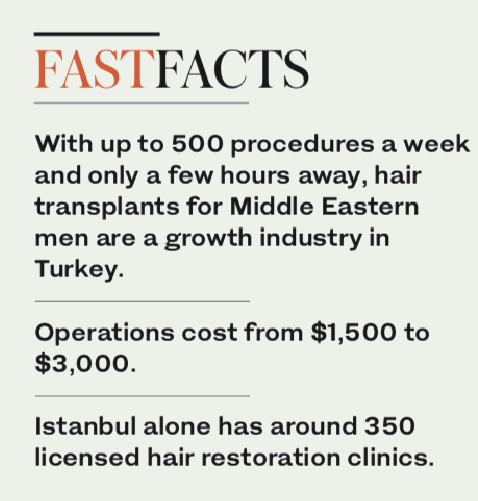
Privacy is another factor, he added. Some clinics offer package deals that include collection from the airport, a private driver and a hotel stay during the after-care period. Many Arab patients take a holiday at one of Turkey’s southern resorts first, then book into a clinic after they’ve sent the family home.
But experts warn that there are reportedly several hundred clinics operating illegally in Istanbul alone. While the transplant industry in Turkey is supposedly regulated, unlicensed clinics are able to attract customers because in a highly competitive market they are invariably cheaper.
However, since they are by nature “underground” setups, they are also less likely to adhere to clinical standards, not least because most do not operate from hospital premises. In short, patients have no way knowing if an unlicensed clinic is safe.
“The operations must be carried out under hospital-standard hygiene conditions and with the guidance of a specialist doctor, otherwise there is always the risk of losing the remaining hair without regaining any hair,” said Makbule Ezmeoglu, director of the Ankara branch of Estetik International told Arab News.
There are other dangers. Last year, an Iraqi-born British citizen was beaten up and robbed by a gang at a so-called hair transplant clinic. The man, who worked for an international money transfer company in London, had booked his treatment on the Internet and flew to Istanbul, where he was met by four people and installed in an upmarket hotel.
Shortly afterwards, two people arrived supposedly to collect him for surgery.
Instead they drove him to a remote part of Istanbul where they tied him up, beat him and stole his money, his mobile phones and two expensive watches. They then threw him out into the street in the early hours. He was so badly hurt that he had to be hospitalized.
His stolen property was recovered after a police investigation.
Ozgur Unlu had a hair transplant 10 years ago when it was relatively new to Turkey and stresses the importance of research before committing to treatment.
“Personally I care very much about my health and my looks, so I had the operation in a very well-known private hospital in Istanbul. I also advised my friends to do the same,” he told Arab News.
“Potential patients should also carry out in-depth research about the current hair transplant techniques that are used in Turkey, and should also examine the clinics and their reputation in the sector, rather than being attracted by the marketing techniques.
“As the Turkish saying goes, the game is not worth the candle. So, one should be careful about the potential health risks in this competitive sector and avoid falling into the trap of the criminal networks that offer lower prices, but higher health risks at the end.”