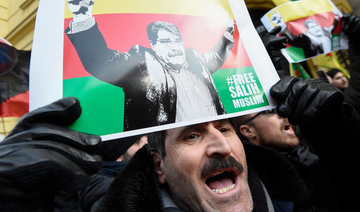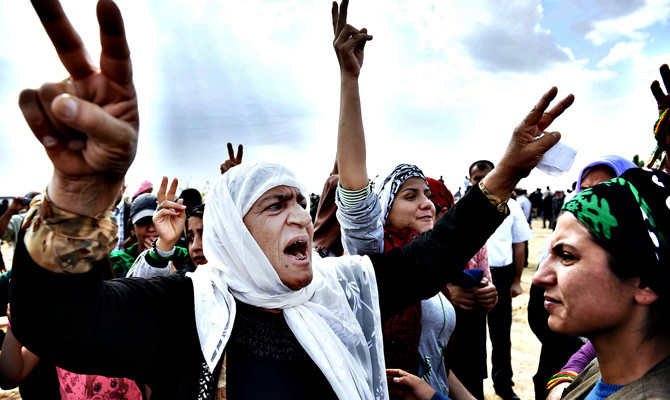

LONDON: The Kurds of northern Syria face an “exponential threat” from Turkey while Western allies in the fight against Daesh remain “silent,” Lloyd Russell-Moyle, a member of Parliament for the UK opposition Labour Party, told Arab News.
Speaking after visiting the Kurdish region of northern Syria this month, he said Kurdish communities in the area “feel abandoned” by the West in a “moment of real need.”
“While we were there, a place we’d been the day before was shelled by Turkey, so these things do go on and they do affect day-to-day lives. People seem genuinely very afraid,” he said.
Traveling via Baghdad and Irbil, before being escorted across the Syrian border by the Kurdish People’s Protection Units (YPG), his delegation, which undertook the visit independently of the Labor Party, witnessed the devastation wreaked by Daesh and Turkish rockets in Kobani and other cities.
The route opened up a few months ago, Russell-Moyle said, creating a “window of opportunity” to “talk to the Kurds about what they were facing” and to “give hope to people that are struggling and are doing an amazing job.”
Describing the democratic, secular, feminist state being established in the Kurdish-controlled area of northern Syria as “impressive,” he said this is the “best” and “only” example of the kind in Syria and that Britain should be helping to rebuild it in the aftermath of the conflict.
During a visit to Qamishli, Lord Glasman, a Labour peer who was part of the delegation, said: “We’re here for a long-term relationship with you, where we can support you against all the people who are trying to destroy your liberty.”
In March, the Turkish military overran the north Syrian city of Afrin following a bloody campaign to oust the YPG from the area. Dozens of Kurdish fighters lost their lives, including 26-year-old British national Anna Campbell, who'd been volunteering with the YPJ, the female arm of the YPG.
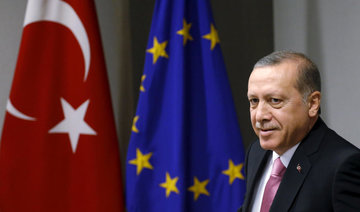
Recep Tayyip Erdogan, Turkish president, has vowed to expand the offensive to other YPG-held areas, citing security concerns in response to US plans to help Kurdish militias create a 30,000-strong “border security force” to defend the Syrian-Turkish border against Daesh.
Turkey views the YPG as an extension of the Kurdistan Workers’ Party (PKK), which it defines as a terrorist organization, following a three-decade battle for Kurdish independence on Turkish soil.
The UK and US, wary of upsetting an important NATO ally, remain reluctant to get involved. A statement released by the US State Department in March said it was “committed to our NATO ally Turkey” with its “legitimate security concerns,” sentiments reiterated by British Foreign Secretary Boris Johnson who insisted: “Turkey has the right to want to keep its borders secure.”
Kurdish forces are “infuriated” by the response, feeling that they have been let down by their allies, commentators said. Kurdish fighters make up the majority of the US-led Syrian Democratic Forces (SDF) fighting against Daesh.
Josh Walker, a British YPG fighter who has since returned to the UK, said: “Kurds have been seeing this as another chapter in their long history of betrayal by major powers; they are especially disappointed considering their major contribution to the near-defeat of ISIS, which was only prevented from being total defeat by Turkish intervention.”
Since the assault on Afrin, the YPG has redeployed hundreds of troops from the frontlines against Daesh to defend the city on the other side of Syria. Turkey’s “increasingly belligerent” position toward the Kurds has thrown up “contradictions” for UK and US foreign policy in Syria, said Robert Lowe, deputy director of the Middle East Center at the London School of Economic and Political Sciences.
“Their overriding priority is to defeat ISIS (Daesh) and associated groups. That’s been hurt by the Turkish invasion and made their continuing operations to defeat ISIS, or clear out what’s left of them, more difficult because the Kurds have had to move resources.
“The US and the UK are only prepared to go so far in their criticism of Turkey,” he said. “They have urged restraint … but also haven’t been as critical as they might have been.”
Russell-Moyle said the UK needed to be “stepping up, not stepping away.” The recent decision taken by Theresa May, UK prime minister, to engage in US-orchestrated airstrikes targeting the Syrian regime’s chemical weapons facilities without parliamentary approval was a “very risky strategy,” he said.
To bring an end to this conflict “we should be building up societies,” he said, and “supporting a civil population that will never allow it to happen again.”
In Rojava, and the cantons of Kobani, Cizre and Afrin, Kurdish communities have embarked on a political project to form the Democratic Federation of Northern Syria, establishing a system of government based on democratic confederalism, ecology and gender equality. Councils set up by local people, have been established, based on equal representation of minority groups in the area.
Elif Gun, from the Kurdistan Students Union in the UK, described a “system of stateless democracy, working from bottom up, with power handed and divided.
“It is the only form of democracy and state that offers real change to the people and gives the power of decision making to the people.”