KARACHI: The World Bank has vowed to safeguard the Indus Waters Treaty by amicably resolving the dispute between Pakistan and India over the construction of Kishanganga Hydroelectric Plant and Ratle Hydroelectric Plant at rivers of Kashmir, a disputed territory.
India is constructing 330-megawatt Kishenganga and 850 megawatts Ratle hydroelectric power plants on the Jehlum and Chenab rivers respectively.
Under the treaty Pakistan has unrestricted access to these two rivers.
Pakistan had recently communicated with the World Bank, which brokered the Indus Waters Treaty back in 1960, asking it to move from the standstill position it has adopted for long over the appointment of neutral experts or Court of Arbitration.
“The Indus Waters Treaty is a profoundly important international agreement that provides an essential cooperative framework for India and Pakistan to address current and future challenges of effective water management to meet human needs and achieve development goals.
“The World Bank continues to work with both countries to resolve the most recent disagreement in an amicable manner and to safeguard the Treaty,” World Bank spokesperson Mariam Sara Altaf told Arab News.
In an interview with Arab News Syed Mehar Ali Shah, Indus Water Commissioner, confirmed that Pakistan has approached the World Bank to “reiterate our position” and both sides are working together on the issue.
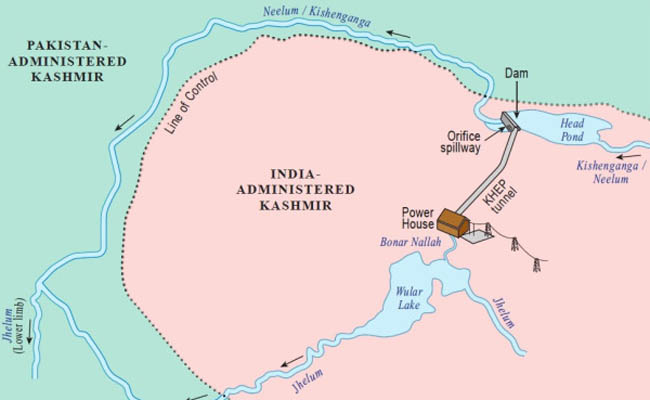
Map of the project
Pakistan believes that India was able to construct projects with “faulty design” due to the inaction over resolving the dispute.
“It means that India has violated the limits set in the treaty by expanding the project,” Sheraz Memon, Additional Commissioner of Indus Water Commission, told Arab News.
Pakistan has been pushing for the Court of Arbitration to intervene while India wants the decision to be taken by a neutral expert.
The disagreement on procedure led the World Bank Group president, Jim Yong Kim, to announce a pause on December 12, 2016 until there is agreement on procedure.
According to the World Bank, its role in relation to “disputes” is limited to the “designation of people to fulfil certain roles when requested by either or both of the parties”.
Sheraz Memon believes that the case could be resolved through the appointment of neutral experts.
Experts believe that the stance adopted by Pakistan is justified, but feel there is a lack of seriousness on the Pakistani side.
“We went to Court of Arbitration very late because there is a clause in the treaty that if the work on any project crosses a certain limit, no party can complain on any design discharge or other matters. Hence we lost the opportunity,” Zulfiqar Halepoto, executive director for the think tank Center for Social Change told Arab News.
He added that “the way we (Pakistan) lost eastern rivers, and the way we are not seriously fighting our case of western rivers, the perception emerged that we are not interested in our waters.”
The Indus Water Treaty was signed on September 19, 1960, by India’s then president Jawaharlal Nehru and Field Marshal Mohammed Ayub Khan, president of Pakistan.