PESHAWAR: Pakistan Tehreek-e-Insaf (PTI) politicians accused by party chairman Imran Khan of selling their votes in Senate elections in March 2018 have denied the allegations, claiming that party bosses are targeting them for political reasons.
“I was part of a 12-member panel of provincial lawmakers who were asked to vote for Fida Mohammed Khan in the Senate polls,” said Nagina Khan, a member of the provincial assembly (MPA) for Khyber Pakhtunkhwa elected to a seat reserved for a woman. “Fida became a senator since all the 12 lawmakers voted for him. Why am I then accused of selling my vote?”
She added that the party had experienced a significant increase in the number of female politicians recently.
“This explains why the PTI leaders are trying to expel some of us since they need to create space to accommodate new people,” she said. “Hence, I was expelled on trumped-up charges.”
Another lawmaker, Naseem Hayat, said Imran Khan should have talked to the 20 named MPAs in person before publicly accusing them of corruption.
“I spent 21 years in this party and I am its oldest activist,” she said. “This is how Imran Khan has rewarded me, by making me wear the medal of imaginary corrupt practices.”
Hayat did not rule out the possibility that some members might have sold their votes, pointing out that the PTI-supported Maulana Sami Ul Haq did not get elected to the upper house of parliament which, she admitted, had put the party in an embarrassing situation. However, she said she was targeted for a different reason.
“I was trying to investigate the embezzlement of funds by the provincial authorities in the Bus Rapid Transit project in Peshawar,” she said. “I was also trying to figure out how the Selfie Bridge, which was recently constructed in the city, developed cracks so easily.”
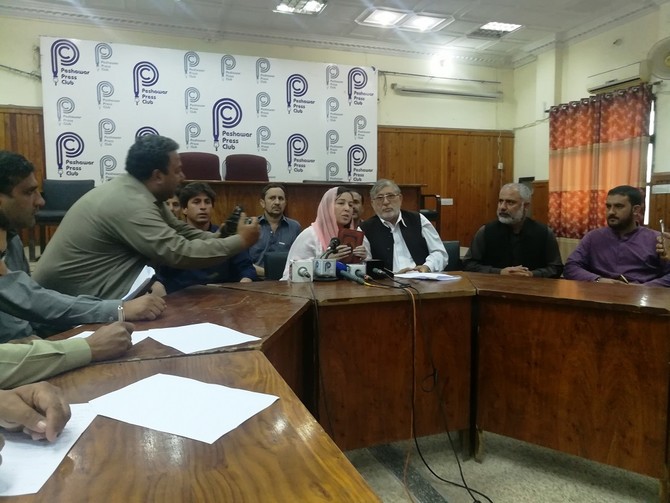
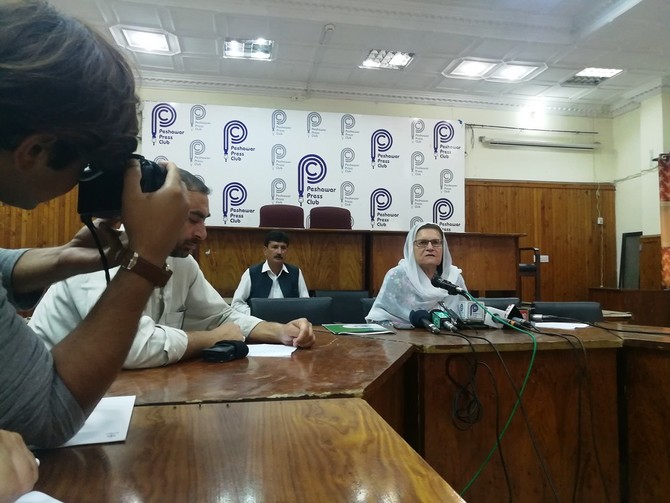
MPA Fauzia Bibi brought the Holy Qur’an to the Peshawar Press Club and swore on it that she did not sell her vote in the elections.
Addressing a news conference, she called on Imran Khan to send the case to the National Accountability Bureau (NAB) to properly investigate which lawmakers had broken the rules.
“Imran Khan once told me that he trusted me so much that he could give me a ticket to contest elections on a general seat for the National Assembly of Pakistan,” she added. “I believe this didn’t go down well with some party leaders who got jealous and conspired against me.”
She said an initial list of accused MPAs did not include her name, but it was added later.
In a separate press conference, MPA Meraj Humayun Khan said she was elected to the provincial assembly as a member of the Qaumi Watan Party, and joined PTI after the Senate elections last month.
“Why have I been targeted, then?” she asked. “I joined the party after the Senate polls. Why has the chief minister included my name in the PTI panel, saying that I didn’t vote for the party’s chosen candidate?”
She said the PTI leadership should have issued notices to the accused MPAs confidentially, then publicly named those who failed to prove their innocence.
“If the chief minister has any proof that I had sold my vote,” she added, “he should produce it and I will accept this allegation.”
PTI’s KP spokesman Shaukat Yousafzai said the allegations had been confirmed by party sources.
“Our party’s internal committee confirmed the allegations before Imran Khan did the news conference,” he said. “Also, the case is now going to the NAB.”
He denied that there had been more than one version of the list of accused MPAs, saying: “There was only one list. The other list being circulated is fake.”


PTI politicians deny party leader’s accusation that they sold their senate votes

PTI politicians deny party leader’s accusation that they sold their senate votes

- Denials comes a day after chairman Imran Khan named 20 lawmakers from Khyber Pakhtunkhwa he said accepted money for votes in recent Senate election
- Some of the accused claim they have been targeted due to power games within the party


US and Mideast countries seek Kyiv’s drone expertise as Russia-Ukraine talks put on ice
KYIV, Ukraine: The United States and its allies in the Middle East are seeking Ukraine's expertise in countering Iran's Shahed drones, according to Ukrainian President Volodymyr Zelenskyy.
Various countries, including the United States, have approached Ukraine for help in defending against the Iranian drones, Zelenskyy said late Wednesday. He said he has spoken in recent days with the leaders of the United Arab Emirates, Qatar, Bahrain, Jordan and Kuwait about possible cooperation.
Russia has fired tens of thousands of Shaheds at Ukraine since it invaded its neighbor just over four years ago, launching a swarm of more than 800 drones and decoys in its biggest nighttime barrage. Iran has responded to joint U.S.-Israeli strikes by launching the same type of drones at countries in the Middle East.
Ukrainian assistance in countering Iranian drones will be provided only if it does not weaken Ukraine's own defenses, and if it adds leverage to Kyiv's diplomatic efforts to stop the Russian invasion, according to the Ukrainian leader.
"We help to defend from war those who help us, Ukraine, bring a just end to the war" with Russia, Zelenskyy said. Later Thursday, Zelenskyy said he had received a U.S. request for support to defend against the drones in the Middle East and had given the order for equipment to be provided along with Ukrainian experts without providing further details.
"Ukraine helps partners who help our security and the protection of our people's lives," he added in a social media post.
Trump, in an interview Thursday with Reuters, said, "Certainly I'll take, you know, any assistance from any country."
Ukraine has battle-tested drone defenses
Ukraine has pioneered the development of cut-price drone killers that cost as little as $1,000, rewriting the air defense rule book and making other countries take notice.
European countries got a wake-up call last September on the changed nature of air defense when Poland scrambled multimillion-dollar military assets, including F-35 and F-16 fighter jets and Black Hawk helicopters, in response to airspace violations by cheap drones.
Ukrainian manufacturers have developed low-cost interceptor drones specifically designed to hunt and destroy Shaheds, and its rapidly expanding drone industry is producing excess capacity.
Zelenskyy announced earlier this year that Ukraine would begin exporting the battle-tested systems.
The European Union's top diplomat, Kaja Kallas, said before chairing a meeting of EU and Gulf foreign ministers via video link Thursday that the talks would look at how Ukraine's experience can help countries counter Iranian drones.
Middle East war delays Russia-Ukraine talks
The Iran war, now in its sixth day, has drawn international attention away from Europe's biggest conflict since World War II, and forced the postponement of a new round of U. S-brokered talks between Russia and Ukraine planned for this week, Zelenskyy said.
Western governments and analysts say the Russia-Ukraine war has killed hundreds of thousands of people, while there is no sign that yearlong U.S.-led peace efforts will stop the fighting any time soon.
"Right now, because of the situation around Iran, there are not yet the necessary signals for a trilateral meeting," Zelenskyy said. "But as soon as the security situation and the overall political context allow us to resume that trilateral diplomatic work, it will be done."
Zelenskyy thanked the United States for the return from Russia on Thursday of 200 Ukrainian prisoners of war. Russia's Defense Ministry also said it received the same number of prisoners from Ukraine and thanked the U.S. and United Arab Emirates for mediating.
Prisoner swaps have been one of the few tangible results of the talks. Vladimir Medinsky, a Russian negotiator, said on social media that a total of 500 prisoners from each side would be exchanged between Thursday and Friday.
Oleksandr Merezhko, the head of Ukraine's parliamentary foreign affairs committee, said Russian President Vladimir Putin is trying to drag out the negotiations so that he can press on with Russia's invasion while escaping further U.S. sanctions.
He urged the U.S. administration to look at the Russia-Ukraine war and the war in the Middle East as linked.
"In reality, Russia and Iran are close allies that act in concert — Iran supplies weapons and Russia helps Iran develop its defense industry. These are interconnected conflicts," Merezhko told The Associated Press.
Ukraine's army has recently pushed back Russian forces at some points along the roughly 1,250-kilometer (750-mile) front line, according to the Institute for the Study of War.
Localized Ukrainian counterattacks liberated more territory than Ukrainian forces lost in the last two weeks of February, the Washington-based think tank said this week, estimating the recovered land at about 257 square kilometers (100 square miles) since Jan. 1.


