LONDON: In a medical first, a French surgeon says he has performed a second face transplant on the same patient — who is now doing well and even spent a recent weekend in Brittany.
Dr. Laurent Lantieri of the Georges Pompidou Hospital in Paris first transplanted a new face onto Jerome Hamon in 2010, when Hamon was in his mid-30s. But after getting ill in 2015, Hamon was given drugs that interfered with the anti-rejection medicines he was taking for his face transplant.
Last November, the tissue in his transplanted face began to die, leading Lantieri to remove it.
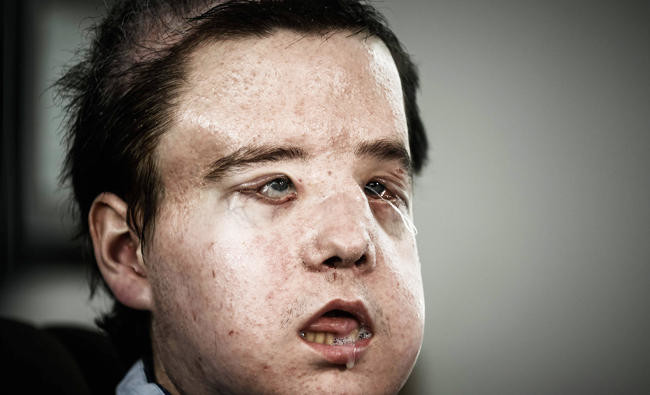
That left Hamon without a face, a condition that Lantieri described as “the walking dead.” Hamon had no eyelids, no ears, no skin and could not speak or eat. He had limited hearing and could express himself only by turning his head slightly, in addition to writing a little.
“If you have no skin, you have infections,” Lantieri told The Associated Press in an interview Tuesday. “We were very concerned about the possibility of a new rejection.”
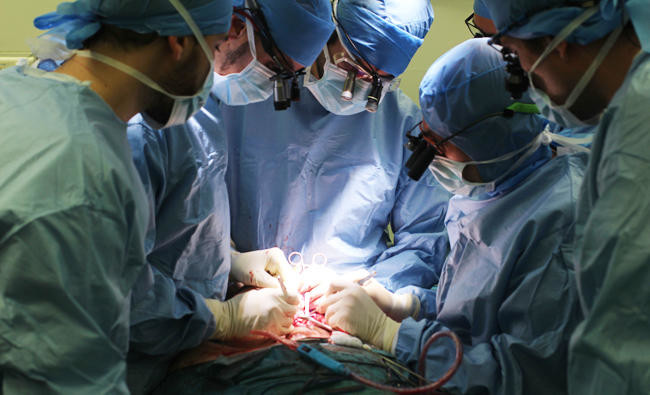
In January, when a second face donor for Hamon became available, Lantieri and his team performed a second face transplant. But before undergoing the second transplant, doctors had to replace all of the blood in his body in a monthlong procedure, to eliminate some potentially worrisome antibodies from previous treatments.
“For a man who went through all this, which is like going through a nuclear war, he’s doing fine,” Lantieri said. He added that Hamon is now being monitored like any other face transplant patient.
Hamon’s first face was donated by a 60-year-old. With his second transplanted face, Hamon said he managed to drop a few decades.
“I’m 43. The donor was 22. So I’ve become 20 years younger,” Hamon joked on French television Tuesday.
Other doctors applauded the French team’s efforts and said the techniques could be used to help critically ill patients with few options.
“The fact that Professor Lantieri was able to save this patient gives us hope that other patients can have a backup surgery if necessary,” said Dr. Frank Papay, of the Cleveland Clinic, who performed the first face transplant in the US
He said the techniques being developed by Lantieri and others could help doctors achieve what he called “the holy grail” of transplant medicine: allowing patients to tolerate tissue transplants from others.
Dr. Bohdan Pomahac of Harvard University, who has done face transplants in the US, said similar procedures would ultimately become more common, with rising numbers of patients.
“The more we see what’s happening with (face transplant) patients, the more we have to accept that chronic rejection is a reality,” Pomahac said. “Face transplants will become essentially non-functional, distorted and that may be a good time to consider re-transplanting.”
He said it’s still unknown how long face transplants might last, but guessed they might be similar to kidneys, which generally last about 10 to 15 years.
“Maybe some patients will get lucky and their faces will last longer. But it will probably be more common that some will have to be replaced,” he said, noting there are still many unknowns about when chronic rejection might occur.
Lantieri said he and his team would soon publish their findings in a medical journal but he hoped cases like Hamon would remain the exception.
“The other patients I’m following, some have had some alteration of their transplant over time, but they are doing fine,” he said. “I hope not to do any future transplants like this.”


Man with 3 faces: Frenchman gets 2nd face transplant



Man with 3 faces: Frenchman gets 2nd face transplant
- Hamon's first face was donated by a 60-year-old
- Lantieri said he and his team would soon publish their findings in a medical journal but he hoped cases like Hamon would remain the exception


Arts festival’s decision to exclude Palestinian author spurs boycott
- A Macquarie University academic who researches Islamophobia and Palestine, Abdel-Fattah responded saying it was “a blatant and shameless act of anti-Palestinian racism and censorship,” with her lawyers issuing a letter to the festival
SYDENY: A top Australian arts festival has seen the withdrawal of dozens of writers in a backlash against its decision to bar an Australian Palestinian author after the Bondi Beach mass shooting, as moves to curb antisemitism spur free speech concerns.
The shooting which killed 15 people at a Jewish Hanukkah celebration at Sydney’s Bondi Beach on Dec. 14 sparked nationwide calls to tackle antisemitism. Police say the alleged gunmen were inspired by Daesh.
The Adelaide Festival board said last Thursday it would disinvite Randa Abdel-Fattah from February’s Writers Week in the state of South Australia because “it would not be culturally sensitive to continue to program her at this unprecedented time so soon after Bondi.”
FASTFACTS
• Abdel-Fattah responded, saying it was ‘a blatant and shameless act of anti-Palestinian racism and censorship.’
• Around 50 authors have since withdrawn from the festival in protest, leaving it in doubt, local media reported.
A Macquarie University academic who researches Islamophobia and Palestine, Abdel-Fattah responded saying it was “a blatant and shameless act of anti-Palestinian racism and censorship,” with her lawyers issuing a letter to the festival.
Around 50 authors have since withdrawn from the festival in protest, leaving it in doubt, local media reported.
Among the boycotting authors, Kathy Lette wrote on social media the decision to bar Abdel-Fattah “sends a divisive and plainly discriminatory message that platforming Australian Palestinians is ‘culturally insensitive.'”
The Adelaide Festival said in a statement on Monday that three board members and the chairperson had resigned. The festival’s executive director, Julian Hobba, said the arts body was “navigating a complex moment.”
a complex and unprecedented moment” after the “significant community response” to the board decision.
In the days after the Bondi Beach attack, Jewish community groups and the Israeli government criticized Prime Minister Anthony Albanese for failing to act on a rise in antisemitic attacks and criticized protest marches against Israel’s war in Gaza held since 2023.
Albanese said last week a Royal Commission will consider the events of the shooting as well as antisemitism and social cohesion in Australia. Albanese said on Monday he would recall parliament next week to pass tougher hate speech laws.
On Monday, New South Wales state premier Chris Minns announced new rules that would allow local councils to cut off power and water to illegally operating prayer halls.
Minns said the new rules were prompted by the difficulty in closing a prayer hall in Sydney linked to a cleric found by a court to have made statements intimidating Jewish Australians.
The mayor of the western Sydney suburb of Fairfield said the rules were ill-considered and councils should not be responsible for determining hate speech.
“Freedom of speech is something that should always be allowed, as long as it is done in a peaceful way,” Mayor Frank Carbone told Reuters.


