France’s Macron to push EU lawmakers on reforms

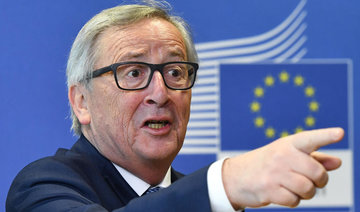
French President Emmanuel Macron will travel to Berlin for crucial talks with German Chancellor Angela Merkel to try to win her support for his plans for the future of the eurozone. (AFP)
Updated 17 April 2018
Follow

France’s Macron to push EU lawmakers on reforms

  • EU leaders are set to adopt preliminary Macron-backed plans for eurozone reforms and for an overhaul of its troubled asylum system in June

STRASBOURG, France: French President Emmanuel Macron will on Tuesday address the European Parliament for the first time in a bid to shore up support for his ambitious plans for post-Brexit reforms of the EU.
The energetic young French leader wants big changes in the face of growing skepticism about the European project, but there has been a marked lack of enthusiasm from Berlin to Budapest.
Macron’s speech to MEPs in the eastern French city of Strasbourg is part of a charm offensive ahead of European Parliament elections in May 2019, the first after Britain’s departure.
“He will say that it is urgent to take action at a difficult time both inside the European Union, and outside,” said the Elysee, the French presidency, ahead of Macron’s address.
Internal problems include election results in Italy and Hungary which both saw euro skeptics surge in popularity, compounding fears that the 2016 Brexit vote was part of a pattern.
Externally the EU is dealing with the war in Syria — France and Britain joined the US in air strikes targeting the regime’s alleged chemical weapons at the weekend — a hostile Russia, and the unpredictable figure of Donald Trump in the United States.
Macron said in a television interview on Sunday that Europe was experiencing a “rise in illiberalism... the populism of people who call the rule of law into question.”
Later this week Macron will travel to Berlin for crucial talks with German Chancellor Angela Merkel to try to win her support for his plans for the future of the eurozone.
Merkel’s conservative CDU party pushed back on Monday against plans for deeper eurozone integration, including a separate eurozone budget and the expansion of the EU’s bailout fund.
Any reforms have to be “in the European and in the German interest,” CDU secretary-general Annegret Kramp-Karrenbauer told reporters.
EU leaders are set to adopt preliminary Macron-backed plans for eurozone reforms and for an overhaul of its troubled asylum system in June, but there is still a large amount of work to do.
Merkel is due to address the European Parliament in November, officials said on Monday.
In contrast, Merkel made a joint speech with then-French president Francois Hollande in Strasbourg in 2015 in which they urged unity in the face of the migrant crisis.
European lawmakers welcomed Macron’s decision to address the parliament but urged him to turn words into action as soon as possible.
Macron had “lots of projects for Europe” but “not everything he has proposed has been well received,” said Manfred Weber, a Merkel ally who heads the center-right European People’s Party, the biggest group in the European Parliament.
He added that it was a “handicap” that Macron — who rose to power on the back of his new En Marche party — did not belong to any of the main political groups in the European Parliament.


Top UN court to hear Rohingya genocide case against Myanmar

Updated 6 sec ago
Follow

Top UN court to hear Rohingya genocide case against Myanmar

THE HAGUE: Did Myanmar commit genocide against its Rohingya Muslim minority? That’s what judges at the International Court of Justice will weigh during three weeks of hearings starting Monday.
The Gambia brought the case accusing Myanmar of breaching the 1948 Genocide Convention during a crackdown in 2017.
Legal experts are watching closely as it could give clues for how the court will handle similar accusations against Israel over its military campaign in Gaza, a case brought to the ICJ by South Africa.
Hundreds of thousands of Rohingya Muslims fled violence by the Myanmar army and Buddhist militias, escaping to neighboring Bangladesh and bringing harrowing accounts of mass rape, arson and murder.
Today, 1.17 million Rohingya live crammed into dilapidated camps spread over 8,000 acres in Cox’s Bazar in Bangladesh.
From there, mother-of-two Janifa Begum told AFP: “I want to see whether the suffering we endured is reflected during the hearing.”
“We want justice and peace,” said the 37-year-old.

’Senseless killings’

The Gambia, a Muslim-majority country in West Africa, brought the case in 2019 to the ICJ, which rules in disputes between states.
Under the Genocide Convention, any country can file a case at the ICJ against any other it believes is in breach of the treaty.
In December 2019, lawyers for the African nation presented evidence of what they said were “senseless killings... acts of barbarity that continue to shock our collective conscience.”
In a landmark moment at the Peace Palace courthouse in The Hague, Nobel Peace laureate Aung San Suu Kyi appeared herself to defend her country.
She dismissed Banjul’s argument as a “misleading and incomplete factual picture” of what she said was an “internal armed conflict.”
The former democracy icon warned that the genocide case at the ICJ risked reigniting the crisis, which she said was a response to attacks by Rohingya militants.
Myanmar has always maintained the crackdown by its armed forces, known as the Tatmadaw, was justified to root out Rohingya insurgents after a series of attacks left a dozen security personnel dead.

‘Physical destruction’

The ICJ initially sided with The Gambia, which had asked judges for “provisional measures” to halt the violence while the case was being considered.
The court in 2020 said Myanmar must take “all measures within its power” to halt any acts prohibited in the 1948 UN Genocide Convention.
These acts included “killing members of the group” and “deliberately inflicting on the group conditions of life calculated to bring about its physical destruction in whole or in part.”
The United States officially declared that the violence amounted to genocide in 2022, three years after a UN team said Myanmar harbored “genocidal intent” toward the Rohingya.
The hearings, which wrap up on January 30, represent the heart of the case.
The court had already thrown out a 2022 Myanmar challenge to its jurisdiction, so judges believe they have the power to rule on the genocide issue.
A final decision could take months or even years and while the ICJ has no means of enforcing its decisions, a ruling in favor of The Gambia would heap more political pressure on Myanmar.
Suu Kyi will not be revisiting the Peace Palace. She has been detained since a 2021 coup, on charges rights groups say were politically motivated.
The ICJ is not the only court looking into possible genocide against the Rohingya.
The International Criminal Court, also based in The Hague, is investigating military chief Min Aung Hlaing for suspected crimes against humanity.
Another case is being heard in Argentina under the principle of universal jurisdiction, the idea that some crimes are so heinous they can be heard in any court.