King Salman, Pakistan PM discuss regional security

1 / 2
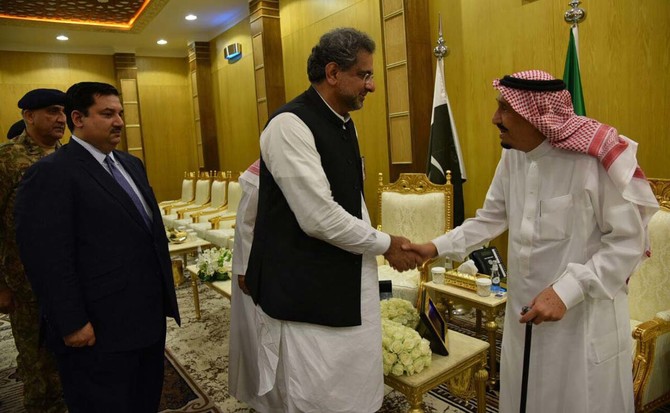
King Salman receives Pakistan Prime Minister Shahid Khaqan Abbasi in Alkhobar on Monday.
2 / 2
King Salman receives Pakistan Prime Minister Shahid Khaqan Abbasi in Alkhobar on Monday.
Updated 16 April 2018
Follow

King Salman, Pakistan PM discuss regional security

  • The prime minister is accompanied by Defense Minister Khurram Dastgir Khan and army chief Gen. Qamar Javed Bajwa
  • The prime minister witnessed the closing ceremony of Gulf Shield-1 exercise

ISLAMABAD: Prime Minister Shahid Khaqan Abbasi met King Salman during the closing ceremony of the 24-nation joint military exercise, Gulf Shield-1, on Monday.

The prime minister, along with Defense Minister Khurram Dastgir Khan and Chief of Army Staff Gen. Qamar Javed Bajwa, is on a two-day official visit to the Kingdom to witness the joint tri-services military exercises on the east coast of Saudi Arabia.

The month-long joint military exercise aimed at strengthening military and security cooperation and coordination among regional countries concluded on Monday.

During his meeting with  King Salman, Prime Minister Abbasi discussed matters of mutual interest and regional security.

Earlier, Pakistan’s top political and military leadership was received at the King Abdul Aziz Air Force Base by Eastern Province Gov. Prince Saud bin Naif.

Members of the visiting delegation held talks with the governor and other Saudi officials on a wide range of significant issues.

Pakistan and Saudi Arabia enjoy close brotherly relations. The relationship draws its strength from religious and cultural affinities, mutual trust, and a shared vision of peace and security on regional as well as on international levels.

Troops of the Pakistan Army, the Pakistan Air Force, C-130 aircraft, JF-17 Thunder Fighter jets, Pakistan Navy ships, and commandos from Special Services Group also participated in Gulf Shield-1.

The exercise is considered the largest military drill in the region in terms of diversity of troops, weapon systems, and operational maneuvering.

It aimed at raising the level of preparedness, improving mutual coordination and cooperation among the participating countries, along with the exchange of expertise and security integration.

Along with King Salman,  Prime Minister Abbasi and other leaders of the participating countries, witnessed the exercise.


Pakistan to invest $1 billion in AI by 2030 in push to modernize economy

Updated 5 sec ago
Follow

Pakistan to invest $1 billion in AI by 2030 in push to modernize economy

  • PM says government will introduce AI curriculum in schools nationwide
  • The transformation plan will help train 1 million non-IT professionals in AI

ISLAMABAD: Prime Minister Shehbaz Sharif on Monday announced that Pakistan would invest $1 billion in artificial intelligence (AI) by 2030, in a major step to modernize the South Asian nation’s digital economy.

Pakistan, a country of 240 million people, seeks to become a key participant in the global AI economy, amid growing interest from governments in the Global South to harness AI for productivity, skills development and innovation.

The South Asian nation has been actively developing its AI landscape and approved its National AI Policy in July last year, which was followed by the launch of the country’s sovereign AI cloud and a startup fund.

Speaking at the launch of the Indus AI Week 2026 in Islamabad, Sharif unveiled a multi-pronged roadmap intended to transform Pakistan from a provider of IT technicians into a global hub for AI expertise.

“I am pleased to announce that the Government of Pakistan is committed to invest $1 billion in AI by 2030, which will go a long way in building AI ecosystem in our country,” he told policymakers and international tech experts at Islamabad’s Jinnah Convention Center.

Sharif detailed several flagship initiatives to support this transformation, including a sweeping educational reform, at the event organized by the Information Technology (IT) Ministry, which will be running until Feb. 15, featuring strategic dialogues on sovereign AI and technical showcases.

“AI curriculum will be introduced not only in all federally controlled or run schools, but also in all schools of AJK, that is Azad Jammu and Kashmir, and Gilgit-Baltistan, as well as remote parts of Balochistan,” he said.

The government will provide 1,000 fully funded PhD scholarships in AI to postgraduates to bolster high-level research, according to the PM. It plans to launch a nationwide program to train 1 million “non-IT professionals in AI skills” to enhance productivity and improve livelihoods across traditional sectors of the economy.

Sharif emphasized that the focus would remain on high-impact sectors, including agriculture, mines and minerals, and the empowerment of Pakistan’s youth which makes up 60 percent of its 240 million population.

“We will, God willing, bring in programs to transform them from IT technicians to AI experts, which will lead to our agriculture production in terms of its yield, its quality, its efficiency, like never before,” he said.

Drawing parallels to previous digitization efforts in the Punjab province, such as land record digitization and the establishment of the first IT university in Lahore, Sharif framed the AI push as a “gamechanger” for national governance. He noted the Federal Board of Revenue is already undergoing a digital overhaul to curb smuggling and tax evasion.

“Pakistan is absolutely ready to accept the challenge and walk with our global partners absolutely with great commitment and dedication,” he said. “Our commitment is solid, unwavering. We will never look back.”