Palestine and Iran: Arab leaders declare their top priorities

1 / 3
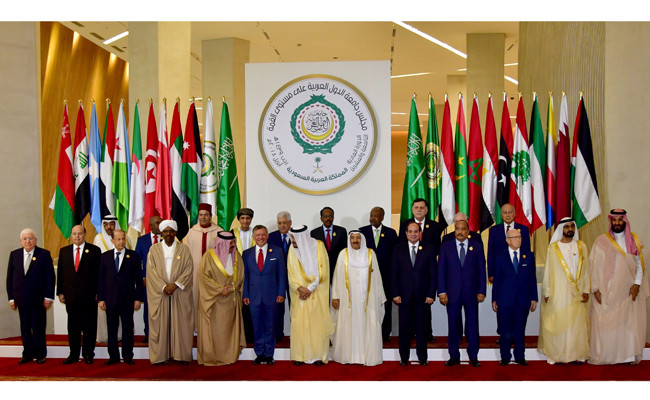
Arab League leaders pose for a family photo during the 29th Arab League Summit in Dhahran, Saudi Arabia, on April 15, 2018. (Saudi Royal Palace photo/Bandar Al-Jaloud)
2 / 3
King Salman criticized the US decision to transfer its embassy in Israel to Jerusalem as Arab leaders met in Dhahran for the annual summit. (Reuters)
3 / 3
Saudi King Salman (C) welcoming UAE's Vice President Mohammed bin Rashid Al-Maktoum (L) ahead of the 29th Arab League Summit in Dhahran. (Saudi Royal Palace photo/Bandar Al-Jaloud)
Updated 16 April 2018
Follow

Palestine and Iran: Arab leaders declare their top priorities

  • Houthi militias blamed for continuous war and suffering in Yemen
  • Iran’s blatant interference in affairs of Arab countries condemned

DHAHRAN, Saudi Arabia: Leaders gathered at the Arab summit stressed the centrality of the Palestinian cause and their support for the Palestinian people in their struggle to have an independent state with East Jerusalem as its capital.

The leaders also stressed the importance of uniting Arab efforts in the fight against terrorism and to confront Iran’s expansionist ambitions in the Arab region.

In his opening remarks, King Salman named the current Arab League Summit the “Jerusalem Summit” in solidarity with the Palestinian people.

He also announced the dedication of $50 million to UNRWA and $150 million to the Islamic Endowment Support Program in Jerusalem, saying: “The Palestinian issue will remain our top issue until all Palestinians get their legal right to establish an independent state with Jerusalem as its capital.

“As we reiterate our condemnation and rejection of the American administration’s decision concerning Jerusalem, we commend the international consensus that rejects it, and we affirm that East Jerusalem is an inalienable part of the Palestinian territory.

“On Yemen, we affirm our commitment to Yemen’s unity, sovereignty, independence, security and territorial integrity.

“We hold the terrorist Iranian-allied Houthi militants fully responsible for the continuous war and suffering in Yemen. We welcome the UN’s statement that denounced the launching of the 119 Iranian-made ballistic missiles by the Houthi militants toward Saudi cities, three of which were targeting Makkah, proving to the international community once again the dangers of Iranian behavior in the region, its violation of the principles of international law and its disrespect of the values, ethics and principles of good neighborliness, and we call for a decisive UN position on this issue.”

King Salman added: “One of the most serious challenges facing our world today is the challenge of terrorism that has allied with extremism and sectarianism to produce internal conflicts that have affected many Arab countries. We renew our strong condemnation of Iran’s terrorist acts in the Arab region and reject its blatant interference in the affairs of Arab countries.

“Based on our belief that the Arab national security is an integral and indivisible system, we have presented you with an initiative to deal with the challenges facing the Arab countries under the title ‘Strengthening Arab National Security to Face Common Challenges,’ stressing the importance of developing the Arab League and its system.”

Jordan’s King Abdullah II said his country made every effort during its presidency of the Arab Summit, and in coordination with Arab leaders, to face the historical challenges of the Arab nation and harness all possibilities and international relations to serve the just causes of our Arab nation, especially the Palestinian cause and Holy Jerusalem.

King Abdullah praised the “positive developments and the victory that the Iraqi brothers achieved against Daesh terrorist organization ... we emphasize the need to complement the military victory with a political process that involves all components of the brotherly Iraqi people.”

Palestinian President Mahmoud Abbas called for the adoption and support of the peace plan he put forward last February in the UN Security Council, which is based on the Arab initiative. It calls for convening an international peace conference in 2018 and for the admission of the State of Palestine as a full member of the UN.

Abbas added: “The current US administration broke international laws by its decision to recognize Jerusalem as the capital of Israel, and has made itself a party to the conflict instead of a mediator for its solution, making talk of a US peace plan untenable.”

Abbas stressed that the Palestinian side never refused to engage in negotiations and that “it responded to all the initiatives that were presented, and worked with the international quartet and all successive US administrations down to the current one. We met with President Trump several times and waited [for the current administration] to present its plan for peace, but its recent decision constituted a major setback which was rejected by the majority of the world.”

Egyptian President Abdel Fattah El-Sisi affirmed absolute confidence in the wisdom of King Salman in supporting the joint Arab action mechanism, stressing that some regional countries are trying to establish areas of influence in the Arab countries.

As for the Yemeni crisis, El-Sisi said that Egypt is committed to working toward achieving a political solution in Yemen, stressing that Egypt would not tolerate the bombing of Saudi Arabia by some Yemeni elements. El-Sisi added that the army of a foreign state is currently present on the territories of two Arab countries.


Saudi Arabia launches key projects at World Defense Show in Riyadh

Updated 09 February 2026
Follow

Saudi Arabia launches key projects at World Defense Show in Riyadh

  • Defense Minister Prince Khalid bin Salman unveils initiatives
  • New firms set up and deals inked at event running to Feb. 12  

RIYADH: Defense Minister Prince Khalid bin Salman unveiled new initiatives and signed several agreements on the opening of the third World Defense Show in Riyadh on Sunday.

Prince Khalid opened the show on behalf of Crown Prince Mohammed bin Salman, the Saudi Press Agency reported.

Organized by the General Authority for Military Industries, the five-day event will run until Feb. 12, showcasing the Kingdom’s rapid strides toward strategic independence and technological leadership in the defense sector.

The 2026 edition features a purpose-built venue with a 2,700-meter runway for live air and land demonstrations, underscoring the show’s status as a premier global defense event.

The GAMI’s Gov. Ahmad Al-Ohali said the show reflects Saudi Arabia’s commitment to localizing over 50 percent of military spending in line with Vision 2030, and fostering an integrated ecosystem where government bodies and international partners collaborate on innovation.


The event brings together official delegations, government entities, and leading international companies specializing in the defense and security sectors. (SPA)

Strategic agreements and major launches

At the Saudi Arabian Military Industries Group pavilion, Prince Khalid launched several key initiatives.

  • New entities: The inauguration of the SAMI Land Co., SAMI Autonomous Co., and the SAMI Land Industrial Complex.
  • Supply chain: The unveiling of the SAMI Local Content Program and the HEET Program.
  • International cooperation: A memorandum of understanding was signed between the Saudi General Authority for Defense Development and the Korean Agency for Defense Development on advanced military research.
  • Defense deals: The minister signed cooperation agreements with Slovakia, Malaysia, and Somalia.
Defense Minister Prince Khalid signed cooperation agreements with Slovakia, Malaysia, and Somalia. (SPA)


Technological debuts and innovations

The show is also serving as a launchpad for cutting-edge security technologies across various government sectors.

  • AI-Powered Lucid Gravity: Public Security debuted its advanced Lucid Gravity electric security vehicle at the Ministry of Interior’s pavilion.

The vehicle integrates state-of-the-art artificial intelligence and specialized security equipment designed to accelerate emergency response times and support field operations.

Public Security’s advanced Lucid Gravity electric security vehicle is displayed at the Ministry of Interior’s pavilion. (SPA)

By leveraging predictive intelligence and advanced command-and-control systems, the Lucid Gravity exemplifies the ministry’s commitment to protecting the Kingdom.

  • Smart helmet: Also at the Ministry of Interior’s pavilion, the General Directorate of Civil Defense unveiled its smart helmet.

Designed to revolutionize public safety and emergency response, the helmet features day-and-night cameras and specialized sensors to detect hazardous materials in hard-to-reach locations.

The device serves as a mobile command node, delivering live video feeds directly to command-and-control centers. By enabling real-time data analysis and faster decision-making, the helmet reduces response times and enhances personnel safety in high-risk environments.


The smart helmet features day-and-night cameras and specialized sensors to detect hazardous materials in hard-to-reach locations. (SPA)


  • Border security: The General Directorate of the Border Guard showcased an integrated security system featuring radar and thermal cameras capable of detecting drones and classifying moving targets to protect critical infrastructure.

It also functions as an early warning system for critical facilities and border areas and is fully integrated with command-and-control systems.


Border Guard's ntegrated security system features radar and thermal cameras capable of detecting drones and classifying moving targets to protect critical infrastructure. (SPA)
  • Counter-terrorism: The Islamic Military Counter Terrorism Coalition presented a comprehensive framework integrating intellectual, media, and military domains to combat extremism and terror financing.

    Visitors were briefed on specialized programs designed to raise the readiness of national personnel and foster sustainable institutional cooperation among member states to combat extremism.

    On the event’s opening day, the pavilion hosted high-level delegations, including ministers, military leaders, and ambassadors who reviewed and praised the coalition’s pivotal role in coordinating local and international security efforts.

    A view of the Islamic Military Counter Terrorism Coalition pavilion. (SPA)
  • Meteorology: The National Center for Meteorology displayed advanced weather systems essential for ensuring the safety of the event’s air shows and military operations.

    At its dedicated pavilion, the NCM is showcasing its latest advanced meteorological technologies and systems. These solutions serve both the military and civilian sectors, providing accurate data to support beneficiary entities’ operational processes.

World Defense Show CEO Andrew Pearcey said that participation is expected to surpass previous records, reflecting the event’s growing importance on the international stage.

NCM's latest meteorological technologies and systems serve both the military and civilian sectors