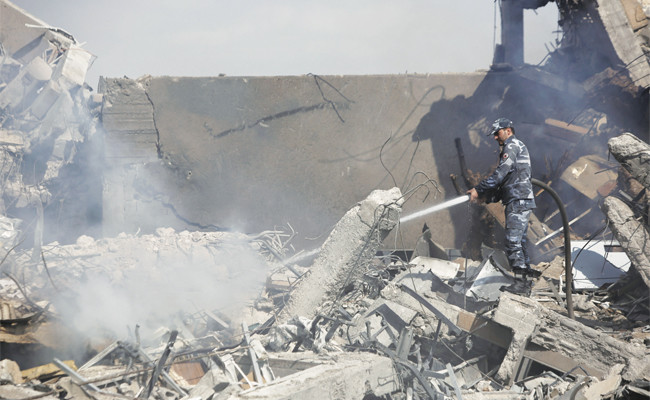


WASHINGTON: While describing Saturday's missile strikes in Syria as a "mission accomplished," US President Donald Trump warned that America and its allies would not hesitate to take further action should the "barbaric" Assad regime use chemical weapons again on its foes.
“We are prepared to sustain this response until the Syrian regime stops its use of prohibited chemical agents,” the US president said in a televised address.
US, British and French forces hit Syria with more than 100 missiles in the early hours of Saturday in the first coordinated Western strikes against the Damascus government, targeting what they said were chemical weapons sites in retaliation for a suspected poison
gas attack.
In a statement from the White House, Trump said the three allies had “marshaled their righteous power against barbarism and brutality”. Later he tweeted: “Mission accomplished.”
His choice of words recalled a similar claim associated with President George W. Bush following the US-led invasion of Iraq. Bush addressed sailors aboard a ship in May 2003 alongside a “Mission Accomplished” banner, just weeks before it became apparent that Iraqis had organized an insurgency that tied down US forces for years.
The Syria strikes represent a major escalation in the West’s confrontation with President Bashar Assad’s superpower ally Russia, but is unlikely to alter the course of a multi-sided war that has killed at least half a million people in the past seven years. That, in turn, raises the question of where Western countries go from here, after a volley of missile strikes denounced by Damascus and Moscow as both reckless and pointless.
There were no immediate reports of casualties and Damascus’ allies said the buildings hit had been evacuated in advance.
Russia had promised to respond to any attack on its ally and said on Saturday that Syrian air defenses had intercepted 71 of the 105 missiles fired. But the Pentagon said the US had “deconfliction” contacts with Russia before and after the strikes, that Syrian air defense systems had been largely ineffective, and there was no indication that Russian systems had been employed.
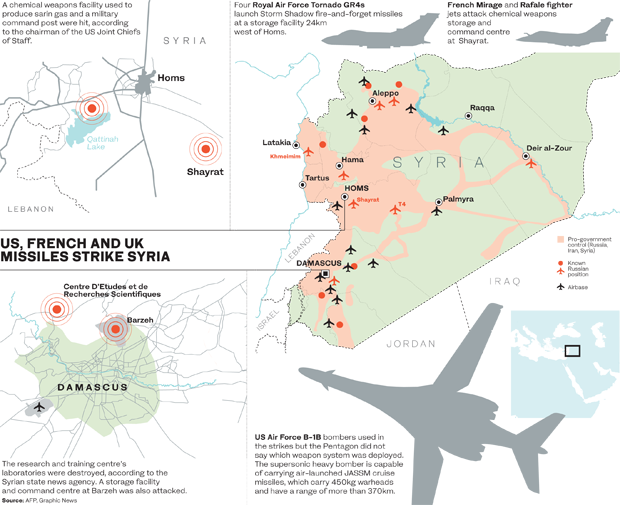
Washington described its targets as a center near Damascus for the research, production and testing of chemical and biological weapons, a chemical weapons storage site near the city of Homs, and another site near Homs that stored chemical weapons equipment and housed a command post.
US Defense Secretary Jim Mattis called the strikes a “one-time shot,” although Trump raised the prospect of further strikes if Assad’s government used chemical weapons again.
The Pentagon said there had been chemical weapons agents at one of the targets, and that although there were other parts to Syria’s chemical weapons system, the strikes had significantly limited its ability to produce such weapons.
Russian President Vladimir Putin called for a meeting of the UN Security Council to discuss what Moscow decried as an unjustified attack on a sovereign state.
Inspectors from the global chemical weapons watchdog the Organization for the Prohibition of Chemical Weapons were due to visit Douma later on Saturday to inspect the site of the suspected gas attack on April 7. Moscow condemned the Western states for refusing to wait for their findings.
Russia, whose relations with the West have deteriorated to levels of Cold War-era hostility, has denied any gas attack took place and even accused Britain of staging the assault to whip up anti-Russian hysteria.
But despite responding outwardly with fury to Saturday’s attack, Damascus and its allies also made clear that they considered it a one-off, unlikely to seriously harm Assad. A senior official in a regional alliance that backs Damascus told Reuters the sites that were targeted had been evacuated days ago after a warning from Russia.
In Douma, site of the suspected gas attack, the last buses were due on Saturday to transport rebels and their families who agreed to surrender the town, state TV reported. That effectively ends all resistance in the suburbs of Damascus known as Eastern Ghouta, marking one of the biggest victories for Assad’s government of the entire war.
Russian and Iranian military help in the past three years has let Assad crush the rebel threat to topple him.
The US, Britain and France have all participated in the Syrian conflict for years, arming rebels, bombing Daesh fighters and deploying troops on the ground to fight the extremists. But they have refrained from targeting Assad’s government, apart from a volley of US missiles last year.
The Pentagon said on Saturday that US strikes in Syria overnight had successfully hit every target and significantly limited Assad’s ability to produce chemical weapons.
Although the operation was secretly unfolding for hours before the first impact, the strike by 105 precision-guided missile on three Syrian chemical weapons targets lasted only minutes, officials said.
Marine Lt. Gen. Kenneth McKenzie, director of the Joint Staff, rejected assertions from Russia and Syria that scores of the Western missiles were shot down. He said Russian air defenses did not fire, while Syrian air defenses were ineffective against an attack from multiple directions involving not only US, British and French aircraft but also US naval destroyers, a cruiser and French frigate and even a US submarine.
The Syrian air defenses missed the incoming missiles and kept firing even after the last US, British and French strikes were complete.
Some of the 40 Syrian missile interceptors might have hit civilian targets, he said.
Pentagon spokeswoman Dana White warned that Russia was attempting to sow confusion about the attack. “The Russian disinformation campaign has already begun. There has been a 2,000 percent increase in Russian trolls in the past 24 hours,” she said.
The prime target of the operation was the Barza Research and Development Center in the greater Damascus area, which McKenzie said was “one of the most heavily defended aerospace areas in the world.”
Barza took the brunt of the attack, with 57 Tomahawk cruise missiles and 19 Joint Air-to-Surface Standoff missiles.
Before sunrise on Saturday, loud explosions jolted Damascus and the sky turned orange as Syrian air defense units fired surface-to-air missiles in response to three waves of military strikes.
Associated Press reporters saw smoke rising from east Damascus and what appeared to be a flame lighting up the sky. From a distance, US missiles hitting suburbs of the capital sounded like thunder.
Shortly after the one-hour attack ended, vehicles with loudspeakers took to the streets of Damascus blaring nationalist songs.
The decision to strike, after days of deliberations, marked Trump’s second order to attack Syria.
He authorized a barrage of Tomahawk cruise missiles to hit a single Syrian airfield in April 2017 in retaliation for Assad’s use of sarin gas against civilians.