

After seven years of suffering, US-led raids crush Assad’s deadly arsenal

1 / 2
A badly injured survivor of a chemical weapons attack in the opposition-held Eastern Ghouta area of Damascus. Reuters
2 / 2
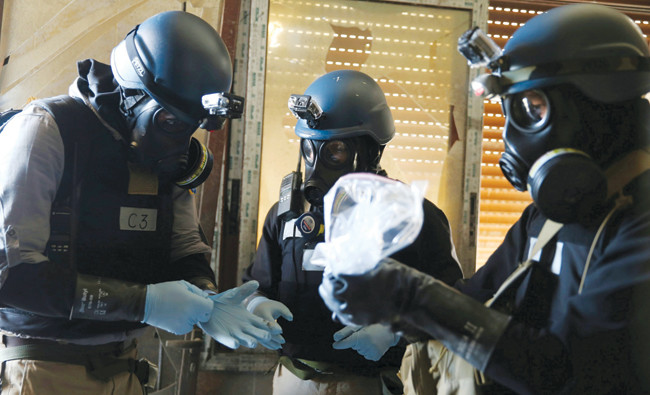
UN inspectors hold a bag containing testing samples from the site of an alleged chemical attack in Ain Tarma. Reuters
Updated 15 April 2018
Follow

After seven years of suffering, US-led raids crush Assad’s deadly arsenal

LONDON: The US military on Saturday insisted its missile strikes against three targets in Syria had dealt a “severe blow” to Bashar Al-Assad’s ability to produce chemical weapons.
American cruise missiles flattened a research center on the edge of Damascus and destroyed another site used as a command center and storage facility in the Syrian capital. French and British jets destroyed a facility near Homs and another at Shayrat.
The strikes significantly limited Assad’s ability to produce chemical weapons, Lt. Gen. Kenneth McKenzie, director of the US military’s Joint Staff said, adding it would set back the regime’s ability to produce such weapons “for years.”
His confidence in the success of the mission and the assertion that the targets were the “heart” of the Syrian chemical weapons program, raised a broader question that goes to the core of the failure of Western policy on the conflict: How has the Syrian president been allowed to get away with repeatedly using poisoned gas on his own people?
Barack Obama first set his “red line” on the use of chemical weapons in 2012. When that line was crossed in August 2013, a doomed attempt was launched by UN experts to rid the country of Al-Assad’s chemical weapons stockpiles.
The futility of that exercise was fully exposed when dozens more died from symptoms similar to that caused by sarin, after an air raid on Khan Sheikhoun in Idlib province last year. Keen to act decisively in the way his predecessor had failed, Donald Trump ordered missile strikes on an airbase that were little more than a rap on the knuckles for the Syrian government.

Stockpiles
The ineffective policies of the two administrations were highlighted again in Douma last week with the all-too-familiar images of Syrian infants gasping for breath. Assad stands accused of the third major chemical weapons attack unleashed during the seven-year conflict, and countless reports of lower-level use of chemicals against civilians.
The Pentagon said yesterday that the missile strikes last year that damaged aircraft, hangars, and runways at the Shayrat airbase had targeted the “means of delivery”, while this time around they had gone after the main facilities of the program.

“I would say there is still a residual element of the Syrian program that’s out there,” McKenzie said. “I’m not going to say that they’re going to be unable to continue to conduct a chemical attack in the future. I suspect, however, they’ll think long and hard about it.”
Karl Dewey, an expert on chemical, biological and nuclear assessments at defense Jane’s by IHS Markit, said it remained to be seen if the strikes would deter the future use of chemical weapons.
“The US strike last April did not provide a consistent response to the on-going allegations and failed to deter chemical attacks,” he said.
Syria began stockpiling chemical weapons in the early 1970s, according to US assessments. With the help of the Soviet Union, Damascus started to gather the knowledge and materials to develop its own weapons in the 1980s.
Before the uprising against Al-Assad in 2011, the Syrian Scientific Studies and Research Centre was believed to operate at least four manufacturing plants for chemical agents, and dozens of storage facilities were built across the country.

Rocket attack
In 2012, Israel accused Syria of having one of the world’s largest chemical weapons stockpiles, including sulfur, mustard, sarin and VX nerve agents.
A French military assessment from 2013 said Assad had a vast array of weapons systems that could deliver the chemicals. The section of the military responsible was the highly loyal “Branch 450” from the same Allawite religion as the president.
Syria’s horrifying capability was realized in August 2013, when an opposition-held area on the edge of Damascus was struck by rockets containing sarin. More than 1,000 people are estimated to have died in the strike on Eastern Ghouta. The US and other countries said they were certain the attack was carried out by Assad’s forces.
The red line set by Barack Obama had been crossed, but instead of a military response, a US-Russian agreement was signed to destroy the Syrian regime’s chemical weapons.
Assad’s government was forced to join the Organization for the Prohibition of Chemical Weapons (OPCW).
A year after the Eastern Ghouta attack, the White House declared that 581 tons of sarin and 19.8 tons of mustard gas had been destroyed under the OPCW’s supervision.
For the Syrian civilians still suffering the horrors of attacks using chemical weapons, it clearly wasn’t enough.


Gaza ceasefire enters phase two despite unresolved issues

Updated 16 January 2026
Follow

Gaza ceasefire enters phase two despite unresolved issues

  • Under the second phase, Gaza is to be administered by a 15-member Palestinian technocratic committee operating under the supervision of a so-called “Board of Peace,” to be chaired by Trump

JERUSALEM: A US-backed plan to end the war in Gaza has entered its second phase despite unresolved disputes between Israel and Hamas over alleged ceasefire violations and issues unaddressed in the first stage.
The most contentious questions remain Hamas’s refusal to publicly commit to full disarmament, a non-negotiable demand from Israel, and Israel’s lack of clarity over whether it will fully withdraw its forces from Gaza.
The creation of a Palestinian technocratic committee, announced on Wednesday, is intended to manage day-to-day governance in post-war Gaza, but it leaves unresolved broader political and security questions.
Below is a breakdown of developments from phase one to the newly launched second stage.

Gains and gaps in phase one

The first phase of the plan, part of a 20-point proposal unveiled by US President Donald Trump, began on October 10 and aimed primarily to stop the fighting in the Gaza Strip, allow in aid and secure the return of all remaining living and deceased hostages held by Hamas and allied Palestinian militant groups.
All hostages have since been returned, except for the remains of one Israeli, Ran Gvili.
Israel has accused Hamas of delaying the handover of Gvili’s body, while Hamas has said widespread destruction in Gaza made locating the remains difficult.
Gvili’s family had urged mediators to delay the transition to phase two.
“Moving on breaks my heart. Have we given up? Ran did not give up on anyone,” his sister, Shira Gvili, said after mediators announced the move.
Israeli Prime Minister Benjamin Netanyahu said efforts to recover Gvili’s remains would continue but has not publicly commented on the launch of phase two.
Hamas has accused Israel of repeated ceasefire violations, including air strikes, firing on civilians and advancing the so-called “Yellow Line,” an informal boundary separating areas under Israeli military control from those under Hamas authority.
Gaza’s Hamas-run health ministry said Israeli forces had killed 451 people since the ceasefire took effect.
Israel’s military said it had targeted suspected militants who crossed into restricted zones near the Yellow Line, adding that three Israeli soldiers were also killed by militants during the same period.
Aid agencies say Israel has not allowed the volume of humanitarian assistance envisaged under phase one, a claim Israel rejects.
Gaza, whose borders and access points remain under Israeli control, continues to face severe shortages of food, clean water, medicine and fuel.
Israel and the United Nations have repeatedly disputed figures on the number of aid trucks permitted to enter the Palestinian territory.

Disarmament, governance in phase two

Under the second phase, Gaza is to be administered by a 15-member Palestinian technocratic committee operating under the supervision of a so-called “Board of Peace,” to be chaired by Trump.
“The ball is now in the court of the mediators, the American guarantor and the international community to empower the committee,” Bassem Naim, a senior Hamas leader, said in a statement on Thursday.
Trump on Thursday announced the board of peace had been formed and its members would be announced “shortly.”
Mediators Egypt, Turkiye and Qatar said Ali Shaath, a former deputy minister in the Ramallah-based Palestinian Authority, had been appointed to lead the committee.
Later on Thursday, Egyptian state television reported that all members of the committee had “arrived in Egypt and begun their meetings in preparation for entering the territory.”
Al-Qahera News, which is close to Egypt’s state intelligence services, said the members’ arrival followed US Middle East envoy Steve Witkoff’s announcement on Wednesday “of the start of the second phase and what was agreed upon at the meeting of Palestinian factions in Cairo yesterday.”
Shaath, in a recent interview, said the committee would rely on “brains rather than weapons” and would not coordinate with armed groups.
On Wednesday, Witkoff said phase two aims for the “full demilitarization and reconstruction of Gaza,” including the disarmament of all unauthorized armed factions.
Witkoff said Washington expected Hamas to fulfil its remaining obligations, including the return of Gvili’s body, warning that failure to do so would bring “serious consequences.”
The plan also calls for the deployment of an International Stabilization Force to help secure Gaza and train vetted Palestinian police units.
For Palestinians, the central issue remains Israel’s full military withdrawal from Gaza — a step included in the framework but for which no detailed timetable has been announced.
With fundamental disagreements persisting over disarmament, withdrawal and governance, diplomats say the success of phase two will depend on sustained pressure from mediators and whether both sides are willing — or able — to move beyond long-standing red lines.