


Swiss and Saudi fashion join forces

1 / 3
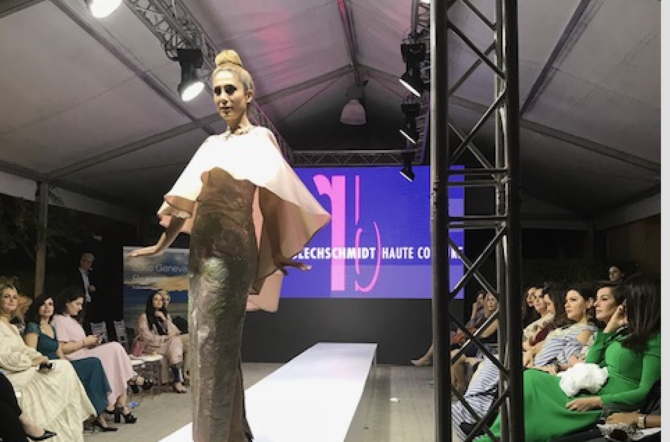
The Swiss Fashion Days Riyadh, a collaboration between Saudi and Swiss fashion designers, was launched on Wednesday. (AN photo)
2 / 3
The Swiss Fashion Days Riyadh, a collaboration between Saudi and Swiss fashion designers, was launched on Wednesday. (AN photo)
3 / 3
The Swiss Fashion Days Riyadh, a collaboration between Saudi and Swiss fashion designers, was launched on Wednesday. (AN photo)
Updated 12 April 2018
Follow

Swiss and Saudi fashion join forces

  • The event took place at the Swiss ambassador’s home and showcased the collections of six designers.
  • The Swiss ambassador’s wife Grisel Sandoval greeted guests at the event.

Riyadh: The Swiss Fashion Days Riyadh, a collaboration between Saudi and Swiss fashion designers, was launched on Wednesday.

“The beauty of art and fashion is what unites us today,” said Princess Joharah bint Talal bin Abdul Aziz Al-Saud at the event at the Swiss ambassador’s home, which showcased the collections of six designers.

Saudi designers Aram Designs by Arwa Al-Ammari, La’ Beso by Balqees Alqadeeb, Nuun Jewels by Nourah Al Faisal and Madawi Alissa were joined by two Swiss designers Gaia Schenk and Raphael Blechschmidt Haute Couture.

Saudi artist Khalid Al-Sudairy presented a collection of his latest photographs and the beauty of the Swiss locations of Lake Geneva, Lucerne, Ascona Locarno, Basel and Bern were displayed throughout the venue.

The Swiss ambassador Heinrich Schellenberg said: “The fashion show is a fantastic opportunity to inspire our guests by the beauty of Switzerland and at the same time to celebrate the close cooperation between Saudi and Swiss fashion designers.”

The Swiss ambassador’s wife Grisel Sandoval greeted guests. She told Arab News: “Our idea was to incorporate the Saudi designers with the Swiss designers, to make a team and give a new vision of Saudi society. We also wanted to highlight a very talented photographer. We are so pleased and honored to have all these guests here tonight with us.”

Most of the designs were high-end and for evening wear. Dresses were detailed; some had sequins while others featured patterned cloth.


Japanese researchers hope to restore coral from Saudi-made structures

Updated 05 January 2026
Follow

Japanese researchers hope to restore coral from Saudi-made structures

  • Coral skeletons made for Saudi Pavilion at Japan expo last year
  • Results of Japanese study to be revealed at Riyadh Expo 2030

TOKYO: Japanese universities are seeking to restore coral reefs and marine ecosystems after receiving artificial structures that Saudi Arabia made and showcased at last year’s Osaka-Kansai Expo.

The coral skeletons were donated to the University of the Ryukyus in Okinawa and Kansai University in Osaka Prefecture, Kyodo News reported at the weekend.

The structures are made from calcium carbonate, a material on which corals are believed to grow more easily compared to artificial alternatives such as concrete or metal.

The skeletal structures were created using 3-D printers, with one piece produced a day during the expo, and displayed across an entire wall in the Saudi Arabia Pavilion, which had an area focusing on sustainable marine environments.

Coral reefs serve as habitats for much marine life, but over 40 percent of the world’s 892 species face possible extinction, according to the International Union for Conservation of Nature.

The University of the Ryukyus, which received about 150 of the artificial coral skeletons, will place them in waters off the eastern coast of Okinawa’s main island and then examine their impact on the ecosystem.

Kansai University has placed theirs in the sea around Kagoshima Prefecture’s Yoron Island to observe their growth after transplanting coral polyps onto the structures.

The results of the research are expected to be revealed at the Riyadh Expo in 2030.

“I had never imagined that Japan and Saudi Arabia would cooperate on coral research,” said Masato Ueda, a professor specializing in regenerative medicine at Kansai University.

Ueda said he wants to demonstrate to children that “humanity is attempting to restore the environment.”