

Army hands control of Malakand to civil agencies

1 / 4
Policemen stand guard at a check post in Lower Dir district. (AN photos)
2 / 4
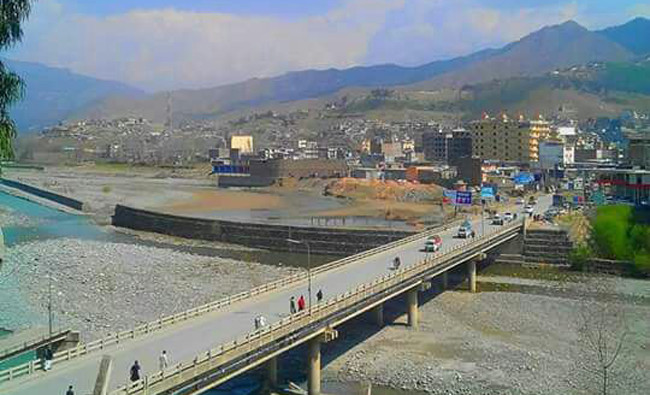
Malakand Division comprises several districts and is a scenic place having many tourist spots. (AN photos)
3 / 4
Police and army personnel jointly check vehicles at a check post in Upper Dir district. (AN photos)
4 / 4
Timargara Bazar. (AN photos)
Updated 11 April 2018
Follow

Army hands control of Malakand to civil agencies

  • The transfer of administrative powers in Malakand was initiated in the Upper and Lower Dir in a ceremony attended by senior civil and military officials.
  • In 2009, the army launched a military offensive, ‘Rah-e-Nijat,’ in the area when a local faction led by Mulla Fazlullah challenged the government.

PESHAWAR: Pakistan’s government and army have begun handing over administrative powers to civil authorities in Malakand, a senior official confirmed on Wednesday.

The process was initiated in Lower and Upper Dir, said Sarmad Saleem Akram, Lower Dir deputy commissioner.

He told Arab News that the army had handed over Bandagai checkpoint to a local administration on Wednesday, while Khall and Chakdara checkpoints would follow. 

“In the entire Lower Dir, only three checkpoints will now be jointly manned by the police and Frontier Corps (FC) personnel. The rest, all of them, have been handed over to the local police authorities,” he said.

Discussing the challenges resulting from transfer of security responsibility to civilian administration, Akram said: “There may be a problem in terms of shortage of security personnel, however Khyber Pakhtunkhwa (KP) police are trained to handle the situation.”

Akram said the army would probably withdraw from Malakand’s border checkpoints as well, handing over the area’s security to FC personnel.

Hafizur Rehman, who lives in Lower Dir, welcomed the change and said police would man the checkpoints more efficiently since they lived in the area and knew local residents. 

“Although the military ensures tight security of the area, police checks will be less time consuming since they know the locals,” he said.

“The police are ready to take up the challenges since it is a public service,” Shahab Ali Shah, district police officer in Upper Dir, said.

“If we need the military’s support, we will call them and they will be here to assist us.”

Kamran Khan, a schoolteacher from Upper Dir, said that the army had played a key role in restoring peace in the area.

“They ended public display of weapons and resolved several disputes in Dir,” he said. “The army can perhaps better control the security of the area.”

Peshawar-based analyst Rahimullah Yusufzai told Arab News that the transfer of security responsibilities from the army to the civil administration had been a lengthy process.

“There could be challenges in the future and this is why the army will be available to provide backup support to the police manning security checkpoints,” he said. 

He said that if the transfer of powers proved successful in the Upper and Lower Dir districts, it would be carried out in other areas of Malakand division as well.

“The army wants to reduce public dealing by soldiers on roadside checkpoints since this can sometimes create resentment among people,” he said.

Dr. Abaseen Yousafzai, a Peshawar University professor from Lower Dir, praised the army for establishing peace in the region and said he favored handing over control to civil administrators. 

“This was an extra burden on the army. The country’s military has done the right thing by transferring this responsibility to the police since it will help its soldiers concentrate on other important issues,” he said.

Yousafzai said that he now visited his village in Lower Dir at night without fear of militants or anti-state elements in the area.

The army stayed in Malakand for almost 10 years. It launched a military operation, Rah-e-Nijat, against militant groups in the region in 2009 after two peace accords failed.

The offensive was launched after the Taliban refused to lay down its arms despite a ruling that established sharia law in Malakand, one of the militant group’s chief demands.


Türkiye says ready to help restore Pakistan-Afghanistan ceasefire amid continuing clashes

Updated 8 sec ago
Follow

Türkiye says ready to help restore Pakistan-Afghanistan ceasefire amid continuing clashes

  • President Recep Tayyip Erdoğan made the mediation offer during a phone call to PM Shehbaz Sharif
  • They also discussed the ongoing Middle East conflict, called for restraint to prevent further escalation

ISLAMABAD: Türkiye is ready to help restore a ceasefire between Pakistan and Afghanistan amid fierce clashes between the two neighboring states, according to a statement released by the authorities in Ankara on Tuesday after President Recep Tayyip Erdoğan spoke with Prime Minister Shehbaz Sharif over telephone.

The call came as Pakistani security officials reported heavy cross-border firing with Afghan forces in the Bazaar Zakhakhel area of Khyber district, highlighting the fragility of relations between the two countries.

Türkiye previously mediated talks between Pakistan and Afghanistan last year after major border skirmishes in October prompted Islamabad to close all crossing points for bilateral and transit trade.

Pakistan has frequently blamed Afghanistan for sheltering anti-Pakistan militant groups such as the proscribed Tehreek-e-Taliban Pakistan (TTP) and Balochistan Liberation Army (BLA) and facilitating their cross-border attacks. Islamabad has said it targeted militant hideouts on the Afghan side of the frontier last month after repeatedly taking up the issue with the administration in Kabul.

The Afghan Taliban, who have always denied Islamabad’s charges, launched what Pakistan called “unprovoked aggression” in support of militant entities.

“Türkiye will continue to stand by Pakistan in its fight against terrorism and contribute to the re-establishment of the ceasefire between Pakistan and Afghanistan reached through Türkiye’s initiatives,” Erdoğan said during the call, according to a statement from the Turkish presidency.

Pakistan’s Information Minister Ataullah Tarar earlier released figures related to his country’s military campaign against Afghanistan, saying 464 Taliban fighters had been killed since the beginning of the war and over 665 were injured.

He said Pakistani security forces had destroyed 188 Afghan check posts and captured 31. Additionally, they had targeted 56 locations across Afghanistan in aerial strikes.

According to Prime Minister Sharif’s social media message on X, he also discussed the escalating situation in the Middle East and apprised President Erdoğan of his country’s outreach to the Gulf leadership to reaffirm “Pakistan’s full solidarity with them.”

“We agreed that maximum restraint by all parties is imperative to prevent further escalation,” he added. “We also exchanged views on recent developments in Afghanistan and resolved to remain in close and frequent contact in our shared pursuit of peace and stability in the region.”