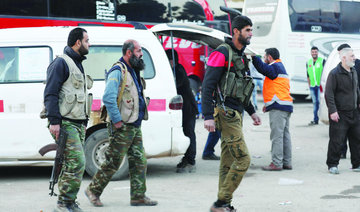
GENEVA: The United Nations voiced alarm on Tuesday at “spiralling new displacement” from the Syrian enclave of eastern Ghouta, after more than 133,000 people were estimated to have fled in four weeks, and where UN aid agencies still do not have access.
About 45,000 of those displaced are staying in eight collective shelters in the Damascus countryside. Roughly the same number of women, children and elderly men have left the overcrowded shelters after screening by government authorities.
“We are aware of screening taking place as civilians are leaving eastern Ghouta, but as you know we are not part of current evacuation deals or its implementation,” Andrej Mahecic, spokesman of the UN refugee agency UNHCR, told a briefing.

UN says more than 130,000 have fled Syria’s Ghouta in four weeks
- About 45,000 of those displaced are staying in eight collective shelters in the Damascus countryside
- Roughly the same number of women, children and elderly men have left the overcrowded shelters after screening by government authorities
Syria welcomes Canada’s decision to amend sanctions
- Husarieh said the decision could pave the way for Canadian participation in Syria’s reconstruction and infrastructure development
DAMSCUS: Syria’s Central Bank governor, Abdulkader Husarieh, commended the Canadian government’s decision to amend the sanctions imposed on Damascus under the Special Economic Measures Regulations, including the lifting of the comprehensive economic embargo in place since May 2011.
In a post published on his personal Facebook page, Husarieh described the move as an important milestone that reinforces the implementation of understandings reached during his recent visit to Canada.
He added that the amendment provides an opportunity to boost economic relations and activate cooperation between Canadian and Syrian banks and financial institutions.
Husarieh said the decision could pave the way for Canadian participation in Syria’s reconstruction and infrastructure development.
Meanwhile, the Syrian Arab Red Crescent and the Turkish Red Crescent signed cooperation agreements on Friday to strengthen humanitarian efforts in Syria amid ongoing crises and economic hardship.
Syrian Arab Red Crescent President Hazem Bakleh met in Damascus with Alper Kucuk, the Turkish Red Crescent’s director general for international affairs and migration services, to discuss rising humanitarian needs and ways to enhance coordination in support of vulnerable communities.
According to a statement released by the Syrian organization, the agreement provides for expanding relief and service activities.
It includes support for the construction of a new Red Crescent branch headquarters in Idlib province and the launch of a project to distribute hot meals and bread in Damascus and Aleppo during the holy month of Ramadan.
The Syrian Arab Red Crescent has sought to broaden partnerships with regional and international organizations in recent years to strengthen its operational capacity across multiple provinces, as the country continues to face economic strain and humanitarian challenges affecting large segments of the population.