LAHORE: Punjab Law Minister Rana Sanaullah said on Monday that the provincial administration would try to resolve the issue of Tehreek-e-Labaik’s sit-in through a peaceful dialogue process.
“Since this issue is related to the federal government, the provincial administration is in contact with it. We are also in touch with the leaders of Tehreek-e-Labaik to bring their protest to a positive conclusion,” he told Arab News.
The Punjab government has held two rounds of talks with the leaders of the religious-political group. In the first round, the State Minister for Interior, Talal Chaudhry, and the Chief Commissioner Islamabad, Aftab Akbar Durrani, were also present.
“The Punjab government will not use force against the participants of the sit-in to avoid a Faizabad-like situation,” the law minister added.
Earlier in the day, Tehreek-e-Labaik leaders announced that they would spread their protest across the country if their demands were not met in the next three days.
“We will block the motorway and all the national highways,” Sahibzada Usman Ali told Arab News. “Our workers will stage sit-ins and block the main roads of all the districts in the country. The protest will be seen from Khyber to Karachi, if the government does not accept our demands by Thursday afternoon.”
Tehreek-e-Labaik has staged a sit-in in front of Data Darbar, one of the most popular Sufi shrines in Pakistan, for the past seven days, causing numerous problems to the public.
Traffic congestion has become a norm in the neighborhood where business activities have also significantly declined. Schools in the nearby areas have not been operational for the past few days, and their residents have been finding it hard to carry out their routine activities.
The religious-political organization started its protest when an anti-terrorism court in Islamabad declared its leaders, including Khadim Hussain Rizvi and Afzal Qadri, proclaimed offenders.
Tehreek-e-Labaik is once again repeating its old demand of making the Raja Zafarul Haq Report public. The report investigated the change in the Khatam-e-Nabuwat clause in the Election Act, 2017.
The group also wants withdrawal of all cases against its leaders and workers, besides lodging police reports against the “culprits” who “martyred” its workers. Other than that, it wants the government to fulfill the terms agreed in the Army-brokered agreement during the Faizabad sit-in last year.
However, some members of the Punjab provincial administration say it will not be possible to accept these conditions.
“The demands made in the Faizabad agreement cannot be fulfilled since the Islamabad High Court has already declared the agreement null and void,” Malik Ahmad Khan, spokesperson of the Punjab Government, said while talking to Dawn News, a local television channel.
“There are some elements present at the sit-in who can create a violent situation if the government uses police action against them,” Khan added.

Punjab government wants to deal peacefully with Tehreek-e-Labaik protest
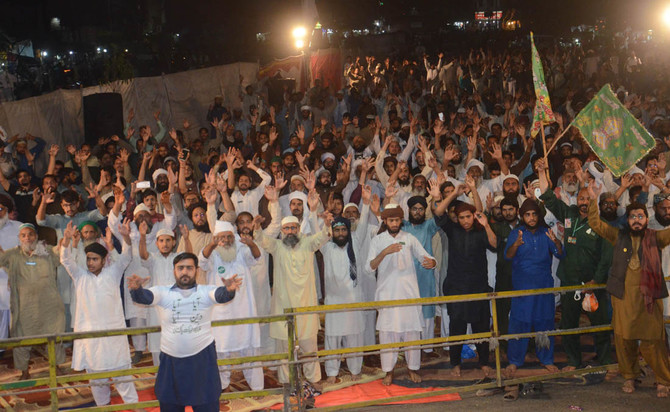
- The group has threatened to spread its protest across Pakistan if its demands are not met in three days
- Impossible to accept demands after Islamabad High Court’s ruling, maintain some members of provincial administration
Pakistan making diplomatic efforts to de-escalate Middle East tensions, FM says
- The statement came as Iran pressed on with a third day of strikes in the Gulf in response to US-Israeli air raids
- Pakistan’s position is clear that all countries must abide by principles of UN Charter, international law, FM says
ISLAMABAD: Pakistan is making diplomatic efforts to de-escalate heightened tensions in the Middle East, Foreign Minister Ishaq Dar said on Monday, amid US-Israeli strikes on Iran and Tehran’s counterstrikes against US bases in Gulf countries.
Tensions escalated across the Middle East on Saturday after coordinated US-Israel strikes killed Supreme Leader Ali Khamenei among other senior Iranian officials. Tehran responded by targeting US military bases in the UAE, Bahrain, Qatar, Kuwait and Jordan. Saudi Arabia said Iran also launched attacks targeting Riyadh and the Eastern Province.
The Iranian missile and drone strikes continued on Monday in retaliation for the ongoing US-Israeli air raids, casting uncertainty over the future of the Islamic republic and heightening the risk of broader instability in the already volatile region.
Speaking at a press conference, FM Dar, who recently returned from Saudi Arabia where he attended an Organization of Islamic Cooperation OIC) meeting on Palestine, said Pakistan is very closely monitoring the evolving situation in Iran and the tensions which are building up in the region.
“These serious developments have taken place at a time when diplomatic efforts were underway to reach a peaceful and negotiated solution to [Iran nuclear program],” he said.
“We are making our full diplomatic efforts and, you know, requesting all parties to de-escalate and to refrain.”
Dar said Islamabad was concerned over a violation of the norms and international law, and the age-old tradition that the heads of state and the government should not be targeted.
“Post-World War II, we all know that these institutions were created to create some international, you know, law and order, and that’s why there was a UN Charter. There are certain conventions which we all are supposed to follow,” he said.
“But things are on ground moving very differently, which obviously is worrisome... The international law must prevail and the conventions must be respected.”
The statement came hours after the Ras Tanura oil refinery in Saudi Arabia sustained limited damage as a result of debris from the interception of two drones in its vicinity, the Saudi Press Agency reported, citing an official source at the Saudi Ministry of Energy.
Several American warplanes crashed in Kuwait on Monday morning but their crew survived, Kuwait’s defense ministry said, as Iran pressed on with a third day of strikes in the Gulf.
Dar said Pakistan’s position has been clear and persistent that all countries must abide by the principles of UN Charter and international law, including respect for the sovereignty and territorial integrity of other states as well as international humanitarian law.
“In my latest conversation with [Iranian] Foreign Minister Abbas Araqshi on 28th of February, I conveyed Pakistan’s condemnation of the attacks and called for restraint and diplomacy and dialogue, which he positively responded,” he shared.
“But on ground, we are seeing that things are not yet settling or easing out.”
Pakistan stands in full solidarity with all its brotherly countries and underscores the need to exercise maximum restraint, according to FM Dar.
“This is a message we have been giving to whosoever prime minister speaks, whosoever I speak, or whosoever Field Marshal Asim Munir speaks to, his counterparts on the defense side,” he said.


