

Saudi Aramco takes step to integrating petrochems into United States’ biggest refinery

A Saudi Aramco employee sits in the area of its stand at the Middle East Petrotech 2016, an exhibition and conference for the refining and petrochemical industries, in Manama, Bahrain, September 27, 2016. (Reuters)
Updated 08 April 2018
Follow

Saudi Aramco takes step to integrating petrochems into United States’ biggest refinery

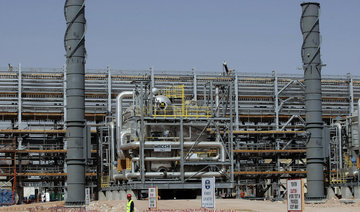
HOUSTON: Saudi Aramco took the first steps to integrating a petrochemicals business into the United States’ biggest oil refinery, which is operated by its subsidiary Motiva Enterprises.
Aramco’s Chief Executive Amin Nasser signed memoranda of understanding (MoUs) worth $8 billion-$10 billion with Honeywell UOP and Technip FMC to study petrochemical production technology for use in a chemical plant the company is considering building at the Port Arthur refinery.
Saudi Arabia’s Crown Prince Mohammed bin Salman, who was winding up a two-week visit to the United States, was present at the signing in Houston, Texas, on Saturday along with Saudi Energy Minister Khalid Al-Falih and US Energy Secretary Rick Perry.
“These agreements signal our plans for expansion into petrochemicals,” Motiva’s Chief Executive Brian Coffman said.
Aramco, which wants to develop its downstream business as the government prepares to sell up to 5 percent of the world’s largest oil firm in an initial public offering (IPO) this year, wants to use oil as a major petrochemicals feedstock.
Coffman also said Motiva was evaluating boosting the 603,000 barrel-per-day (bpd) Port Arthur refinery’s capacity to 1 million or 1.5 million bpd, which would make it the largest in the world.


The aromatics unit for which Honeywell UOP’s technology is being considered under one of the MoUs, would convert benzene and paraxylene, byproducts of gasoline production, into 2 million tons annually of feedstocks for chemicals and plastics.
The other MoU would allow Aramco to use Technip FMC’s mixed-feed ethylene production technologies in the United States. The technology would produce 2 million tons a year of ethylene, which is used to make plastics, Motiva said.
The final investment decision on setting up a multi-billion-dollar petrochemical plant at Port Arthur is not expected until 2019, and is “dependent on strong economics, competitive incentives, and regulatory support,” Aramco said in a statement.
Coffman did not provide a timeline for the possible expansion of the Port Arthur refinery’s crude oil processing capacity.
“That’s something we’re evaluating, we’re studying for in the future,” he said.
The 1.2-million bpd Reliance Industries refinery in Jamnagar, India, has the world’s largest crude oil processing capacity.
Aramco said last year that it would invest $18 billion in Motiva to expand the refinery and move into petrochemical production.
Other US companies, including Chevron Phillips Chemical Co. — a joint venture of Chevron Corp. and Phillips 66 — and Exxon Mobil Corp, have recently opened plants, like the one Motiva is considering, to process ethane into ethylene.
Chevron Phillips is considering building a second ethane cracker on the Gulf Coast of Texas.
The price tag for a large ethane cracker is typically over $6 billion, according to analysts. In addition to taking refining byproducts, ethane crackers provide hydrogen for refineries to use in making motor fuels.
FASTFACTS

Motiva

Aramco-subsidiary Motiva is evaluating raising the Port Arthur refinery's capacity to up to 1.5 million bpd, which would make it the largest in the world.


Saudi Arabia opens 3rd round of Exploration Empowerment Program

Updated 01 February 2026
Follow

Saudi Arabia opens 3rd round of Exploration Empowerment Program

RIYADH: Saudi Arabia’s Ministry of Industry and Mineral Resources, in collaboration with the Ministry of Investment, has opened applications for the third round of the Exploration Empowerment Program, part of ongoing efforts to accelerate mineral exploration in the Kingdom, reduce early-stage investment risks, and attract high-quality investment from local and international mining companies.

The third round of the Exploration Empowerment Program offers a comprehensive support package targeting exploration companies and mineral prospecting license holders.

The initiative aims to lower investment risks for projects and support a faster transition from prospecting to development.

"The program provides coverage of up to 70 percent of the total salaries of Saudi technical staff, such as geologists, during the first two years, increasing to 100 percent thereafter, in line with program requirements.

This support aims to develop talent, build national capabilities in mineral exploration, promote job localization, and facilitate the transfer of geological knowledge.

The application for the third round opened on Jan. 14, allowing participants to benefit from the Kingdom’s attractive investment environment, its stable legal framework, and streamlined regulatory structures, as well as integrated infrastructure that supports the transition from mineral resources to operational mines.

The ministry has set the timeline for the third round, with the application period running from Jan. 14 to March 31.

This will be followed by the evaluation, approval, and signing of agreements from April 1 to May 31, with the eligible projects set to be announced between June 1 and July 31 of the same year.

The program stages include submitting exploration data during the reimbursement and payment phase from Sept. 1 to Nov. 30, followed by technical and financial verification of work programs and approval of the disbursement of support funds in January 2027.

The exploration data will then be published on the National Geological Database in April 2027.

The ministry emphasized that the EEP focuses on supporting the exploration of strategically important minerals with national priority. It also contributes to enhancing geological knowledge by providing up-to-date data that meets international standards, helping investors make informed decisions and supporting the growth of national companies and local supply chains.

The ministry urged companies to apply early to benefit from the program’s third round, which coincided with the fifth edition of the International Mining Conference, which was held from Jan. 13 to 15.


