RIYADH: Ever since Saudi King Faisal and French President Charles de Gaulle met in 1967, relations between the two countries have evolved through personal contacts and visits at the highest levels.
King Khalid visited France in 1978 and 1981, and King Fahd visited twice when he was crown prince, in 1975 and 1981.
The first French president to visit the Kingdom was Valery Giscard d’Estaing in 1977, who visited again in 1980 and 1981.
King Fahd went on two official visits to France in 1984 and 1987, while King Abdullah visited twice, in 1985 and 1999.
The visit by President Jacques Chirac to the Kingdom in 1997 was followed by visits in 2001 and 2006.
In 1986, Chirac and King Salman, who was then governor of Riyadh, opened a Saudi exhibition in Paris that was visited by thousands of French citizens who were exposed to Saudi traditions and religious values.
The “Roads of Arabia” exhibition, highlighting Saudi archaeological masterpieces and cultural heritage, was started in 2010 and was hosted at the Louvre Museum in Paris, which signifies the strength of cultural relations between the two countries.
The closer relations are also evident from the fact that former French President Francois Hollande paid four visits to the Kingdom after his election in 2012.
His last official visit in May 2015 was particularly historic as besides meeting King Salman and senior officials, he attended the 15th meeting of the Gulf Cooperation Council (GCC), a rare invitation to a foreign leader.
This visit bolstered a new reinforcement of strategic partnership between the Kingdom and France as well as with the GCC countries.
In 2014, King Salman, who was then crown prince and defense minister, visited France at the invitation of Hollande.
In bolstering ties, King Salman and President Hollande played a crucial role by strengthening the Saudi-French global strategic partnership.
The two leaders in May 2015 adopted an ambitious action plan to boost bilateral relations through a win-win approach.
Now, Crown Prince Mohammed bin Salman is paying an official visit to France, during which he is expected to focus on investment as well as on key issues of mutual importance, a French Embassy senior official said Friday.
France and Saudi Arabia enjoy a very cordial and close relationship, which has gained momentum in recent years with the increasing pace of bilateral visits.
A number of military and security officials also exchanged regular visits that boosted cooperation around training for marine, air and ground troops.
Earlier, the Kingdom signed a security agreement with France in 2008.
Moreover, the Kingdom and France share longstanding economic ties, to which Saudi Vision 2030 provided an incentive to further strengthen a win-win relationship.
France is the third-biggest investor in the Kingdom, with more than $15 billion of investments, while Saudi Arabia is France’s leading commercial partner in the Gulf, with commercial flows amounting to more than $8 billion.
Significantly, more than 80 French companies, some of which are global leaders in their fields, have an active presence in the Kingdom and employ more than 27,000 people, with a Saudization rate of 36 percent.
French companies are involved in many strategic projects throughout the Kingdom, serving the Saudi ambition to develop a world-class railway and urban transportation infrastructure, energy network, tourism industry, financial services, telecommunications and health care.
French companies are also engaged in solar and nuclear projects that will help the Kingdom diversify its energy mix.
So far as the Saudi business involvement in France is concerned, the total investment caps are at less than $1 billion, and are mostly directed toward real estate.
With the two sides sharing very cordial relations, the new governments in France and Saudi Arabia will pave the way for new opportunities over the years.


![]()
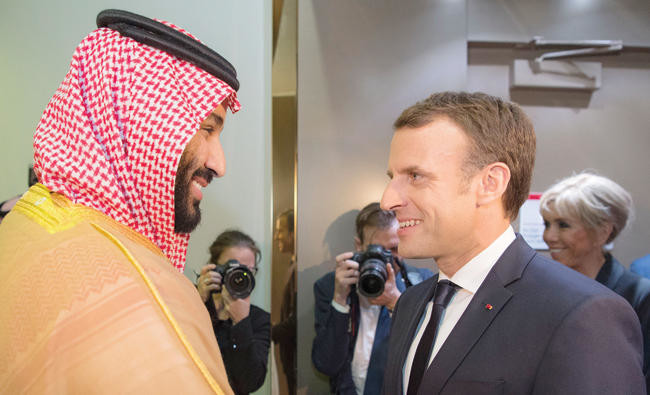
Saudi Arabia, France enjoying ever-growing strategic partnership
Saudi Arabia, France enjoying ever-growing strategic partnership
- France is the third-biggest investor in Saudi Arabia
- The “Roads of Arabia” exhibition, highlighting Saudi archaeological masterpieces and cultural heritage.


Latest updates


© 2026 SAUDI RESEARCH & PUBLISHING COMPANY, All Rights Reserved And subject to Terms of Use Agreement.