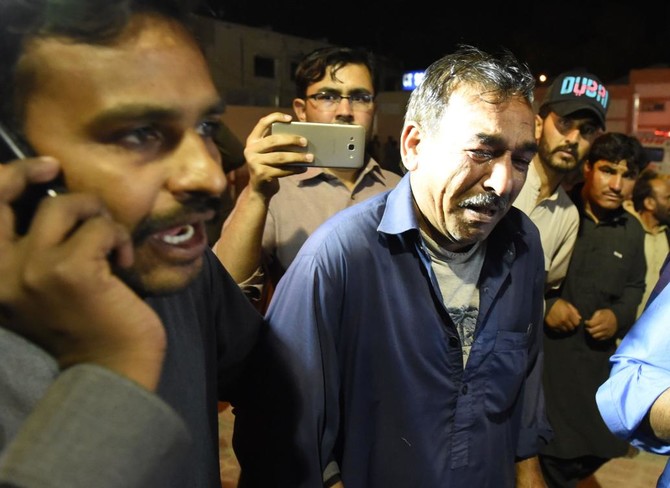
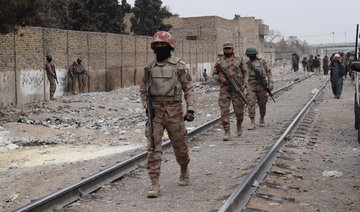
QUETTA: Gunmen riding on motorcycles carried out two separate attacks in the Pakistani city of Quetta on Monday, killing five Muslims in one shooting and four members of a Christian family in the other, police said.
Abdul Qadeer, a local police chief, said the attacks were apparently unrelated. It was unclear who was behind the attacks in Quetta, which is home to ethnic Baluch separatists as well as Islamic militants.
Earlier Monday, Pakistan’s army chief Gen. Qamar Javed Bajwa confirmed death sentences for 10 convicted militants, including the killer of a well-known Sufi singer, according to a military statement.
The military courts found the “terrorists” guilty of taking part in separate attacks that killed 62 people, it said.
The trials are closed to the public, but defendants are allowed to hire lawyers.
One of those whose sentence was confirmed was found guilty of a 2016 attack in Karachi that killed Amjad Sabri. He and his late father, Ghulam Farid Sabri, were renowned qawwali singers, a style of music rooted in Islamic mysticism.
Pakistan resumed military trials for convicted terrorists and lifted a moratorium on the death penalty after a 2014 attack on a school in Peshawar that killed more than 150 people, mostly young students.

Gunmen kill 9 in separate attacks in Pakistan’s Quetta
- Five Muslims, in one shooting and four members of a Christian family in the other, police said.
- Five Muslims, four members of a Christian family were killed in separate attacks.
India, Arab League target $500bn in trade by 2030
- It was the first such gathering of India–Arab FMs since the forum’s inauguration in 2016
- India and Arab states agree to link their startup ecosystems, cooperate in the space sector
NEW DELHI: India and the Arab League have committed to doubling bilateral trade to $500 billion by 2030, as their top diplomats met in New Delhi for the India–Arab Foreign Ministers’ Meeting.
The foreign ministers’ forum is the highest mechanism guiding India’s partnership with the Arab world. It was established in March 2002, with an agreement to institutionalize dialogue between India and the League of Arab States, a regional bloc of 22 Arab countries from the Middle East and North Africa.
The New Delhi meeting on Saturday was the first gathering in a decade, following the inaugural forum in Bahrain in 2016.
India’s Foreign Minister S. Jaishankar said in his opening remarks that the forum was taking place amid a transformation in the global order.
“Nowhere is this more apparent than in West Asia or the Middle East, where the landscape itself has undergone a dramatic change in the last year,” he said. “This obviously impacts all of us, and India as a proximate region. To a considerable degree, its implications are relevant for India’s relationship with Arab nations as well.”
Jaishankar and his UAE counterpart co-chaired the talks, which aimed at producing a cooperation agenda for 2026-28.
“It currently covers energy, environment, agriculture, tourism, human resource development, culture and education, amongst others,” Jaishankar said.
“India looks forward to more contemporary dimensions of cooperation being included, such as digital, space, start-ups, innovation, etc.”
According to the “executive program” released by India’s Ministry of External Affairs, the roadmap agreed by India and the League outlined their planned collaboration, which included the target “to double trade between India and LAS to US$500 billion by 2030, from the current trade of US$240 billion.”
Under the roadmap, they also agreed to link their startup ecosystems by facilitating market access, joint projects, and investment opportunities — especially health tech, fintech, agritech, and green technologies — and strengthen cooperation in space with the establishment of an India–Arab Space Cooperation Working Group, of which the first meeting is scheduled for next year.
Over the past few years, there has been a growing momentum in Indo-Arab relations focused on economic, business, trade and investment ties between the regions that have some of the world’s youngest demographics, resulting in a “commonality of circumstances, visions and goals,” according to Muddassir Quamar, associate professor at the School of International Studies, Jawaharlal Nehru University.
“The focus of the summit meeting was on capitalizing on the economic opportunities … including in the field of energy security, sustainability, renewables, food and water security, environmental security, trade, investments, entrepreneurship, start-ups, technological innovations, educational cooperation, cultural cooperation, youth engagement, etc.,” Quamar told Arab News.
“A number of critical decisions have been taken for furthering future cooperation in this regard. In terms of opportunities, there is immense potential.”