Pakistan’s southwestern Quetta city targeted by militants again

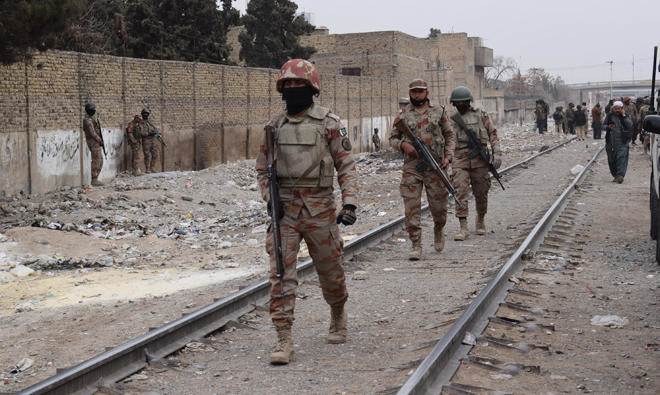
Pakistani paramilitary soldiers patrol near the site of an attack by gunmen on policemen in Quetta. (AFP)
Updated 28 February 2018
Follow

Pakistan’s southwestern Quetta city targeted by militants again

QUETTA: The provincial capital of Pakistan’s southwestern Balochistan province witnessed two militant attacks on law enforcement agencies on Wednesday in which six uniformed personnel were killed.
The first incident took place in the morning when an unidentified assailant tried to target Deputy Superintendent Police Hameedullah Dasti, killing two of his colleagues instead.
In the second incident, a suicide bomber hit a Frontier Corps camp in the city, killing four soldiers and injuring six others.
Security forces immediately cordoned off the area to evacuate the casualties and deal with the situation.
A proscribed militant faction, Tehreek-e-Taliban Pakistan (TTP), claimed the responsibility of the first attack in a statement sent to various media outlets in Pakistan. However, no group claimed the responsibility of the second incident by the time this report was filed.
Talking to Arab News, Deputy Inspector General Police Abdul Razzaq Cheema dismissed the TTP statement about the first attack, saying: “Nothing can be said until proper investigation of the incident is completed.”
He added that Dasti’s vehicle was ambushed while he was carrying out his official duties.
Quetta has witnessed an escalation in militant violence in recent weeks, and most of these attacks are directed against police and security officials.


Pakistan warns of heightened glacial lake flood risk as temperatures rise

Updated 6 sec ago
Follow

Pakistan warns of heightened glacial lake flood risk as temperatures rise

  • NDMA says early heatwave conditions could accelerate glacier melt in northern Pakistan
  • Authorities urge contingency planning, early warnings and evacuations in at-risk areas

PESHAWAR: Pakistan’s disaster management authority warned on Thursday of an elevated risk of glacial lake outburst floods (GLOFs) starting next month as rising temperatures threaten to accelerate snow and glacier melt in the country’s northern regions.

The National Disaster Management Authority (NDMA) said seasonal forecasts point to higher-than-normal temperatures and possible early heatwave conditions that could destabilize glacial lakes in Gilgit-Baltistan and upper Khyber Pakhtunkhwa.

GLOFs occur when water from melting glaciers breaches natural barriers and is suddenly released, triggering fast-moving floods downstream.

“Increasing temperatures during March to June 2026 may accelerate snow and glacier melt in Gilgit Baltistan and Upper Khyber Pakhtunkhwa, heightening the risk of GLOF incidents,” the NDMA said in a statement. “Such events can trigger flash floods, causing damage to homes, infrastructure, agriculture, communication networks and may result in human casualties in vulnerable downstream communities.”

The advisory identified several potentially exposed areas, including valleys in Gilgit-Baltistan such as Ishkoman, Gulkin and Gulmit, as well as parts of Chitral and Upper Dir in Khyber Pakhtunkhwa.

The NDMA urged provincial and local authorities to review contingency plans, strengthen early warning systems and prepare evacuation arrangements where necessary.

Communities living near glacial streams were advised to remain vigilant, avoid unnecessary movement in high-risk zones and follow official instructions.

Climate change has become a major concern for Pakistan, which is frequently ranked among the world’s most vulnerable countries to global warming despite contributing less than 1 percent of global greenhouse gas emissions.

In recent years, the country has endured devastating floods, prolonged droughts and record-breaking heatwaves that have killed thousands of people, damaged critical infrastructure and deepened food security challenges.