DUBAI: The Dubai World Cup meeting on Saturday may well be the biggest stage in international racing, but it also acts as a leg-up for those not yet in the limelight.
Nicholas Bachalard knows the opportunities that the richest night in racing at $30 million (SR 112.5 million) presents all too well, and is set to be part of the action at Meydan Racecourse by proxy.
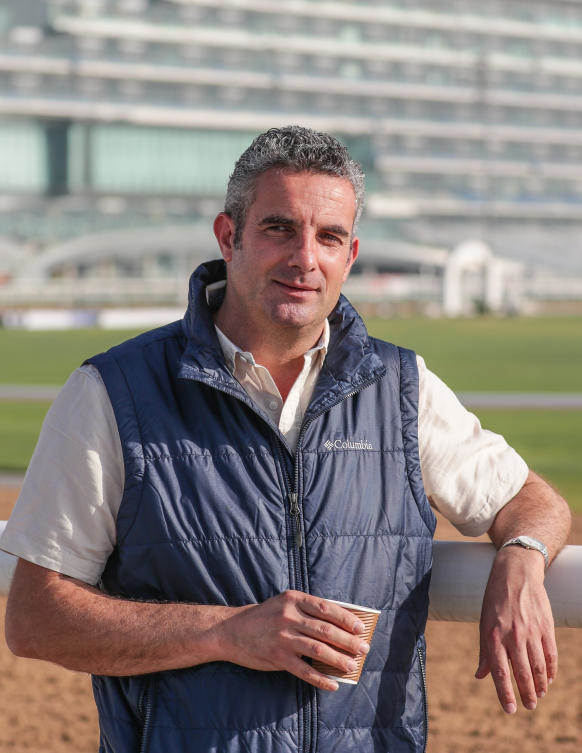
Thirteen years ago the smooth-talking 47-year-old Frenchman was working as a key lieutenant for fellow French emigre Christophe Clement at Payson Park in Florida.
Clement came to Dubai and saddled outsider Dynever to finish second to American raider Roses, in May, in the Dubai World Cup, at Nad Al-Sheba for King Abdullah. When the Saudi royal family were looking for a trainer in Riyadh several years later, they were so impressed by Clement’s methods and performance, that they came calling, and settled for one of the key cogs in the wheel.
“They contacted me and asked me whether I was interested in coming to Saudi Arabia,” Bachalard told Arab News at morning trackwork at Meydan. “I was a bit reluctant at the beginning — I wasn’t sure what I was getting into, but I spoke to a few friends there, and they helped me make up my mind, and I have now been there for eight years.”
There have been significant highs. Bachalard has won more than 270 races in Saudi Arabia and saddled three-time US Grade One winner Ron The Greek to win The Custodian of the Two Holy Mosques Cup (King’s Cup), in 2015.
There have also been some lows. For a former American star with a heart of a lion, it was disappointing that Ron The Greek, trailed in 12th in the World Cup in 2014.
From one opportunity has come another. Last year Bachalard came to Meydan on a Dubai Carnival raid, with the Saudi-owned Nashmiah. They went home with the UAE 1,000 Guineas.
When Sheikh Ahmed bin Rashid Al-Maktoum of Dubai was searching for a replacement at Jebel Ali Stables for Gopi Selvaratnam, who replaced his long-serving brother Dhruba, Bachalard was once again on the list. He was appointed head trainer at Jebel Ali Stables and Racecourse in February. Alongside the 50-60 horses that Bachalard will inherit over here, as the dust settles on Saturday’s action will be American import Economic Model, who will be a key player in the Godolphin Mile under Joel Rosario. Economic Model won a Group 3 race for American trainer Chad Brown, who continued to train the horse until after the race in Florida in February, after which Bachalard stepped in and bought him for his new patron.
“We bought him because we thought he would be a good fit for the Godolphin Mile,” Bachalard said proudly. “Mostly we bought him for next year. He has tactical speed. You need tactical speed here. The horse was a lightly-raced four-year-old and should improve. Once he runs here, he will stay here and get acclimatized to the weather. From there we will see.”
Godolphin have showed with African Story that a win in the Godolphin Mile can set a horse up for subsequent success in the World Cup. Were Economic Model to win the $1 million opener to Saturday’s nine-race card, the question inevitably turns to whether Bachalard might consider the new record-breaking horse race slated for next year in Riyadh.
Last month the General Sports Authority announced that the King Abdulaziz Horse Championship will carry a purse of $17 million. There was scant detail, but Bachalard believes the time is ripe in Saudi Arabia and has taken a look at the international program and believes there is little room for maneuver.
“They want to improve and promote Saudi racing, that is why they are going to have the Abdulaziz race,” he said. “Hopefully, it will get off the ground next year in February, so it does not clash with the World Cup, but they have a lot of organization to do before then. The track in Saudi Arabia is one of the nicest tracks in the world. The grounds, the way it is kept, any international visitor will have a great experience. The track is amazing, and most of the international jockeys who go there rave about the surface. It was well thought-out, and well-built, all of the turns are banked, it is very horse-friendly, with very few injuries. If they have that race, it is sure to be a good stage for it.
“It will probably stay as Saudi racing. There is little desire to have new owners or horses from abroad. Most of the horses that run in Saudi Arabia are born and raised in Saudi Arabia. They may have to bring in a few stallions to improve the breed. As long as they keep getting the support for King Salman and the royal family, it has a bright future.”
It could be a very interesting 12 months.


![]()
Saudi Arabia horse racing has a bright future, says departing top trainer
Saudi Arabia horse racing has a bright future, says departing top trainer


Latest updates


Recommended


© 2026 SAUDI RESEARCH & PUBLISHING COMPANY, All Rights Reserved And subject to Terms of Use Agreement.