LONDON: The stadium was a little under two-thirds full. The away fans, a mass of navy and tartan sequestered in one corner, made an effort, but an air of apathy hung over the whole occasion. Scotland won, 1-0, and probably just about deserved it but there was little hiding the fact this was a poor game between two poor teams. When the sides met in a friendly at Hampden Park in December 1954, 113,000 turned up to watch Hungary win 4-2; that was a game that mattered.
No two European sides, perhaps, have suffered the same decline Hungary and Scotland have. Hungary have twice reached World Cup finals. Before the 1954 final, in which they were surprisingly beaten by West Germany, a side featuring the likes of Ferenc Puskas, Jozsef Bozsik and Sandor Kocsis went unbeaten for four years, winning Olympic gold and twice inflicting humiliating defeats on England. They were, for most of that period, the best side in the world.
Yet the suspicion now is that the damage had already been done, that the nationalisation of football clubs in 1949, following on from the catastrophe of the Second World War, destroyed the culture that had led to Hungary becoming probably the world’s most influential football country in the 1930s, when its coaches, forced abroad by economic circumstances and rising anti-Semitism, had a major impact on shaping the game in Brazil, Argentina, Italy, Germany and Sweden.
Scotland’s reach goes back even further and, while most would trace Hungary’s emergence as a first-rate footballing nation to the arrival of the English coach Jimmy Hogan, swapping what was effectively house arrest as an enemy alien in Vienna for a much less restrictive regime in Budapest in 1916, the foundations for the what he instituted at MTK had been laid by the Scottish coach John Tait Robertson. But much more recently, Scotland qualified for five World Cups in a row between 1974 and 1990 while providing the backbone of the Liver-pool and Notting-ham Forest sides that dominated Europe in the late 1970s and early 1980s. Decline for both has been precipitous.
In part, it is a matter of size. If success in football is, as Simon Kuper and Stefan Szymanski claim in Soccernomics, a matter of population multiplied by GDP multiplied by football experience, then it must be accepted that there is only so much you can do with a population of a little under 10 million (in Hungary’s case) and a little over 5 million (in Scotland’s).
And yet still that does not feel wholly adequate as an explanation. These were two teams who, the previous week, had lost at home to Kazakhstan and Costa Rica; they looked like it. Aberdeen’s Scott McKenna had a good game on Tuesday and the goalkeeper Allan McGregor of Hull City made a couple of decent saves, but the left wing-back, Liverpool’s Andrew Robertson, stood out as the one truly top-class player on the pitch. It is a frustrating quirk for Scotland that their two best players, Robertson and Celtic’s Kieran Tierney, who was injured, both prefer to play at left-back.
But at least Scotland, even if they have not been to a major tournament since the 1998 World Cup, still produce players who can operate at the highest level. Hungary’s decline is such that there only outfielder who has been near a top club in recent years, the left-sided midfielder Balazs Dzsudzsak who was at PSV and then Dinamo Moscow, is now 31 and playing in the UAE. Laszlo Kleinheisler, the midfielder whose energy was so vital in the play-off against Norway to qualify for Euro 2016, looks as raw at 23 as he always did, and conceded a penalty, missed by Charlie Mulgrew, with an entirely needless challenge in the corner of the box.
The economics of modern European football do not help, dragging whatever talent there is to the big leagues of Spain, England, Germany and Italy, but that is only part of the problem. Nor is it just an issue of a small population and the natural cycles that must exist as a result. Local governance, in some way, must be at fault, but finding actual solutions is much harder than pointing a finger. What was clear on Tuesday, though, was the profound sense of loss, of a glory that in 60 years has simply disappeared.


![]()
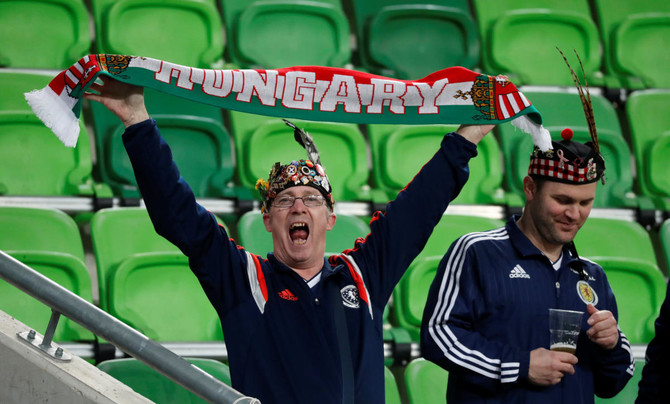
More than 110,000 once turned up to watch Scotland vs. Hungary. How times have changed for this fallen pair
More than 110,000 once turned up to watch Scotland vs. Hungary. How times have changed for this fallen pair



Latest updates





© 2026 SAUDI RESEARCH & PUBLISHING COMPANY, All Rights Reserved And subject to Terms of Use Agreement.