SYDNEY: Malaysia’s prime minister Saturday warned his Southeast Asian neighbors that the Rohingya refugee crisis in Myanmar could become a serious security threat for the region.
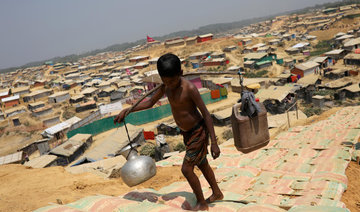
Hundreds of thousands of the Muslim-minority Rohingya have fled Myanmar’s troubled Rakhine state after authorities launched a brutal crackdown on insurgents six months ago that the UN has called “ethnic cleansing.”
Myanmar has vehemently denied the allegations, insisting it was responding to attacks by Rohingya militants in late August.
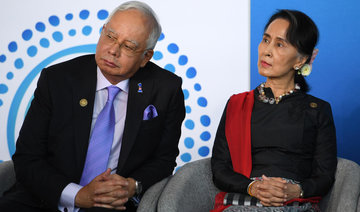
Malaysian Prime Minister Najib Razak raised fears that so many desperate and displaced people could fall prey to extremist groups like Daesh.
With Myanmar’s de-facto leader Aung San Suu Kyi sitting just meters away at a special Australia-ASEAN summit in Sydney, Najib said it was no longer a domestic issue.
“Because of the suffering of Rohingya people and that of displacement around the region, the situation in Rakhine state and Myanmar can no longer be considered to be a purely domestic matter,” he said.
“In addition, the problem should not be looked at through the humanitarian prism only because it has the potential of developing into a serious security threat to the region.
“Rakhine with thousands of despairing ... people who see no hope in the future will be a fertile ground for radicalization and recruitment by Daesh and affiliated groups.”
The United Nations on Friday launched an appeal for nearly $1 billion to care for Rohingya refugees, who have mostly fled to Bangladesh.
Najib said Malaysia was ready to assist in finding “a just and durable solution,” while urging Southeast Asian nations to work closely to deter any extremist threats.
“We must be vigilant and increase our collaboration, because the collapse of Daesh territories in Iraq and Syria has forced it to go underground and re-emerge elsewhere, especially in crisis zones where it can grow and operate.”
He pointed to pro-Daesh militants seizing the southern Philippine city of Marawi last year as a warning of what can happen.
“We must draw lessons from Marawi and be extremely concerned that at least 10 militant groups in the Mindanao region (of the Philippines) have declared their affiliation to Daesh,” he said.
ASEAN groups Brunei, Cambodia, Indonesia, Laos, Malaysia, Myanmar, the Philippines, Singapore, Thailand and Vietnam, with Australia a dialogue partner since 1974.
All leaders are attending the summit in Sydney except the Philippines’ Rodrigo Duterte, who cited more pressing developments at home.


![]()

Malaysia warns Rohingya crisis could pose security risk
Malaysia warns Rohingya crisis could pose security risk

Latest updates


© 2026 SAUDI RESEARCH & PUBLISHING COMPANY, All Rights Reserved And subject to Terms of Use Agreement.