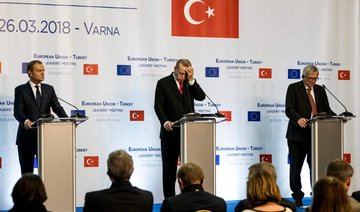
ISTANBUL: President Tayyip Erdogan has filed a lawsuit against the leader of Turkey’s main opposition party over “baseless” comments linking the president to the Muslim cleric Ankara blames for a failed 2016 coup, Erdogan’s lawyer said on Thursday.
The cleric, Fethullah Gulen, was once a close ally of Erdogan’s government, but they fell out in recent years. Turkish authorities declared Gulen’s movement a terrorist organization in 2016 and accused his supporters of instigating the military putsch later that year in which 250 people were killed.
Tens of thousands of people have been detained on charges of links to Gulen’s movement in the security crackdown that followed the attempt to overthrow Erdogan.
The head of the secular opposition People’s Republican Party (CHP,) Kemal Kilicdaroglu, said this week Erdogan had been closer to Gulen than any other Turkish politician.
“The political arm of the Gulenist network is the person who is occupying the presidency,” Kilicdaroglu said in a speech to members of his party in Ankara. “The number one political arm of Gulenist network, the number one defendant, is the person who occupies the presidency.”
Lawyer Huseyin Aydin dismissed the accusation, saying it was clear to everyone Erdogan was leading the fight against Gulen and that the president was seeking 250,000 lira ($63,000) in damages.
“We have filed a lawsuit because of Kilicdaroglu’s unfair and baseless accusations directed toward our president,” Aydin said on Twitter.
Gulen, who has lived in self-imposed exile in Pennsylvania since 1999, has denied involvement in the abortive coup.
The UN human rights office said earlier this month Turkey has detained 160,000 people and dismissed nearly the same number of civil servants since July 2016. Of those detained, 50,000 have been formally charged and kept in jail during trial.
Erdogan, who has dominated Turkish politics for 15 years as prime minister and then president, has had multiple spats with Kilicdaroglu that produced more than 20 court cases. ($1 = 3.9855 liras)

Turkey’s Erdogan sues opposition party chief over Gulen comments
Iran’s unrelenting attacks on Mideast shipping and energy infrastructure send oil prices soaring
- With traffic in the Strait effectively stopped, the price of Brent crude oil, the international standard, rose another 9 percent on Thursday to more than $100 a barrel
DUBAI: Unrelenting Iranian attacks on shipping traffic and energy infrastructure pushed oil above $100 a barrel on Thursday, as American and Israeli strikes pounded the Islamic Republic with no sign of an end to the war in sight.
Iran hit a container ship off the coast of Dubai, caused a blaze near Bahrain’s international airport, targeted a major Saudi oil field with a drone attack and forced Iraq to halt operations at all the country’s oil terminals after an attack on its port of Basra on the Arabian Gulf.
Iran flouted a United Nations Security Council resolution from the previous day demanding that it halt strikes on its Gulf neighbors with new attacks also reported in Kuwait and the United Arab Emirates.
Sirens wailed before dawn in Jerusalem after Israel said it was working to intercept missiles launched from Iran. The country also announced it had begun a “wide-scale wave of strikes” on Tehran. In Lebanon, where Israel says it is targeting Iran-linked Hezbollah militants, 11 people were killed in two early morning strikes.
Since the United States and Israel sparked with war with a Feb. 28 attack on Iran, Tehran has embarked on a campaign generated at inflicting enough global economic pain to pressure them to relent in their attacks.
In addition to attacking energy infrastructure around the region, Iran has a stranglehold on the Strait of Hormuz, the strategic waterway leading from the Arabian Gulf toward the Indian Ocean through which a fifth of the world’s oil is transported.
With traffic in the Strait effectively stopped, the price of Brent crude oil, the international standard, rose another 9 percent on Thursday to more than $100 a barrel, up some 38 percent over what it cost when the war started.
Iran fires at multiple Gulf Arab countries and hits ship in Arabian Gulf
The UN Security Council voted Wednesday to approve a resolution demanding a halt to Iran’s “egregious attacks” on its Gulf neighbors, but Tehran showed no signs of changing its strategy.
As the day began Thursday, a container ship in the Arabian Gulf was hit with a projectile off the coast of Dubai, sparking a small fire, according to British military’s United Kingdom Maritime Trade Operations Center. It said the crew of the vessel were safe.
In Bahrain, an early Iranian attack sparked a major fire on Muharraq Island, home to the country’s international airport. Authorities urged people to stay indoors and close windows to avoid smoke. The airport has jet fuel tanks, and other tanks in the area serve the kingdom’s oil industry.
Kuwait’s Defense Ministry said an Iranian drone smashed into a residential building, wounding two people, the UAE said it had activated air defenses twice to protect Dubai from attacks, and firefighters extinguished a blaze at a tower in Dubai Creek Harbor after a drone hit.
Saudi Arabia said it had shot down a drone targeting the diplomatic quarter of the capital, Riyadh, and also reported downing drones in kingdom’s east, including at least one trying to target its Shaybah oil field in the Empty Quarter desert.
Following an attack on Iraq’s Basra port that killed at least one person, officials said Thursday that it had been forced to halt operations at all the country’s oil terminals.
Farhan Al-Fartousi, the director-general of the General Company for Ports of Iraq, said the attack targeted a vessel in a ship-to-ship transfer area of the Arabian Gulf port.
Explosions rock Jerusalem while Lebanon and Tehran are hit by Israeli strikes
Sirens wailed and loud explosions were heard shortly after midnight in Jerusalem and other parts of Israel. The Israeli military said it was responding with another “wide-scale wave of strikes” in Tehran.
Overnight missile launches from Iran and Hezbollah also sent Israelis to shelters in multiple other areas, including Tel Aviv and the northern border with Lebanon.
An Israeli strike hit a car Thursday in Ramlet Al-Bayda, a major seaside tourist area of Beirut where dozens of displaced people have been sheltering. Eight people were killed and 31 others were wounded, the Lebanese Health Ministry said. The Israeli military press office told The Associated Press it was “not aware” of a strike at that location.
In Aramoun, a town about 10 kilometers (six miles) south of Beirut, another three people were killed and a child was wounded in another early Israeli attack.
Casualties continue to climb as conflict continues
At least 634 people have been killed in Lebanon since the latest fighting began, the Lebanese Health Ministry said Wednesday.
The UN refugee agency said at least 759,000 people have been internally displaced in Lebanon.
Iranian authorities say more than 1,300 people have been killed there, and Israel has reported 12 people dead. The US has lost seven soldiers while another eight have suffered severe injuries.
Iran hit a container ship off the coast of Dubai, caused a blaze near Bahrain’s international airport, targeted a major Saudi oil field with a drone attack and forced Iraq to halt operations at all the country’s oil terminals after an attack on its port of Basra on the Arabian Gulf.
Iran flouted a United Nations Security Council resolution from the previous day demanding that it halt strikes on its Gulf neighbors with new attacks also reported in Kuwait and the United Arab Emirates.
Sirens wailed before dawn in Jerusalem after Israel said it was working to intercept missiles launched from Iran. The country also announced it had begun a “wide-scale wave of strikes” on Tehran. In Lebanon, where Israel says it is targeting Iran-linked Hezbollah militants, 11 people were killed in two early morning strikes.
Since the United States and Israel sparked with war with a Feb. 28 attack on Iran, Tehran has embarked on a campaign generated at inflicting enough global economic pain to pressure them to relent in their attacks.
In addition to attacking energy infrastructure around the region, Iran has a stranglehold on the Strait of Hormuz, the strategic waterway leading from the Arabian Gulf toward the Indian Ocean through which a fifth of the world’s oil is transported.
With traffic in the Strait effectively stopped, the price of Brent crude oil, the international standard, rose another 9 percent on Thursday to more than $100 a barrel, up some 38 percent over what it cost when the war started.
Iran fires at multiple Gulf Arab countries and hits ship in Arabian Gulf
The UN Security Council voted Wednesday to approve a resolution demanding a halt to Iran’s “egregious attacks” on its Gulf neighbors, but Tehran showed no signs of changing its strategy.
As the day began Thursday, a container ship in the Arabian Gulf was hit with a projectile off the coast of Dubai, sparking a small fire, according to British military’s United Kingdom Maritime Trade Operations Center. It said the crew of the vessel were safe.
In Bahrain, an early Iranian attack sparked a major fire on Muharraq Island, home to the country’s international airport. Authorities urged people to stay indoors and close windows to avoid smoke. The airport has jet fuel tanks, and other tanks in the area serve the kingdom’s oil industry.
Kuwait’s Defense Ministry said an Iranian drone smashed into a residential building, wounding two people, the UAE said it had activated air defenses twice to protect Dubai from attacks, and firefighters extinguished a blaze at a tower in Dubai Creek Harbor after a drone hit.
Saudi Arabia said it had shot down a drone targeting the diplomatic quarter of the capital, Riyadh, and also reported downing drones in kingdom’s east, including at least one trying to target its Shaybah oil field in the Empty Quarter desert.
Following an attack on Iraq’s Basra port that killed at least one person, officials said Thursday that it had been forced to halt operations at all the country’s oil terminals.
Farhan Al-Fartousi, the director-general of the General Company for Ports of Iraq, said the attack targeted a vessel in a ship-to-ship transfer area of the Arabian Gulf port.
Explosions rock Jerusalem while Lebanon and Tehran are hit by Israeli strikes
Sirens wailed and loud explosions were heard shortly after midnight in Jerusalem and other parts of Israel. The Israeli military said it was responding with another “wide-scale wave of strikes” in Tehran.
Overnight missile launches from Iran and Hezbollah also sent Israelis to shelters in multiple other areas, including Tel Aviv and the northern border with Lebanon.
An Israeli strike hit a car Thursday in Ramlet Al-Bayda, a major seaside tourist area of Beirut where dozens of displaced people have been sheltering. Eight people were killed and 31 others were wounded, the Lebanese Health Ministry said. The Israeli military press office told The Associated Press it was “not aware” of a strike at that location.
In Aramoun, a town about 10 kilometers (six miles) south of Beirut, another three people were killed and a child was wounded in another early Israeli attack.
Casualties continue to climb as conflict continues
At least 634 people have been killed in Lebanon since the latest fighting began, the Lebanese Health Ministry said Wednesday.
The UN refugee agency said at least 759,000 people have been internally displaced in Lebanon.
Iranian authorities say more than 1,300 people have been killed there, and Israel has reported 12 people dead. The US has lost seven soldiers while another eight have suffered severe injuries.
© 2026 SAUDI RESEARCH & PUBLISHING COMPANY, All Rights Reserved And subject to Terms of Use Agreement.