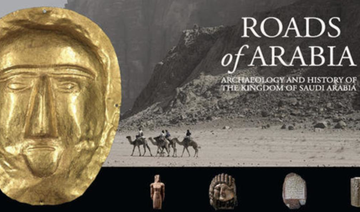
‘Roads of Arabia’ expo plays crucial role in enhancing Saudi-American cultural ties

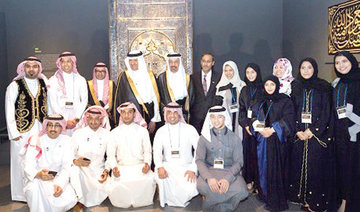
Visitors listening to a briefing at the "Roads of Arabia" expo at the Carnegie Museums in Pennsylvania, US.
Updated 28 March 2018
Follow

‘Roads of Arabia’ expo plays crucial role in enhancing Saudi-American cultural ties

RIYADH: “Roads of Arabia,” a premier exhibition on Saudi archaeological masterpieces through the ages, has been successfully hosted by 13 international museums in Europe, the United States and Asia, with the US holding the distinction of hosting the prestigious exhibition a record five times.
The expo, considered the most important mobile Saudi exhibition highlighting the cultural heritage of the Kingdom all over the world, was started in 2010 and was launched for the first time in Europe at the Louvre Museum in Paris, France on Feb. 13, 2010.
It then went to La Caixa Foundation in Barcelona, Spain, the Hermitage Museum of Art and Culture in Saint Petersburg, Russia, the Pergamon Museum in Berlin, Germany, and the Vittoriano Museum in Rome, Italy, before it moved to the US.
In the US the exhibition was first hosted by the famous Arthur M. Sackler Gallery and the Freer Gallery of Art, which form the Smithsonian Institution’s national museums of Asian art in Washington, DC, followed by the Carnegie Museum of Pittsburgh in western Pennsylvania, the Fine Art Museum in Houston, Texas, the Nelson Atkins Museum of Art in Kansas City, Missouri, and finally by the Asian Arts Museum in San Francisco, California.
The Asian Arts Museum was the exhibition's fifth and final stop in the US before it went on an Asian tour at the National Museum in Beijing (2016), the National Museum in Seoul (2017) and the National Museum in Tokyo (2018) -- the last stop so far.
During its tour in the US, the exhibition achieved remarkable success noticed in the heavy turnout and interaction by the public and the people concerned with culture, heritage and antiquities. This reflected the strong cultural ties between the Kingdom and the US, and now many international museums are now competing with each other to host it.
Speaking to Arab News Majed Al-Sheddi, director general of media relations at the Saudi Commission for Tourism and National Heritage (SCTH), said Wednesday: "It is indeed a great feeling that the US hosted the exhibition the highest number of times.The exhibition has contributed to highlighting the Saudi history and heritage amid distinguished engagement by visitors, who admired the archaeological pieces for getting an opportunity to learn first-hand about the Arabian peninsula.”
The importance of "Roads of Arabia" lies in its exposure of the Kingdom’s great heritage and antiquities, which date back to ancient successive civilizations and great cultures in the Arabian peninsula through the ages, he added.
He said these invaluable archaeological treasures are not widely known to a large number of countries, hence it is important to introduce to various parts of the world their great heritage and leading role in human as well as Islamic civilization.
A joint initiative of Saudi Aramco’s King Abdulaziz Center for World Culture and the SCTH, the expo displays more than 400 antiques that identify the Kingdom through different ages. It also focuses on the influence of ancient trade routes that crossed the Arabian Peninsula and allowed for trade and cultural exchange between different civilizations.
The relics cover many historical periods starting from the Paleolithic period, then the late Arab kingdoms, followed by the prophetic era, the Umayyad, Abbasid, the middle and late Islamic periods, and the unification of Saudi Arabia, followed by a period of significant progress and prosperity in various walks of life.
Most of the archaeological masterpieces are taken from the National Museum, King Saud University Museum, King Fahad National Library, King Faisal Center for Islamic Research and Studies, King Abdul Aziz Library, and a number of regional museums in the Kingdom.
The idea of the exhibition came about in 2006 in response to the directives of the late King Abdullah. It was also in response to the suggestion by former French President Jacques Chirac on his visit to the Kingdom during the opening of “Masterpieces of Islamic Art” exhibition, which was organized by the SCTH at the National Museum in Riyadh in March 2006.


Threat to Kingdom’s security is ‘red line’ that will be ‘addressed and neutralized,’ Saudi envoy says

Updated 56 min 29 sec ago
Follow

Threat to Kingdom’s security is ‘red line’ that will be ‘addressed and neutralized,’ Saudi envoy says

  • Abdulaziz Alwasil tells UN Security Council the situation in southern Yemen is ‘a just cause with social and historic dimensions’ that can only be resolved through dialogue
  • Recent military activity in the south was unilateral, resulting in an escalation that harms the interests of Yemeni people and undermines efforts to address issues in the south, he said

NEW YORK CITY: Any attempt to threaten Saudi Arabia’s national security is a “red line” and will be met with decisive action, the Kingdom’s ambassador to the UN told the Security Council on Wednesday.

Speaking during a meeting of the council to discuss Yemen, Abdulaziz Alwasil said the situation in the south of the country is “a just cause with social and historic dimensions” that can only be resolved through dialogue.

“We stress that any attempt to threaten our national security is a red line, and we will not hesitate to take the necessary actions and steps to address it and neutralize it,” he added.

Alwasil reaffirmed Saudi Arabia’s support for Yemeni President Rashad Al-Alimi, the Presidential Leadership Council, and the Yemeni government in their efforts to achieve security, stability, development and peace while preserving national unity.

He said military activity by Southern Transitional Council forces in Hadramout and Al-Mahra on Dec. 2, 2025, was unilateral, did not have the approval of the Presidential Leadership Council, and was not carried out in coordination with the Coalition to Restore Legitimacy in Yemen.

It had resulted in an unjustified escalation that harmed the interests of the Yemeni people, undermined efforts to address the issues in the south, and ran counter to the coalition’s objectives, Alwasil added.

The Kingdom, working with its coalition partners, the Presidential Leadership Council and the Yemeni government, had moved to contain the situation by dispatching a military force to coordinate arrangements with the Southern Transitional Council in Aden, he said.

The aim was to ensure the return of the southern council’s forces to their previous positions outside of Hadramout and Al-Mahra, and the handover of camps to legitimate government forces and local authorities in line with agreed procedures, Alwasil added.

He expressed regret over the military operations that took place in Hadramout and Al-Mahra, close to Saudi Arabia’s southern border, which he said posed a direct threat to the Kingdom’s national security, as well as the security of Yemen and regional stability. Such steps were extremely dangerous, he added, and contradicted the principles on which the Coalition to Restore Legitimacy in Yemen had been founded.

Alwasil welcomed a prisoner and detainee exchange agreement signed in Muscat on Dec. 23, which he described as an important humanitarian measure to alleviate suffering and build confidence.

He praised Oman for hosting and sponsoring the consultations and supporting negotiations, and commended the efforts of UN’s special envoy for Yemen, Hans Grundberg, the International Committee of the Red Cross and all others that has played a part.

Regarding the political efforts to resolve the crisis, Alwasil said Saudi Arabia welcomed President Al-Alimi’s call for an inclusive conference in Riyadh to bring together all stakeholders to discuss just solutions to the situation in southern Yemen.

Preparations for the conference have begun, he added, in cooperation with the Yemeni government and southern representatives, reflecting the close ties between the two countries and their shared interests in stabilizing Yemen.

He urged all southern stakeholders to participate actively and constructively in the talks, to help find comprehensive and just solutions that meet the legitimate aspirations of the people of southern Yemen.

Alwasil called on all Yemeni forces and stakeholders to cooperate and intensify their efforts to reach a lasting political settlement that would ensure security and stability.

He described the southern issue as “a just cause with social and historic dimensions,” adding that “the only way to address it is through dialogue that leads to a comprehensive political solution” based on nationally and internationally agreed terms of reference.