Islamabad: Pakistan Army spokesperson says the basis of Bajwa doctrine, if it exists, is to bring peace and stability back to Pakistan.
Adressing a media conference in Rawalpindi this afternoon, Director General Inter-Services Public Relations, Major General Asif Ghafoor made it clear that it should be viewed under security lens as Army Chief wants Pakistan a peaceful and stable country as every Pakistani does.
Referring to meetings and visits of Army Chief General Qamar Javed Bajwa, he said bilateral and security relations have been strengthening with Army Chief's visits to Sri Lanka, Afghanistan, Germany, Malaysia and other countries.
To a question, he said that Indian High Commissioner was invited to witness Pakistan Day Parade as a goodwill gesture as Pakistan believes in peaceful co-existence with all the neighbors.
He said Indian provocations along Line of Control and Working Boundary will have negative implications for the region.
Major General Asif Ghafoor said the situation is not very different to that of the previous year as 948 ceasefire violations have so far been recorded in first three months of this year.
He said India should know that any provocative acts along the LoC and Working Boundary will further deteriorate peace situation between Pakistan and India.
DG ISPR said Pakistan is a peaceful country but our desire for peace should not be construed as our weakness. He urged India to end targeting civilian population along LoC and Working Boundary.
On Pak-US relations, Major General Asif Ghafoor said Pakistan has played a key role in war against terrorism and to bring peace and stability in the region.
He said the United States must recognize the historic positive role played by Pakistan in facilitating rapprochement between the US and China in 1970s, helping the US in becoming uni-polar power and assisting Washington in gaining its objectives in Afghanistan.
The ISPR Chief said India should also be thankful to Pakistan that Islamabad acted as a buffer state between unstable Afghanistan and India, otherwise India would also have been affected by the scourge of terrorism.
However, he said, if India continues its efforts to destabilize Pakistan by using the land of Afghanistan, it will serve no good for the region. On internal security situation, he said Operation Radd-ul-Fassad continues across Pakistan and so far 26 major operations and twenty three thousand three hundred and eighteen Intelligence Based Opeartions have been carried out during which over 23000 weapons recovered.
He said security situation in Balochistan has improved to a great extent and peace has returned to the province. He said army has deployed more troops in the areas where economic projects are in progress and security forces are assisting the provincial government.
Major General Asif Ghafoor said Pakistan Armed forces are fully cognizant of the challenges faced by the country and are ready to play their role in resolving them.
He said today's Karachi is very different from the city that was in 2013. He said there were 70 No Go Areas in the city in 2017 and now there is not even a single one.
The DG ISPR said China Pakistan Economic Corridor is a major project for bright future of Pakistan and Pakistan Army is committed for its completion. He said all countries of the region can become part of this project to reap its benefits.


![]()
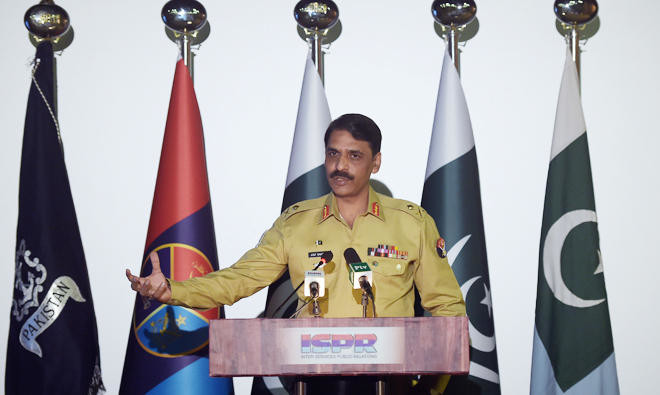
Bajwa doctrine, if it exists, vision to take Pakistan towards peace: DG ISPR
Bajwa doctrine, if it exists, vision to take Pakistan towards peace: DG ISPR
Latest updates





© 2026 SAUDI RESEARCH & PUBLISHING COMPANY, All Rights Reserved And subject to Terms of Use Agreement.