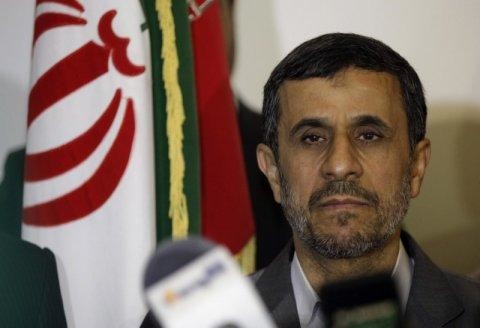
TEHRAN: Former Iranian president Mahmoud Ahmadinejad said Wednesday that his ally Hamid Baghaie was on hunger strike and in deteriorating health after being imprisoned on what he said were politically motivated charges.
Ahmadinejad, who served as president from 2005 to 2013, made the claims in a letter to supreme leader Ayatollah Ali Khamenei, published on the Dolatebahar website run by his supporters.
It is the latest volley in a bitter feud with his former colleagues in the Iranian establishment — particularly the conservative-dominated judiciary — which has led him to demand wide-ranging reforms, including fully free elections.
“The judicial apparatus, without any documents or proof or legal citation... under the cover of financial accusations and in a closed trial — has condemned (Baghaie) to the severest possible punishment,” Ahmadinejad wrote in his latest letter.
Baghaie, who served as his vice president, was jailed this month for 15 years for embezzling 3,766,000 euros and $590,000.
Prosecutors said the cash was given to him by General Ghasem Soleimani, feted head of the external operations arm of the Revolutionary Guards, the Qods Force, and earmarked for “affairs to do with African countries.”
“Mr Baghaie has never accepted these accusations and he’s been on hunger strike for 14 days in protest at this injustice by the judicial apparatus,” Ahmadinejad said in the letter.
“It is heard that his physical situation is deteriorating. He’s been kept in solitary confinement since the first day of his arrest,” Ahmadinejad added, calling on Khamenei to step in to avoid a “big catastrophe and irreparable damage.”
In an earlier report on the Dolatebahar website, Baghaie was quoted as saying: “Suppose this impossible, fabricated story is true — should I be blamed, or should it be General Ghasem Soleimani as the authorized official in the Qods Force who has delivered the said foreign currency?“
Ahmadinejad and Baghaei claim no proof of the alleged transactions was presented at the trial in December.
Another of their associates — Ahmadinejad’s former chief of staff Rahim Mashaie — was arrested this month after burning a copy of Baghaei’s verdict outside the British embassy.
A populist with close ties to the hard-line religious elite and Revolutionary Guards during his time in office, Ahmadinejad’s unruly style saw him fall out with the establishment and clash with Khamenei.
He has become a growing thorn in their side in recent years. Both he and Baghaie were barred from standing in last year’s presidential election by the Guardian Council, which vets candidates.
In another letter to Khamenei last month, Ahmadinejad called for “the immediate holding of free presidential and parliamentary elections — of course without their being engineered by the Guardian Council and without interference by military or security bodies so that people have a free choice.”
Ahmadinejad remains a hate figure for many reformists, who associate him with the bloody crackdown on mass protests in 2009 and 2010 that followed his contested re-election.
However, he remains popular particularly among poorer segments of society who recall the large-scale welfare schemes he implemented during his presidency.