GAZA CITY, Gaza Strip: Gaza’s embattled Hamas rulers are imploring people to march along the border with Israel in the coming weeks in a risky gambit meant to shore up their shaky rule, but with potentially deadly consequences.
Beginning Friday, Hamas hopes it can mobilize large crowds to set up tent camps near the border. It plans a series of demonstrations culminating with a march to the border fence on May 15, the anniversary of Israel’s establishment, known to Palestinians as “the Nakba,” or catastrophe.
The group aims to mobilize hundreds of thousands of people for the effort, though it hasn’t been able to get such turnouts at past rallies. Nonetheless, a jittery Israel is closely watching and vowing a tough response if the border is breached.
“When we march to the border, the organizers will decide then what to do,” said Ismail Radwan, a Hamas official. Warning Israel against targeting the protesters, he said “the occupation should not commit any stupidity in confronting the Palestinian crowds.”
Hamas says the demonstration is meant to draw attention to the plight of hundreds of thousands of Gazans whose relatives fled or were expelled from their homes in what is now Israel during the 1948 war surrounding Israel’s creation.
But the first-of-its-kind protest also comes at a low point for the Islamic militant group and the 2 million residents of Gaza, where conditions have deteriorated since Hamas seized control of the territory from the internationally-backed Palestinian Authority in 2007.
An Israeli-Egyptian blockade, along with three wars with Israel and a series of sanctions by Palestinian President Mahmoud Abbas, have left Gaza’s economy in tatters. Unemployment is well over 40 percent, tap water is undrinkable and Gazans receive just a few hours of electricity a day.
An Egyptian-led attempt to broker a reconciliation deal between Hamas and Abbas’ Fatah movement took a major downturn earlier this month after a bombing targeted a convoy carrying Abbas’ prime minister and security chief shortly after they entered Gaza. Abbas has blamed Hamas and threatened more financial pressure, such as cutting civil servant salaries or fuel purchases, to force the group to cede control.
“Hamas has realized it’s besieged from three sides; Israel, Egypt and the Palestinian Authority,” said Mkhaimar Abusada, political science professor at Gaza’s Al-Azhar University. “It feels the crisis is suffocating.”
He said that for Hamas, the protests can divert attention from their domestic woes while avoiding renewed war with Israel. “They think busying Israel with this issue may put it under pressure,” he said.
As Gaza’s woes have mounted, Hamas’ popularity has plummeted, and it remains unclear whether the group will be able to mobilize the crowds it envisions. Still, a combination of social pressure and curiosity in a territory with few options for recreation could help attract people.
On Tuesday, bulldozers were busy leveling the five camp locations from north to south. Trucks unloaded portable toilet stalls, and the Palestinian Scholars Union, which represents Islamic clerics, declared participation in the protests a religious obligation.
The demonstrations will begin after the Muslim noon prayer on Friday. Buses will carry people from all over Gaza to the five tent camps, situated hundreds of meters (yards) from the border fence.
Hamas and Hamas-allied organizers of the “Great Return March” say the sit-in will remain peaceful through May. But the ultimate plan is to move to the border in mid-May.
Organizers say they are trying to realize the “right of return,” a Palestinian demand that descendants of refugees who lost their homes in 1948 should be able to return to lost family properties in what is now Israel.
Israel opposes any large-scale return of refugees, saying it would destroy the country’s Jewish character. The fate of refugees and their descendants has been a core issue in past rounds of peace talks.
Israeli Cabinet Minister Yoav Galant, a retired general and member of Prime Minister Benjamin Netanyahu’s inner Security Cabinet, said that Israel had set clear red lines.
“Hamas is in distress,” he said. “They are using in a cruel and cynical way their own population in order to hurt them and to hurt Israel.”
He said the military was well-prepared to prevent any infiltrations. “We will try to use the minimum force that is needed in order to avoid Palestinians wounded and casualties. But the red line is very clear. They stay on the Gazan side and we stay in Israel.”
Violent skirmishes are expected even before May 15. Clashes have erupted along the border every Friday since Dec. 6, when President Donald Trump recognized contested Jerusalem as Israel’s capital and announced plans to move the US Embassy from Tel Aviv.
There have been a series of recent incidents along the border, including a bombing that wounded four Israeli soldiers last month. On Tuesday, three Gazans armed with hand grenades managed to cross into Israel and travel some 30 kilometers (20 miles) before they were caught.
The upcoming Jewish holiday of Passover, Israeli Independence Day celebrations in April and the planned move of the embassy in May could lead to additional clashes.
Israel’s Foreign Ministry called the planned marches “a dangerous, premeditated provocation meant to fan the flames of the conflict and increase tension.”


![]()
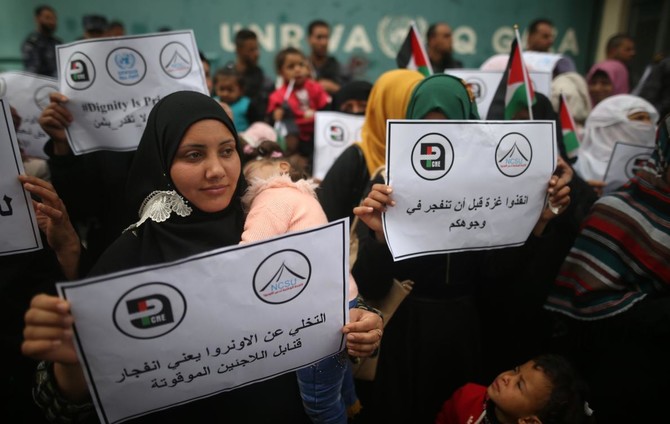

Palestinians prepare mass demonstrations along Gaza border
Palestinians prepare mass demonstrations along Gaza border


Palestinians in the West Bank struggle to get by as Israel severely limits work permits
- Many Palestinians in the occupied West Bank are struggling to get by after losing their permits to work inside Israel
- Israel revoked around 100,000 permits after Hamas’ Oct. 7, 2023, attack ignited the war in the Gaza Strip
TULKAREM, West Bank: Hanadi Abu Zant hasn’t been able to pay rent on her apartment in the occupied West Bank for nearly a year after losing her permit to work inside Israel. When her landlord calls the police on her, she hides in a mosque.
“My biggest fear is being kicked out of my home. Where will we sleep, on the street?” she said, wiping tears from her cheeks.
She is among some 100,000 Palestinians whose work permits were revoked after Hamas’ Oct. 7, 2023, attack ignited the war in the Gaza Strip. Confined to the occupied territory, where jobs are scarce and wages far lower, they face dwindling and dangerous options as the economic crisis deepens.
Some have sold their belongings or gone into debt as they try to pay for food, electricity and school expenses for their children. Others have paid steep fees for black-market permits or tried to sneak into Israel, risking arrest or worse if they are mistaken for militants.
Israel, which has controlled the West Bank for nearly six decades, says it is under no obligation to allow Palestinians to enter for work and makes such decisions based on security considerations. Thousands of Palestinians are still allowed to work in scores of Jewish settlements across the West Bank, built on land they want for a future state.
Risk of collapse
The World Bank has warned that the West Bank economy is at risk of collapse because of Israel’s restrictions. By the end of last year, unemployment had surged to nearly 30 percent compared with around 12 percent before the war, according to the Palestinian Central Bureau of Statistics.
Before the war, tens of thousands of Palestinians worked inside Israel, mainly in construction and service jobs. Wages can be more than double those in the landlocked West Bank, where decades of Israeli checkpoints, land seizures and other restrictions have weighed heavily on the economy. Palestinians also blame the Palestinian Authority, which exercises limited self-rule in parts of the territory, for not doing enough to create jobs.
About 100,000 Palestinians had work permits that were revoked after the outbreak of the war. Israel has since reinstated fewer than 10,000, according to Gisha, an Israeli group advocating for Palestinian freedom of movement.
Wages earned in Israel injected some $4 billion into the Palestinian economy in 2022, according to the Institute for National Security Studies, an Israeli think tank. That’s equivalent to about two-thirds of the Palestinian Authority’s budget that year.
An Israeli official said Palestinians do not have an inherent right to enter Israel, and that permits are subject to security considerations. The official spoke on condition of anonymity in line with regulations.
Israel seized the West Bank, Gaza and east Jerusalem in the 1967 Mideast war, territories the Palestinians want for a future state. Some 3 million Palestinians live in the West Bank, along with over 500,000 Israeli settlers who can come and go freely.
The war in Gaza has brought a spike in Palestinian attacks on Israelis as well as settler violence. Military operations that Israel says are aimed at dismantling militant groups have caused heavy damage in the West Bank and displaced tens of thousands of Palestinians.
‘My refrigerator, it’s empty’
After her husband left her five years ago, Abu Zant secured a job at a food-packing plant in Israel that paid around $1,400 a month, enough to support her four children. When the war erupted, she thought the ban would only last a few months. She baked pastries for friends to scrape by.
Hasan Joma, who ran a business in Tulkarem before the war helping people find work in Israel, said Palestinian brokers are charging more than triple the price for a permit.
While there are no definite figures, tens of thousands of Palestinians are believed to be working illegally in Israel, according to Esteban Klor, professor of economics at Israel’s Hebrew University and a senior researcher at the INSS. Some risk their lives trying to cross Israel’s separation barrier, which consists of 9-meter high (30-foot) concrete walls, fences and closed military roads.
Shuhrat Barghouthi’s husband has spent five months in prison for trying to climb the barrier to enter Israel for work, she said. Before the war, the couple worked in Israel earning a combined $5,700 a month. Now they are both unemployed and around $14,000 in debt.
“Come and see my refrigerator, it’s empty, there’s nothing to feed my children,” she said. She can’t afford to heat her apartment, where she hasn’t paid rent in two years. She says her children are often sick and frequently go to bed hungry.
Sometimes she returns home to see her belongings strewn in the street by the landlord, who has been trying to evict them.
Forced to work in settlements
Of the roughly 48,000 Palestinians who worked in Israeli settlements before the war, more than 65 percent have kept their permits, according to Gisha. The Palestinians and most of the international community view the settlements, which have rapidly expanded in recent years, as illegal.
Israeli officials did not respond to questions about why more Palestinians are permitted to work in the settlements.
Palestinians employed in the settlements, speaking on condition of anonymity for fear of retribution, say their employers have beefed up security since the start of the war and are far more willing to fire anyone stepping out of line, knowing there are plenty more desperate for work.
Two Palestinians working in the Mishor Adumim settlement said security guards look through workers’ phones and revoke their permits arbitrarily.
Israelis have turned to foreign workers to fill jobs held by Palestinians, but some say it’s a poor substitute because they cost more and do not know the language. Palestinians speak Arabic, but those who work in Israel are often fluent in Hebrew.
Raphael Dadush, an Israeli developer, said the permit crackdown has resulted in costly delays.
Before the war, Palestinians made up more than half his workforce. He’s tried to replace them with Chinese workers but says it’s not exactly the same. He understands the government’s decision, but says it’s time to find a way for Palestinians to return that ensures Israel’s security.
Assaf Adiv, the executive director of an Israeli group advocating for Palestinian labor rights, says there has to be some economic integration or there will be “chaos.”
“The alternative to work in Israel is starvation and desperation,” he said.
“My biggest fear is being kicked out of my home. Where will we sleep, on the street?” she said, wiping tears from her cheeks.
She is among some 100,000 Palestinians whose work permits were revoked after Hamas’ Oct. 7, 2023, attack ignited the war in the Gaza Strip. Confined to the occupied territory, where jobs are scarce and wages far lower, they face dwindling and dangerous options as the economic crisis deepens.
Some have sold their belongings or gone into debt as they try to pay for food, electricity and school expenses for their children. Others have paid steep fees for black-market permits or tried to sneak into Israel, risking arrest or worse if they are mistaken for militants.
Israel, which has controlled the West Bank for nearly six decades, says it is under no obligation to allow Palestinians to enter for work and makes such decisions based on security considerations. Thousands of Palestinians are still allowed to work in scores of Jewish settlements across the West Bank, built on land they want for a future state.
Risk of collapse
The World Bank has warned that the West Bank economy is at risk of collapse because of Israel’s restrictions. By the end of last year, unemployment had surged to nearly 30 percent compared with around 12 percent before the war, according to the Palestinian Central Bureau of Statistics.
Before the war, tens of thousands of Palestinians worked inside Israel, mainly in construction and service jobs. Wages can be more than double those in the landlocked West Bank, where decades of Israeli checkpoints, land seizures and other restrictions have weighed heavily on the economy. Palestinians also blame the Palestinian Authority, which exercises limited self-rule in parts of the territory, for not doing enough to create jobs.
About 100,000 Palestinians had work permits that were revoked after the outbreak of the war. Israel has since reinstated fewer than 10,000, according to Gisha, an Israeli group advocating for Palestinian freedom of movement.
Wages earned in Israel injected some $4 billion into the Palestinian economy in 2022, according to the Institute for National Security Studies, an Israeli think tank. That’s equivalent to about two-thirds of the Palestinian Authority’s budget that year.
An Israeli official said Palestinians do not have an inherent right to enter Israel, and that permits are subject to security considerations. The official spoke on condition of anonymity in line with regulations.
Israel seized the West Bank, Gaza and east Jerusalem in the 1967 Mideast war, territories the Palestinians want for a future state. Some 3 million Palestinians live in the West Bank, along with over 500,000 Israeli settlers who can come and go freely.
The war in Gaza has brought a spike in Palestinian attacks on Israelis as well as settler violence. Military operations that Israel says are aimed at dismantling militant groups have caused heavy damage in the West Bank and displaced tens of thousands of Palestinians.
‘My refrigerator, it’s empty’
After her husband left her five years ago, Abu Zant secured a job at a food-packing plant in Israel that paid around $1,400 a month, enough to support her four children. When the war erupted, she thought the ban would only last a few months. She baked pastries for friends to scrape by.
Hasan Joma, who ran a business in Tulkarem before the war helping people find work in Israel, said Palestinian brokers are charging more than triple the price for a permit.
While there are no definite figures, tens of thousands of Palestinians are believed to be working illegally in Israel, according to Esteban Klor, professor of economics at Israel’s Hebrew University and a senior researcher at the INSS. Some risk their lives trying to cross Israel’s separation barrier, which consists of 9-meter high (30-foot) concrete walls, fences and closed military roads.
Shuhrat Barghouthi’s husband has spent five months in prison for trying to climb the barrier to enter Israel for work, she said. Before the war, the couple worked in Israel earning a combined $5,700 a month. Now they are both unemployed and around $14,000 in debt.
“Come and see my refrigerator, it’s empty, there’s nothing to feed my children,” she said. She can’t afford to heat her apartment, where she hasn’t paid rent in two years. She says her children are often sick and frequently go to bed hungry.
Sometimes she returns home to see her belongings strewn in the street by the landlord, who has been trying to evict them.
Forced to work in settlements
Of the roughly 48,000 Palestinians who worked in Israeli settlements before the war, more than 65 percent have kept their permits, according to Gisha. The Palestinians and most of the international community view the settlements, which have rapidly expanded in recent years, as illegal.
Israeli officials did not respond to questions about why more Palestinians are permitted to work in the settlements.
Palestinians employed in the settlements, speaking on condition of anonymity for fear of retribution, say their employers have beefed up security since the start of the war and are far more willing to fire anyone stepping out of line, knowing there are plenty more desperate for work.
Two Palestinians working in the Mishor Adumim settlement said security guards look through workers’ phones and revoke their permits arbitrarily.
Israelis have turned to foreign workers to fill jobs held by Palestinians, but some say it’s a poor substitute because they cost more and do not know the language. Palestinians speak Arabic, but those who work in Israel are often fluent in Hebrew.
Raphael Dadush, an Israeli developer, said the permit crackdown has resulted in costly delays.
Before the war, Palestinians made up more than half his workforce. He’s tried to replace them with Chinese workers but says it’s not exactly the same. He understands the government’s decision, but says it’s time to find a way for Palestinians to return that ensures Israel’s security.
Assaf Adiv, the executive director of an Israeli group advocating for Palestinian labor rights, says there has to be some economic integration or there will be “chaos.”
“The alternative to work in Israel is starvation and desperation,” he said.
Latest updates


Recommended


© 2026 SAUDI RESEARCH & PUBLISHING COMPANY, All Rights Reserved And subject to Terms of Use Agreement.