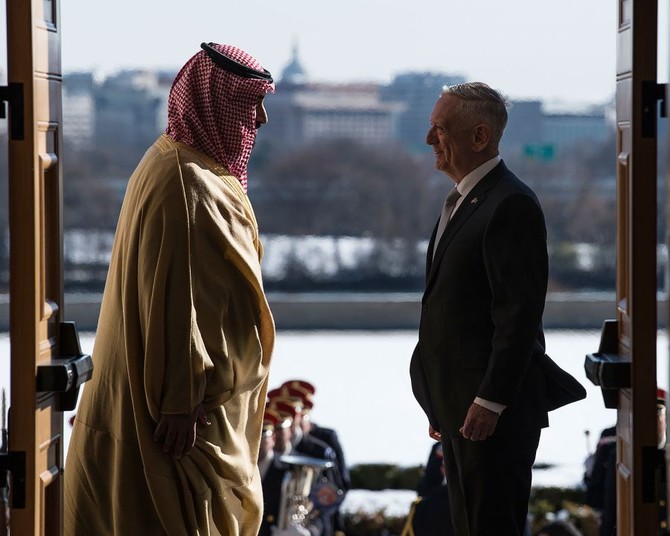
JEDDAH: One day after the royal visit by Saudi Crown Prince Mohammed bin Salman to the White House on Tuesday, the State Department approved three arms sales worth more than $1 billion to Saudi Arabia.
The sales include 6,000 Raytheon TOW-2 anti-tank missiles worth $670 million, $106 million in helicopter support and $300 million worth of vehicle parts. “The proposed sale of TOW 2B missiles and technical support will advance Saudi Arabia’s efforts to develop an integrated ground-defense capability,” the State Department said.
However, the sales are not yet finalized, as all foreign military sales have to be approved by Congress. Prices may change before they are finalized.
Analysts have seen great significance in this deal, since it indicates strong political, economic, and defense ties between the two countries.
Oubai Shahabandar, a fellow in the Washington, DC-based New America International security program, said: “Ensuring interoperability and integration of weapon systems between long-standing strategic partners has long been a mainstay of US foreign policy in the Arabian Gulf. It’s a win-win for all sides involved in these foreign military sales deals.”
He added: “It means more American jobs and ultimately it will help Saudi Arabia to develop a sustainable indigenous military production capacity. No other country comes close to the sheer size and breadth of the foreign military sales cases that the US has with the Kingdom.
“In the long term, Riyadh’s acquisition of new military hardware from the US defense industry must also be met with a joint commitment between the US and the entire Gulf Cooperation Council to enhance the integration of their military readiness against common regional threats.”
Sigurd Neubauer, a Middle East analyst and columnist based in Washington, sees Saudi Arabia as a major ally for the US in the region. He said: “Saudi Arabia has arguably surpassed Israel as Washington’s premier regional ally.
“But because Trump is strengthening his relationship with Riyadh, balancing relations with Ankara and Tel Aviv also becomes paramount as Washington wants to align all of its regional allies against Tehran and its malign activity. Part of that strategy also centers on GCC unity, even if that issue was not discussed during the public part of the MBS-Trump meeting.”
Both Saudi Arabia and the US have common interests and goals, the main one being the containment and countering of Iran’s threats in the region.
“What is significant with the massive arms package, which was initially agreed during the Riyadh summit in May of last year, is Trump’s unwavering support for the Kingdom and its position vis-a-vis Iran,” Neubauer said.
Dr. Hamdan Al-Shehri, a researcher and expert in international relations, said: “This deal confirms the United States’ keenness on the security and stability of the Kingdom. Saudi Arabia plays a major role in fighting international terrorism. The Kingdom is a member of the UN and participates in international peace and security. It always calls for alliances to face any global threat, including terrorism.
“US national security is based on fighting terrorism and confronting Iran. US military supply to Saudi Arabia is an action to make a balance of power in the region. It maintains the power of the Kingdom and helps the US to face the threat of Iran.”
Arms deals between the two countries do not only indicate the two allies' concerns about threats to stability and peace in the region, but also the goals for economic growth, Dr. Al-Shehri said.
“Without cleaning the region of dangers, economic growth cannot happen. This is one of the main concerns of the United States, to keep its investments in the region and especially in Saudi Arabia safe from any potential threat in the future.
“To maintain the security of the region, it is necessary to confront the Iranian militias and their ambitions in the region.”


![]()
US-Saudi military deals make KSA top ally in the region, says analyst
US-Saudi military deals make KSA top ally in the region, says analyst


Latest updates


© 2026 SAUDI RESEARCH & PUBLISHING COMPANY, All Rights Reserved And subject to Terms of Use Agreement.