BEIJING: The US has flouted trade rules with an inquiry into intellectual property and China will defend its interests, Vice Premier Liu He told US Treasury Secretary Steven Mnuchin in a telephone call on Saturday, according to Chinese state media.
The call between Mnuchin and Liu, a confidante of President Xi Jinping, was the highest-level contact between the two governments since US President Donald Trump announced plans for tariffs on up to $60 billion of Chinese goods on Thursday.
The deepening rift has sent a chill through financial markets and the corporate world as investors predicted dire consequences for the global economy should trade barriers start going up.
Several US chief executives attending a high-profile forum in Beijing on Saturday, including BlackRock Inc’s Larry Fink and Apple Inc’s Tim Cook, urged restraint.
In his call with Mnuchin, Liu, a Harvard-trained economist, said China still hoped both sides would remain “rational” and work together to keep trade relations stable, the official Xinhua news agency reported.
US officials said an eight-month probe under the 1974 US Trade Act has found that China engages in unfair trade practices by forcing American investors to turn over key technologies to Chinese firms.
However, the investigation report “violates international trade rules and is beneficial to neither Chinese interests, US interests nor global interests,” Xinhua cited Liu as saying.
In a statement on its website, the office of the US Trade Representative Robert Lighthizer said it had filed a request — at the direction of Trump — for consultations with China at the World Trade Organization to address “discriminatory technology licensing agreements.”
China’s commerce ministry expressed regret at the filing on Saturday, and said China had taken strong measures to protect the legal rights and interests of both domestic and foreign owners of intellectual property.
During a visit to Washington in early March, Liu had requested Washington set up a new economic dialogue mechanism, identify a point person on China issues, and deliver a list of demands.
The Trump administration responded by telling China to immediately shave $100 billion off its record $375 billion trade surplus with the US.
Beijing told Washington that US export restrictions on some high-tech products are to blame.
“China has already prepared, and has the strength, to defend its national interests,” Liu said on Saturday.
Firing off a warning shot, China on Friday declared plans to levy additional duties on up to $3 billion of US imports in response to US tariffs on steel and aluminum, imposed after a separate US probe.
Zhang Zhaoxiang, senior vice president of China Minmetals Corp, said that while the state-owned mining group’s steel exports to the US are tiny, the impact could come indirectly.
“China’s direct exports to the US are not big. But there will
be some impact due to our exports via the US or indirect exports,” Zhang told reporters on the sidelines of the China Development Forum in Beijing on Saturday.
China’s state-run Global Times said Beijing was only just beginning to look at means to retaliate.
“We believe it is only part of China’s countermeasures, and soybeans and other US farm products will be targeted,” the widely read tabloid said in a Saturday editorial.
Wei Jianguo, vice chairman of thew Beijing-based think tank China Center for International Economic Exchanges, told China Daily that Beijing could impose tariffs on more US products, and is considering a second and even third list of targets.
Possible items include aircraft and chips, Wei, a former vice commerce minister, told the news-paper, adding that tourism could be a possible target.
The commerce ministry’s response had so far been “relatively weak,” respected former Chinese finance minister Lou Jiwei said at the forum.
US farm groups have long feared that China, which imports more than third of all US soybeans, could slow purchases of agricultural products, heaping more pain on the struggling US farm sector.
US agricultural exports to China stood at $19.6 billion last year, with soybean shipments accounting for $12.4 billion.
Chinese penalties on US soybeans will especially hurt Iowa, a state that backed Trump in the 2016 presidential elections.
Boeing jets have also been often cited as a potential target by China.
China and the US had benefitted by globalization, Blackrock’s Larry Fink said at the forum.
“I believe that a dialogue — and maybe some adjustments in trade and trade policy — can be in order. It does not need to be done publicly; it can be done privately,” he said.
Apple’s Tim Cook called for “calm heads” amid the dispute.
The sparring has cast a spotlight on hardware makers such as Apple, which assemble most of their products in China for export to other countries.
Electrical goods and tech are the largest US import item from China.
Some economists said higher US tariffs will lead to higher costs and ultimately hurt US consumers, while restrictions on Chinese investments could take away jobs in America.
“I don’t think local governments in the US and President Trump hope to see US workers losing their jobs,” Sun Yongcai, general manager at Chinese railway firm CRRS Corp, which has two US plants, said at the forum.
— Reuters
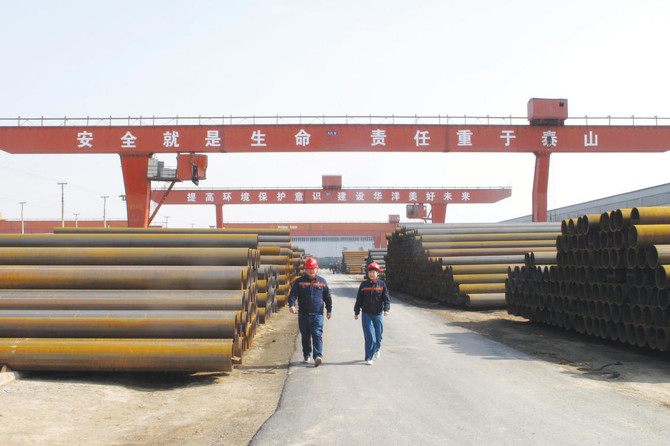
Workers at a steel mill in Cangzhou, China. US President Donald Trump’s plans for steel and aluminum tariffs are at the heart of a deepening rift between the two trading giants.


![]()
China steps up rhetoric to defend trade, hit back at Donald Trump
China steps up rhetoric to defend trade, hit back at Donald Trump


Latest updates


Recommended


© 2026 SAUDI RESEARCH & PUBLISHING COMPANY, All Rights Reserved And subject to Terms of Use Agreement.