

Foreign office: Presidency approved invitation to Indian officials for Pakistan Day ceremony

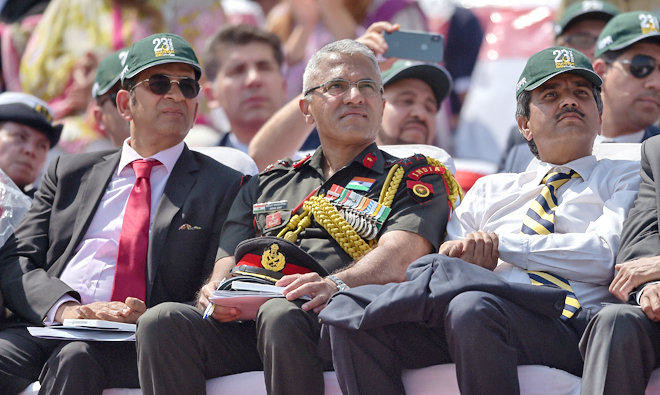
An Indian delegation including Indian Army officer Sanjay Vishwasrao, center, watch the Pakistan Day military parade in Islamabad on March 23, 2018. (AFP)
Updated 25 March 2018
Follow

Foreign office: Presidency approved invitation to Indian officials for Pakistan Day ceremony

ISLAMABAD: The Ministry of Foreign Affairs has confirmed that Indian High Commission diplomats in Islamabad attended the invitation-only Pakistan Day parade on Friday — but denied that the invitation was extended by the Pakistan army.
India’s Union Minister, Gajendra Singh Shekhawat, and Deputy High Commissioner J.P. Singh were among those who attended the parade.
A report in local media earlier quoted an unnamed army official claiming the “initiative” was taken by the Chief of Army Staff, Gen. Qamar Bajwa, to “send a peace message to India.”
The report claimed the invitation was a signal that Pakistan “stands for peace,” but can defend its soil “in case of any misadventure.”
“The host of the ceremony was not the Chief of Army Staff, therefore reports suggesting he invited the Indian delegates are incorrect,” a foreign office spokesman, Dr. Mohammed Faisal, told Arab News.
Invitations to national events are usually approved by the office of the head of state.

Extending invitations to foreign missions in Pakistan to attend state-organized events and ceremonies is a “routine matter,” he said.
“It’s not a warlike situation where we would not invite certain diplomats.”
Faisal said the Ministry of Foreign Affairs vetted diplomats and foreign officials who were invited but had no further role.
“If the Ministry of Foreign Affairs holds a function, only then do we send out invitations,” he said.
Indian diplomats rarely attend national functions in Pakistan following border skirmishes and stalled talks between the two nuclear rivals.
The arrest of an Indian spy in Pakistan in March, 2016, and his later confession have caused further tension.
More recently, India and Pakistan have accused each other of harassing diplomats stationed in Islamabad and New Delhi.
In January, Maleeha Lodhi, Pakistan’s Permanent Representative to the United Nations, attended India’s 69th Republic Day celebrations at the UN. Her participation was surprising, but the gesture was seen as a move that Pakistan is seeking to end the impasse on a range of issues dividing the two countries.
Several leading Pakistani officials attended the Indian Republic Day ceremony in Islamabad hosted by the Indian High Commission.
In his Pakistan Day speech, President Mamnoon Hussain said that the country sought regional peace, but its eastern neighbor should not interpret this as a sign of weakness. The decades-old Kashmir dispute can only be resolved peacefully, he said.
Each year on March 23, Pakistan celebrates the All-India Muslim League’s 1940 resolution calling for the formation of a Muslim-majority nation state. Seven years later, a country was partitioned from British India.


Pakistan says repaid over $13.06 billion domestic debt early in last 14 months

Updated 5 sec ago
Follow

Pakistan says repaid over $13.06 billion domestic debt early in last 14 months

  • Finance adviser says repayment shows “decisive shift” toward fiscal discipline, responsible economic management
  • Says Pakistan’s total public debt has declined from over $286.6 billion in June 2025 to $284.7 billion in November 2025

KARACHI: Pakistan has repaid Rs3,650 billion [$13.06 billion] in domestic debt before time during the last 14 months, Adviser to the Finance Minister Khurram Schehzad said on Thursday, adding that the achievement reflected a shift in the country’s approach toward fiscal discipline. 

Schehzad said Pakistan has been repaying its debt before maturity, owed to the market as well as the State Bank of Pakistan (SBP), since December 2024. He said the government had repaid the central bank Rs300 billion [$1.08 billion] in its latest repayment on Thursday. 

“This landmark achievement reflects a decisive shift toward fiscal discipline, credibility, and responsible economic management,” Schehzad wrote on social media platform X. 

Giving a breakdown of what he said was Pakistan’s “early debt retirement journey,” the finance official said Pakistan retired Rs1,000 billion [$3.576 billion] in December 2024, Rs500 billion [$1.78 billion] in June 2025, Rs1,160 billion [$4.150 billion] in August 2025, Rs200 billion [$715 million] in October 2025, Rs494 billion [$1.76 billion] in December 2025 and $1.08 billion in January 2026. 

He said with the latest debt repaid today, the July to January period of fiscal year 2026 alone recorded Rs2,150 billion [$7.69 billion] in early retirement, which was 44 percent higher than the debt retired in FY25.

He said of the total early repayments, the government has repaid 65 percent of the central bank’s debt, 30 percent of the treasury bills debt and five percent of the Pakistan Investment Bonds (PIBs) debt. 

The official said Pakistan’s total public debt has declined from over Rs 80.5 trillion [$286.6 billion] in June 2025 to Rs80 trillion [$284.7 billion] in November 2025. 

“Crucially, Pakistan’s debt-to-GDP ratio, around 74 percent in FY22, has declined to around 70 percent, reflecting a broader strengthening of fiscal fundamentals alongside disciplined debt management,” Schehzad wrote. 

Pakistan’s government has said the country’s fragile economy is on an upward trajectory. The South Asian country has been trying to navigate a tricky path to economic recovery under a $7 billion loan from the International Monetary Fund.