

Foreign office: Presidency approved invitation to Indian officials for Pakistan Day ceremony

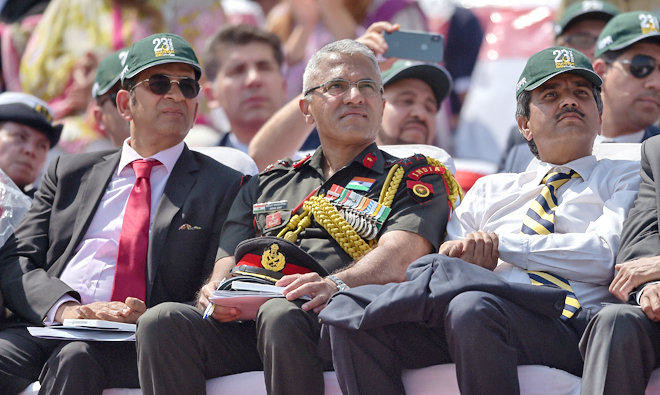
An Indian delegation including Indian Army officer Sanjay Vishwasrao, center, watch the Pakistan Day military parade in Islamabad on March 23, 2018. (AFP)
Updated 25 March 2018
Follow

Foreign office: Presidency approved invitation to Indian officials for Pakistan Day ceremony

ISLAMABAD: The Ministry of Foreign Affairs has confirmed that Indian High Commission diplomats in Islamabad attended the invitation-only Pakistan Day parade on Friday — but denied that the invitation was extended by the Pakistan army.
India’s Union Minister, Gajendra Singh Shekhawat, and Deputy High Commissioner J.P. Singh were among those who attended the parade.
A report in local media earlier quoted an unnamed army official claiming the “initiative” was taken by the Chief of Army Staff, Gen. Qamar Bajwa, to “send a peace message to India.”
The report claimed the invitation was a signal that Pakistan “stands for peace,” but can defend its soil “in case of any misadventure.”
“The host of the ceremony was not the Chief of Army Staff, therefore reports suggesting he invited the Indian delegates are incorrect,” a foreign office spokesman, Dr. Mohammed Faisal, told Arab News.
Invitations to national events are usually approved by the office of the head of state.

Extending invitations to foreign missions in Pakistan to attend state-organized events and ceremonies is a “routine matter,” he said.
“It’s not a warlike situation where we would not invite certain diplomats.”
Faisal said the Ministry of Foreign Affairs vetted diplomats and foreign officials who were invited but had no further role.
“If the Ministry of Foreign Affairs holds a function, only then do we send out invitations,” he said.
Indian diplomats rarely attend national functions in Pakistan following border skirmishes and stalled talks between the two nuclear rivals.
The arrest of an Indian spy in Pakistan in March, 2016, and his later confession have caused further tension.
More recently, India and Pakistan have accused each other of harassing diplomats stationed in Islamabad and New Delhi.
In January, Maleeha Lodhi, Pakistan’s Permanent Representative to the United Nations, attended India’s 69th Republic Day celebrations at the UN. Her participation was surprising, but the gesture was seen as a move that Pakistan is seeking to end the impasse on a range of issues dividing the two countries.
Several leading Pakistani officials attended the Indian Republic Day ceremony in Islamabad hosted by the Indian High Commission.
In his Pakistan Day speech, President Mamnoon Hussain said that the country sought regional peace, but its eastern neighbor should not interpret this as a sign of weakness. The decades-old Kashmir dispute can only be resolved peacefully, he said.
Each year on March 23, Pakistan celebrates the All-India Muslim League’s 1940 resolution calling for the formation of a Muslim-majority nation state. Seven years later, a country was partitioned from British India.


Islamabad dismisses claims about paying up to 8 percent interest on foreign loans as ‘misleading’

Updated 22 February 2026
Follow

Islamabad dismisses claims about paying up to 8 percent interest on foreign loans as ‘misleading’

  • Pakistan has long relied on external loans to help bridge persistent gaps in public finances and foreign exchange reserves
  • Pakistan’s total external debt, liabilities stand at $138 billion at an overall average cost of around 4 percent, ministry says

KARACHI: Pakistan’s finance ministry on Sunday dismissed as “misleading” claims that the country is paying up to 8 percent interest on external loans, saying the overall average cost of external public debt is approximately 4 percent.

Pakistan has long relied on external loans to help bridge persistent gaps in public finances and foreign exchange reserves, driven largely by a narrow tax base, chronic trade deficits, rising debt-servicing costs and repeated balance-of-payments pressures.

Over the decades, successive governments have turned to multilateral and bilateral lenders, including the International Monetary Fund, the World Bank and the Asian Development Bank, to support budgetary needs and shore up foreign exchange reserves.

The finance ministry on Sunday issued a clarification in response to a “recent press commentary” regarding the country’s external debt position and associated interest payments, and said the figures required contextual explanation to ensure accurate understanding of Pakistan’s external debt profile.

“Pakistan’s total external debt and liabilities currently stand at $138 billion. This figure, however, encompasses a broad range of obligations, including public and publicly guaranteed debt, debt of Public Sector Enterprises (both guaranteed and non-guaranteed), bank borrowings, private-sector external debt, and intercompany liabilities to direct investors. It is therefore important to distinguish this aggregate figure from External Public (Government) Debt, which amounts to approximately $92 billion,” it said.

“Of the total External Public Debt, nearly 75 percent comprises concessional and long-term financing obtained from multilateral institutions (excluding the IMF) and bilateral development partners. Only about 7 percent of this debt consists of commercial loans, while another 7 percent relates to long-term Eurobonds. In light of this composition, the claim that Pakistan is paying interest on external loans ‘up to 8 percent’ is misleading.

The overall average cost of External Public Debt is approximately 4 percent, reflecting the predominantly concessional nature of the borrowing portfolio.”

With respect to interest payments, public external debt interest outflows increased from $1.99 billion in Fiscal Year (FY) 2022 to $3.59 billion in FY2025, representing an increase of 80.4 percent, not 84 percent as reported. In absolute terms, interest payments rose by $1.60 billion over this period, not $1.67 billion, it said.

According to the State Bank of Pakistan’s records, Pakistan’s total debt servicing payments to specific creditors during the period under reference were as follows: the IMF received $1.50 billion, of which $580 million constituted interest; Naya Pakistan Certificates payments totaled $1.56 billion, including $94 million in interest; the Asian Development Bank received $1.54 billion, including $615 million in interest; the World Bank received $1.25 billion, including $419 million in interest; and external commercial loans amounted to nearly $3 billion, of which $327 million represented interest payments.

“While interest payments have increased in absolute terms, this rise cannot be attributed solely to an expansion in the debt stock,” the ministry said. “Although the overall debt stock has increased slightly since FY2022, the additional inflows have primarily originated from concessional multilateral sources and the IMF’s Extended Fund Facility (EFF) under the ongoing IMF-supported program.”

Pakistan secured a $7 billion IMF bailout in Sept. 2024 as part of Prime Minister Shehbaz Sharif’s efforts to stabilize the South Asian economy that narrowly averted a default in 2023. The government has since been making efforts to boost trade and bring in foreign investment to consolidate recovery.

“It is also important to note that the increase in interest payments reflects prevailing global interest rate dynamics. In response to the inflation surge of 2021–22, the US Federal Reserve raised the federal funds rate from 0.75-1.00 percent in May 2022 to 5.25–5.50 percent by July 2023. Although rates have since moderated to around 3.75 percent, they remain significantly higher than 2022 levels,” the finance ministry said.

“The government remains committed to prudent debt management, transparency, and the continued strengthening of Pakistan’s macroeconomic stability,” it added.