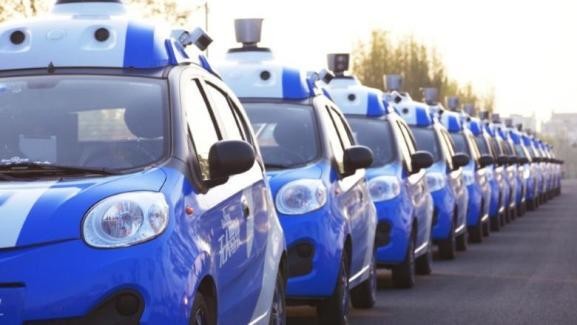
Baidu gets green light to test driverless cars on Beijing streets

Beijing has given Baidu, best known as China’s version of search engine Google, a permit to test its autonomous vehicles on 33 roads spanning around 105 kilometers (65 miles) in the city’s less-populated suburbs. (Reuters)
Updated 24 March 2018
Follow

Baidu gets green light to test driverless cars on Beijing streets

SHANGHAI: China’s capital city has given the green light to tech giant Baidu Inc. to test self-driving cars on its streets, indicating strong support for the budding sector even as the industry reels from a fatal accident in the US.
Beijing’s move is an important step as China looks to bolster its position in the global race for autonomous vehicles, where regulatory concerns have come into the spotlight since the crash earlier this month.
The accident in Tempe, Arizona, involving an Uber self-driving car, was the first death attributed to a self-driving car operating in autonomous mode, and has ramped up pressure on the industry to prove its software and sensors are safe.
Beijing has given Baidu, best known as China’s version of search engine Google, a permit to test its autonomous vehicles on 33 roads spanning around 105 kilometers (65 miles) in the city’s less-populated suburbs, the firm said in a statement.
Baidu is leading China’s push in driverless technology, with Beijing keen to keep up with global rivals such as Waymo, the self-driving arm of Google parent Alphabet, and Tesla. It has a major self-driving project called Apollo.
“With supportive policies, we believe that Beijing will become a rising hub for the autonomous driving industry,” Baidu Vice President Zhao Cheng said.
Two people close to DiDi Chuxing, China’s dominant ride-hailing company which is also working on self-driving, said
earlier this week firms developing autonomous vehicles were not likely to slow down plans for testing and developing.
“I am quite positive on the potential of the technology because autonomous technology makes vehicles far less prone to accidents than human drivers,” one of the people said. Didi declined to comment.
Earlier this month, China issued licenses to car makers allowing self-driving vehicles to be road tested in Shanghai, which included Shanghai-based SAIC Motor Corp. and electric
vehicle start-up NIO.
However, regulations in the sector are struggling to keep pace with rapid growth and the growing numbers of firms wanting to carry out tests on public roads.
Baidu CEO Robin Li tested his firm’s driverless car on Beijing’s roads last July, causing controversy as there were no rules for such a test at the time. The firm hopes to get self-driving cars on to the roads in China by 2019.
Baidu said that before conducting tests on public roads, autonomous vehicles using its Apollo system would go through simulation tests as well as trials on closed courses.


Global brands shut Middle East stores as conflict causes chaos

Updated 03 March 2026
Follow

Global brands shut Middle East stores as conflict causes chaos

  • Luxury brands and retailers close stores in Middle East
  • Conflict threatens the region that has ‌been luxury’s fastest growing
  • Mass-market retailers monitor situation, adjust operations in region

PARIS: In Dubai and other major Middle Eastern shopping hubs, many stores are closed or operating with a skeleton staff as the escalating conflict in the ​region causes chaos for businesses and travel.

The US-Israeli air war against Iran expanded on Monday with no end in sight, with Tehran firing missiles and drones at Gulf states as it retaliates for a weekend of bombing that killed Iran’s supreme leader and reportedly killed scores of Iranian civilians, including a strike on a girls’ primary school.

Chalhoub Group, which runs 900 stores for brands from Versace and Jimmy Choo to Sephora across the region, said its stores in Bahrain were closed, while other markets, including the UAE, Saudi Arabia, and Jordan remained open though staff attendance was “voluntary.”

“We operate with a lean team formed of members who volunteered and feel comfortable to come to the store,” Chalhoub’s Vice President of Communications Lynn al ‌Khatib told Reuters, adding ‌that the company’s leadership team personally visited Dubai Mall and Mall of the Emirates ​on ‌Monday ⁠morning to check ​in ⁠with workers.

E-commerce giant Amazon closed its fulfillment center operations in Abu Dhabi, suspended deliveries across the region and instructed its employees in Saudi Arabia and Jordan to remain indoors, Business Insider reported on Monday, citing an internal memo.

Gucci-owner Kering said its stores were temporarily closed in the UAE, Kuwait, Bahrain and Qatar and it has suspended travel to the Middle East.

Luxury growth engine under threat

Shares in luxury groups LVMH, Hermes, and Cartier-owner Richemont were down 4 percent to 5.7 percent on Monday afternoon as investors digested the knock-on impacts of the conflict.

The Middle East still accounts for a small share of global spending on luxury — between 5 percent and 10 percent, according ⁠to RBC analyst Piral Dadhania. But the region was “luxury’s brightest performer” last year, according to consultancy ‌Bain, while sales of expensive handbags have stalled in the rest of the ‌world.

Now, shuttered airports have put an abrupt stop to tourism flows into ​the region and missile strikes — including one that damaged Dubai’s ‌five-star Fairmont Palm hotel — are likely to dissuade travelers, particularly if the conflict drags on.

“If you assume that it’s ‌a $5 billion to $6 billion (travel retail) market and let’s say it’s going to be shut down for a month, we are talking about hundreds of millions of dollars that are definitely at risk,” said Victor Dijon, senior partner at consultancy Kearney.

If Middle Eastern shoppers cannot travel to Paris or Milan, that could also hurt luxury sales in Europe, he added.

Luxury brands have been investing in lavish new stores and exclusive events ‌across the region. Cartier unveiled a “high-jewelry” exhibition in Dubai’s Keturah Park just days before the conflict started.

Cartier and Richemont did not reply to requests for comment.

Luxury conglomerate LVMH ⁠has also bet big on ⁠the region. Last month, its flagship brand Louis Vuitton staged an exhibition at the Jumeirah Marsa Al Arab hotel, and beauty retailer Sephora launched its first Saudi beauty brand.

LVMH does not report specific figures for the region, but in January Chief Financial Officer Cecile Cabanis said the Middle East has been “displaying significant growth.” LVMH did not reply to a request for comment on how its business may be impacted by the conflict.

The Middle East has also attracted new investment from mass-market players. Budget fashion retailer Primark said in January that it plans to open three stores in Dubai in March, April and May, followed by stores in Bahrain and Qatar by the end of the year.

“Primark is set to open its first store in Dubai at the end of March but clearly this is a fast-moving situation which we are monitoring closely,” a spokesperson for Primark-owner Associated British Foods said.

Apple stores in Dubai will remain closed until Thursday morning, the company’s website showed, while Swedish fast-fashion retailer ​H&M said its stores in Bahrain and Israel are ​closed.

Consumer goods group Reckitt has told all employees in the Middle East to work from home, temporarily closed its Bahrain manufacturing site and suspended all business travel to the region until further notice.