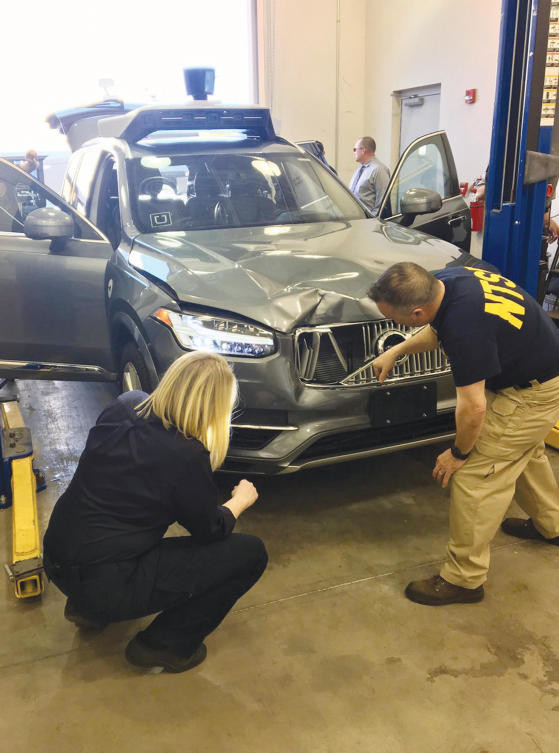
PHOENIX: Video footage of a fatal pedestrian accident involving a self-driving Uber car has prompted calls to limit testing on public roads and raised concerns about the legal framework surrounding autonomous vehicle technology.
The 22-second video shows a woman walking her bike from a darkened area on to a street just before being struck by an Uber SUV in self-driving mode. The footage was released by police in Tempe, Arizona, following the crash earlier this week.
Three experts who studied the emerging technology concluded the video, which includes dashcam footage of the driver’s reaction, indicates the vehicle’s sensors should have spotted the pedestrian and initiated braking to avoid the crash that killed 49-year-old Elaine Herzberg on Sunday.
Uber has suspended testing as the investigation proceeds into the accident, the first fatality involving a self-driving vehicle.
Raj Rajkumar, who heads the autonomous vehicle program at Carnegie Mellon University, said the video was revealing in multiple ways, including that the driver appeared distracted, and that Herzberg appeared to have been in the roadway and moving for several seconds without her presence being sensed.
Laser systems used in the Uber vehicles, called Lidar, can carry a blind spot, he said.
“All of this should be looked at in excruciating detail,” he said.
Herzberg’s death occurs at a time when eagerness to put autonomous vehicles on public roads is accelerating in Silicon Valley, the auto industry and state and federal governments.
More than 100 car manufacturers and industry associations in early March sent a letter urging Congress to expedite passage of a proposal from Senator John Thune that aims to provide regulatory oversight and make it easier to deploy the technology.
After the crash, groups such as Vision Zero, Advocates for Highway and Auto Safety, and other safety-minded organizations urged the Senate Committee on Commerce, Science and Transportation to delay consideration of Thune’s proposal until the Tempe crash investigation is completed.
“The stage is set for what will essentially be beta-testing on public roads with families as unwitting crash test dummies,” the letter said.
Thune, who chairs the science committee, said in a statement Thursday that the crash underscores the need to adopt laws and policies tailored to self-driving vehicles.
“Congress should act to update rules, direct manufacturers to address safety requirements, and enhance the technical expertise of regulators,” Thune said.
Scott Hall, spokesman for the Coalition of Future Mobility, which represents a variety of auto, consumer and taxpayer interest groups, said on Thursday the organization supports the bill because a national framework of rules governing testing and deployment of technology is needed to avoid a 50-state patchwork of laws.
Data from the National Conference of State Legislatures shows that states are increasingly introducing legislation over autonomous vehicles — 33 in 2017. More than 20 states have already enacted autonomous vehicle legislation.
Uber, Intel, Waymo and GM are testing autonomous cars in Arizona, which does not require the firms to get a permit. After the Tempe crash, Governor Doug Ducey, who brought the companies to the state with a promise of minimal regulation, warned against jumping to conclusions.
He said both the Tempe police and National Transportation Safety Board were investigating.
“So let’s see what happened.”
Earlier this month, Ducey issued an executive order that will allow companies to operate autonomous vehicles without a person on board. The only requirement is to send an advisory letter to the state Department of Transportation.
John Simpson, of the California-based advocacy group Consumer Watchdog, said Ducey was turning Arizona into “the Wild West of automobile testing.”
“There are no regulations, and if there is no sheriff in town, somebody gets killed,” Simpson said.
The watchdog group is calling for a national moratorium on the testing of all autonomous vehicles until the cause of the fatal crash is determined. Simpson said other states and Congress should look to California, where even minor crashes must be reported, for a blueprint.
In Arizona, companies such as Uber need to carry only minimum liability insurance to operate self-driving cars. They are not required to track crashes or report any information to the state.
California requires a $5 million insurance policy, and companies must report accidents to the state within 10 days and release an annual tally showing how many times test drivers had to take over.
Michigan Governor Rick Snyder, who has embraced limited regulations for autonomous vehicles, said the crash wasn’t causing him to rethink his state’s laws.
“We need to find out all the issues associated with that (crash),” he said. “It’s terrible to have someone get in an accident and be killed like that. Unfortunately, we have traffic deaths going on far too often in our country. Let’s all work harder on having safe roads.”


![]()
Uber self-driving death puts brakes on tech giants
Uber self-driving death puts brakes on tech giants

Latest updates





© 2026 SAUDI RESEARCH & PUBLISHING COMPANY, All Rights Reserved And subject to Terms of Use Agreement.