LONDON: Even in enforced retirement, octogenarian Bernie Ecclestone remains a vibrant voice in Formula One as on the eve of the 2018 championship, the former motorsport overlord who helped engineer its glory days of the 1990s and turn it into a billion-dollar industry, declared it has lost its “fascination.”
He claims an all-too-familiar title race and increased safety measures — with the advent of the distinctive and divisive “halo” cockpit guard for the new season — have led to a diluted product which lacks the fundamental lifeblood of all great sport — unpredictability.
There is a degree of irony within Ecclestone’s critique, as his pandering to the large manufacturers and desire to turn it into a corporate cash cow raised the financial requirements to compete and marginalized the smaller, boutique teams, arguably contributed more so than anyone to the status quo which permeates today’s racing.
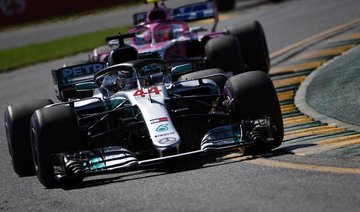
However, whatever his motives, culpability and potential prejudice against successors Liberty Media, it’s difficult to disagree with the 87-year-old, as Lewis Hamilton looks set to dominate again in his Mercedes with Ferrari’s Sebastian Vettel once again his chief and sole realistic challenger.
Hamilton-Vettel may be several laps behind the high drama of Prost-Senna, Lauda-Hunt or even Hamilton-Rosberg, which had its own modern-day reality show-like intrigue in 2015. But still, it is a rivalry and one which forms the backdrop to the new season. When Liberty purchased F1 for $3.3 billion in 2016, their motives were clear, with a desire to introduce a sense of modernity and, after Ecclestone’s world tour to new outposts such as Abu Dhabi, Bahrain, Russia and Azerbaijan, capture the imagination of their own American audience. We are still only in the formative stages of Liberty’s reign and while work has been done on the surface to give F1 a new lease of life with a new logo, greater social media presence and banishing grid girls into the past, the fact remains that without more exciting racing or a greater and wider level of competition, they cannot hope to steal Stateside petrolheads away from NASCAR or IndyCar.
There is considerable history on the line this year as not only does the iconic French GP return after a 10-year absence, Hamilton and Vettel compete for a fifth world title, to tie Juan Manual Fangio in second on the all-time list (Michael Schumacher has seven).
It gives Hamilton and Vettel’s duel an additional layer of narrative but for all the focus on the top two drivers, Mercedes and Ferrari, F1 ultimately needs more than just a fiercely contested title battle between two of the best drivers of all time.
Hamilton has been talking up the chances of Red Bull duo Daniel Ricciardo and Max Verstappen, arguably two of the most likeable and exciting drivers on the grid who were plagued by reliability issues in 2017. Pre-season testing in Catalunya saw Red Bull complete 100 laps more than in 2017, a welcome start and relief after last year’s troubles throughout spring and summer.
Focus will also fall on McLaren, trying to rebound from one of their worst seasons in their 52-year history in the sport, with Fernando Alonso’s tragi-comedy of seven retirements simply not good enough for him, the team or the sport itself. Alonso has boldly declared they are ready to become a fixture in the top five this season.
Outside of the big names, it will be intriguing to see how last year’s big overachievers Force India fare with an increased level of expectation, and with McLaren, Renault and Williams all snapping at their wheels to be “best of the rest.”
F1 desperately needs the excitement factor, beyond the inevitable of Hamilton vs. Vettel. Not just for Liberty and their grand plans but for the sport itself to force its way back into the wider consciousness, because in an age of instant gratification, quick fixes and short attention spans, it is well off the pace.
WHO ELSE CAN JOIN THE TITLE PARTY?
Valtteri Bottas (Mercedes)
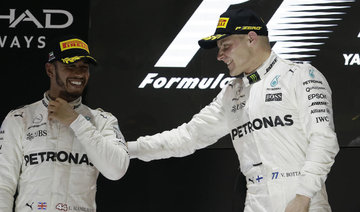
The Finn produced a solid debut season for the Silver Arrows in 2017 with three race wins to finish third overall. A more confident Bottas should once again be a regular face on the podium but he’s unlikely to unseat Hamilton in the Mercedes pecking order.
Max Verstappen (Red Bull)
It’s almost unconceivable that Verstappen won’t be a world champion one day. On his day, perhaps the quickest of all 20 drivers, certainly the most adventurous and aggressive. If the RB14 can stay on the track for the course of the season, he should at least able to exceed his two race wins of 2017.
Daniel Ricciardo (Red Bull)
The perma-smiling Australian will want to make an instant impact on his home GP, a race where he has failed to finish three times. If an early foundation can be built he has the skills and driver smarts to compete with Hamilton and Vettel. The main question, like Verstappen, however falls on the consistency of his car.