Diplomats join Pakistan National Day celebrations in Saudi Arabia

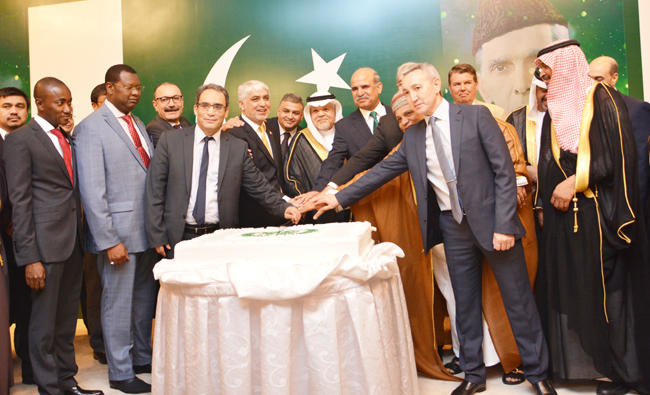
Pakistan’s Ambassador to Saudi Arabia Khan Hasham Bin Saddique and Consul General Shehryar Akbar Khan with diplomats from several nations, representatives from the military, and figures from the business world cut the cake on the occasion of the 78th National Day of Pakistan in Jeddah on Wednesday. (AN photo by Huda Bashatah)
Updated 22 March 2018
Follow

Diplomats join Pakistan National Day celebrations in Saudi Arabia

JEDDAH: Diplomats and other guests gathered on Wednesday for a celebration of the 78th National Day of the Islamic Republic of Pakistan, and the country’s enduring relationship with Saudi Arabia.
The event, in the Crystal ballroom of the Crowne Plaza Hotel in Jeddah, was hosted by Pakistan’s Ambassador to Saudi Arabia Khan Hasham Bin Saddique, and Consul General Shehryar Akbar Khan. The guests included diplomats from several nations, representatives from the military, and figures from the business world.
The festivities began with the national anthems of Pakistan and Saudi Arabia, followed by speeches from the consul general and the ambassador highlighting social and economic development in Saudi Arabia, and the diplomatic ties between the two nations.
“Both Pakistan and Saudi Arabia have been strategic partners for many decades, and our friendship has bonded in various international and regional matters, in faith, shared values and culture,” Saddique told Arab News.
He added that the leadership of both countries are working to further improve their partnership to make it more robust and diverse.
Both the ambassador and consul general also expressed their admiration for Crown Prince Mohammed bin Salman’s initiative, Saudi Vision 2030.
“I think Saudi Arabia is destined to become an economic powerhouse,” said Saddique.
Khan added: “Crown Prince Mohammed bin Salman is a visionary person. He is bringing in all these new projects for the betterment of the Saudi people and their well-being, and of the Islamic world. Pakistan fully supports it.
“We have had the best of relationships with Saudi Arabia ever since Pakistan came into existence in 1947.
There has not been a time where Saudi Arabia has not helped us when we were in need of help, and there has not been a time where Saudi Arabia has called us and we were not there with them, at any level, may it be diplomatic, political or defense — we stand with Saudi Arabia.”
The event also celebrated Pakistan’s wider diplomatic ties.
“I want to congratulate Pakistan on this occasion,” said Italian Consul General Elisabetta Martini. “The consul general of Pakistan is such an important figure here in Jeddah, where they have one of the biggest communities. I know for Pakistan, Jeddah is their biggest diplomatic mission in the world.
“It’s a very complicated and difficult task my colleague is performing in the best way — I wish him all the best.”
US Consul General Matthias Mitman also congratulated his Pakistani colleagues.
“I’m glad I could come and participate in it,” Mitman said.


Afghan leadership vows action against militants using its soil for cross-border attacks

Updated 5 sec ago
Follow

Afghan leadership vows action against militants using its soil for cross-border attacks

  • Foreign minister says Islamic Emirate has not authorized any individual or group to carry out military operations in other countries
  • Pakistan and Afghanistan have struggled to maintain a fragile truce after border clashes killed dozens in October this year

ISLAMABAD: The government in Kabul has pledged this week that Afghan territory will not be used to harm other countries and warned that anyone found violating that directive would face action by the Islamic Emirate.

The remarks by Foreign Minister Amir Khan Muttaqi came after a gathering of Afghan religious scholars who reportedly passed a resolution barring the use of Afghan soil for attacks abroad. According to Afghan broadcaster Tolo News, around 1,000 scholars attended the meeting and endorsed measures allowing the government to act against violators.

Pakistan and Afghanistan have struggled to maintain a fragile truce after border clashes killed dozens in October, their worst fighting since the Afghan Taliban took control of Kabul in 2021. Islamabad has blamed a surge in violence in Pakistan on militants who use Afghan soil to plan their attacks on security forces across the border. Kabul denies the charges, saying Pakistan’s security is an internal problem.

Kabul and Islamabad, once longtime allies, have engaged in intermittent border skirmishes since October, including heavy firing on Friday that killed at least five people. Three rounds of peace talks hosted by Qatar, Turkiye and Saudi Arabia have failed to produce a lasting agreement.

“Officials, leaders, and leadership of the Islamic system have pledged that the territory of Afghanistan will not be used to harm anyone,” Muttaqi said in a speech on Thursday. 

“All scholars and hadith experts also agree that obeying this command is obligatory for all Muslims, and if anyone uses Afghan soil to harm others, the Islamic Emirate has the right to stop them.”

He said the Afghan leadership had not authorized any individual or group to carry out military operations in other countries and the Islamic Emirate was entitled to take action against anyone who violated that directive.

Muttaqi also urged unity within the Muslim world, saying scholars had repeatedly advised against internal hostility. 

“Muslims must pay attention to unity and harmony among themselves, avoid hostility toward one another, and act with brotherhood and fraternity,” he said, calling adherence to scholars’ guidance a “shared duty.”

Pakistan on Thursday welcomed reports of the Afghan scholars’ resolution but said it still required formal, written assurances from Afghanistan’s leadership. 

Foreign Office spokesperson Tahir Andrabi told reporters on Thursday he had not seen the full text of the scholars’ resolution and that similar commitments had been made in the past but were not honored.

“Any developments with regards to the fact that Afghan leadership, the segment of Afghan society, realized the gravity of the situation that their soil is being used by not just TTP, but also by their own nationals to perpetrate terrorism in Pakistan, any realization to this effect is positive and one would certainly welcome it,” Andrabi said. 

However, he added that the resolution did not explicitly mention Pakistan or militant groups Islamabad has accused of launching cross-border attacks.

The shared mountainous border regions between Pakistan and Afghanistan are home to militants from the Tehreek-e-Taliban (TTP), also known as the Pakistani Taliban, who have waged a war against the Pakistani state for nearly 20 years.

The TTP adheres to a strict interpretation of Islamic law akin to their counterparts in Kabul, although the Afghan Taliban maintains that they do not share an operational relationship with the group.