Toyota suspends self-driving car tests after Uber death

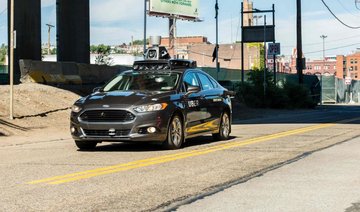
A video grab from dashcam footage released by the Tempe Police Department shows the moment before the collision of ride-sharing Uber’s self-driving vehicle and a pedestrian in Tempe, Arizona on March 18. (Tempe Police Department/AFP)
Updated 22 March 2018
Follow

Toyota suspends self-driving car tests after Uber death

TOKYO: Japanese automaker Toyota said Thursday it was suspending tests of its self-driving cars so staff could “emotionally process” after an autonomous Uber car killed a pedestrian in an accident.
Ride-sharing giant Uber has already suspended use of self-driving cars after one of its vehicles struck and killed a pedestrian Sunday in the US state of Arizona.
“We cannot speculate on the cause of the incident or what it may mean to the automated driving industry going forward,” Toyota said in a statement issued via the US company that conducts its autonomous vehicle research TRI.
“TRI is pausing Chauffeur mode testing to let its drivers emotionally process this tragedy. We’re monitoring the situation and plan to resume testing at an appropriate time,” the statement said.
“This pause is meant to give them time to settle their feelings and come to a sense of balance.”
Toyota said it would continue its tests of semi-autonomous cars on closed circuits.
But all testing of autonomous cars on public roads, which was previously being conducted in Japan and the US states of California and Michigan, is on hold.
Toyota, like Uber, has safety drivers behind the wheel of its autonomous cars during testing, though the drivers are not typically expected to operate the vehicles.
The Uber accident was the first fatal self-driving car crash involving a pedestrian and has raised fresh concern about the safety of autonomous vehicles.
German automaker BMW said Wednesday expressed sympathies over the incident but said it would not affect its self-driving car project, while Nissan has made no comment.


Egypt’s Suez Canal, Namibian Ports Authority sign MoU to propel port development, training

Updated 7 sec ago
Follow

Egypt’s Suez Canal, Namibian Ports Authority sign MoU to propel port development, training

RIYADH: Egypt’s Suez Canal Authority and the Namibian Ports Authority have signed a memorandum of understanding amid efforts to propel cooperation in development and training.

The agreement aims to exchange expertise and enhance bilateral cooperation in several areas, most notably marine construction, the sale and leasing of marine units, and advanced training through the Suez Canal Authority’s academies, according to a statement.

This is supported by figures from the Suez Canal Authority, which reported revenues of $1.97 billion from 5,874 ship transits since early July, representing a 17.5 percent year-on-year increase, chairman Osama Rabie said during a recent meeting with an International Monetary Fund delegation.

It also aligns well with Rabie’s further forecast that the canal’s revenues would improve during the 2026/2027 fiscal year to around $8 billion, rising to approximately $10 billion the following year, according to a statement issued by the authority.

The newly released statement said: “Rabie affirmed the authority’s readiness for fruitful and constructive cooperation with the Namibian Ports Authority, given the expansion of the entity’s international projects and its efforts to open new markets and engage with the African continent.”

“The chairman explained that the Suez Canal Authority’s efforts succeeded in developing and reopening the Libyan port of Sirte after 14 years of closure, marking a successful start to international projects with friendly and sister nations,” it added.

The chairman instructed that all necessary support and procedures be put in place to initiate practical cooperation on multiple projects, highlighting that the authority offers a comprehensive system for maritime and logistics services through its shipyards and subsidiaries.

For her part, Nangula Hamunyela, chairperson of the Namibian Ports Authority, voiced her enthusiasm for collaborating with the Suez Canal Authority on advancing Namibia’s ambitious port development plan, home to the largest ports in West Africa.

She stressed that this partnership highlights the strong relationship between Egypt and Namibia and will help further deepen bilateral ties.

Hamunyela further highlighted that the Suez Canal Authority’s advanced technology and vast expertise across multiple sectors will play a key role in supporting and speeding up development efforts in Namibian ports, reducing dependence on foreign expertise and technology from outside the region.

Egypt’s Suez Canal generated a total of $40 billion between 2019 and 2024 and remains the country’s most important source of foreign currency.