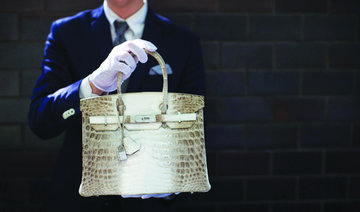
PARIS: French luxury goods maker Hermes, known for $10,000-plus leather handbags such as the Birkin, rewarded shareholders on Wednesday with a higher dividend and a one-off payout after a bumper year for sales and profits.
The company, originally a saddle and harness maker founded in 1837, joined luxury rivals such as Louis Vuitton-owner LVMH and Gucci-parent Kering in benefiting from a rebound in demand from Asian shoppers in 2017.
Hermes shares rose 3.2 percent in early trade after the firm proposed a dividend of €4.10 ($5.03) per share, up 9 percent on a year earlier, and said it also planned a special dividend of €5 per share.
It last made a one-off payout in 2015.
Hermes also reported a record operating margin for last year, reaching 34.6 percent of sales and helped by high productivity at its workshops and the positive impact of currency hedges in the first half of 2017.
“We had an exceptional year in 2017,” CEO Axel Dumas told a briefing with analysts.
Dumas said that hedging against foreign exchange swings would have a slightly negative effect on margins this year, adding these would likely “normalize.” European-based luxury goods firms are grappling with the effects of a stronger euro.
Stocks of Hermes products ran very low at the end of 2017 as items sold out, a situation that was also atypical and which boosted margins, the company said, without detailing a forecast for 2018.
Hermes’ operating margin was 32.6 percent in 2016.
Sales trends in early 2018 had continued the positive momentum of last year, Dumas added.
Hermes, which has long waiting lists for some of its most coveted handbags, is expanding production to keep up with demand, and plans two more leather goods workshops by 2020 in France.
Like peers, it is looking to boost online sales, though it declined to detail how much revenue came from the web. Hermes is rolling out a revamped version of its website, due shortly in Europe after launching in the US and Canada.
By the end of the year, it also plans to set up its first e-commerce site in China, the biggest market for luxury players. Italy’s Gucci and France’s Louis Vuitton launched web sales platforms in China last year.
Hermes’ 2017 operating income was €1.92 billion ($2.36 billion), up 13 percent from a year earlier and in line with analyst forecasts, while net profit rose 11 percent to €1.22 billion.

Hermes boosts dividend as luxury industry thrives
Saudi Arabia set to attract $500bn in private investment, Al-Falih tells conference
RIYADH: Sustainability, technology, and financial models were among the core topics discussed by financial leaders during the first day of the Momentum 2025 Development Finance Conference in Riyadh.
The three-day event features more than 100 speakers and over 20 exhibitors, with the central theme revolving around how development financial institutions can propel economic growth.
Speaking during a panel titled “The Sustainable Investment Opportunity,” Saudi Investment Minister Khalid Al-Falih elaborated on the significant investment progress made in the Kingdom.
“We estimate in the midterm of 2030 or maybe a couple of years more or so, about $1 trillion of infrastructure investment,” he said, adding: “We estimate, as a minimum, 40 percent of this infrastructure is going to be financed by the private sector, so we’re talking in the next few years $400 (billion) to $500 billion.”
The minister drew a correlation between the scale of investment needs and rising global energy demand, especially as artificial intelligence continues to evolve within data processing and digital infrastructure in global spheres.
“The world demand of energy is continuing to grow and is going to grow faster with the advent of the AI processing requirements (…) so our target of the electricity sector is 50 percent from renewables, and 50 percent from gas,” he added.
Al-Falih underscored the importance of AI as a key sector within Saudi Arabia’s development and investment strategy. He made note of the scale of capital expected to go into the sector in coming years, saying: “We have set a very aggressive, but we believe an achievable target, for AI, and we estimate in the short term about $30 billion immediately of investments.”
This emphasis on long-term investment and sustainability targets was echoed across panels at Momentum 2025, during which discussions on essential partnerships between public and private sectors were highlighted.
The shared ambition of translating the Kingdom’s goals into tangible outcomes was particularly essential within the banking sector, as it plays a central role in facilitating both projects and partnerships.
During the “Champions of Sectoral Transformation: Development Funds and Their Ecosystems” panel, Saudi National Bank CEO Tareq Al-Sadhan shed light on the importance of partnerships facilitated via financial institutions.
He explained how they help manage risk while supporting the Kingdom’s ambitions.
“We have different models that we are working on with development funds. We co-financed in certain projects where we see the risk is higher in terms of going alone as a bank to support a certain project,” the CEO said.
Al-Sadhan referred to the role of development funds as an enabler for banks to expand their participation and support for projects without assuming major risk.
“The role of the development fund definitely is to give more comfort to the banking sector to also extend the support … we don’t compete with each other; we always complement each other” he added.